

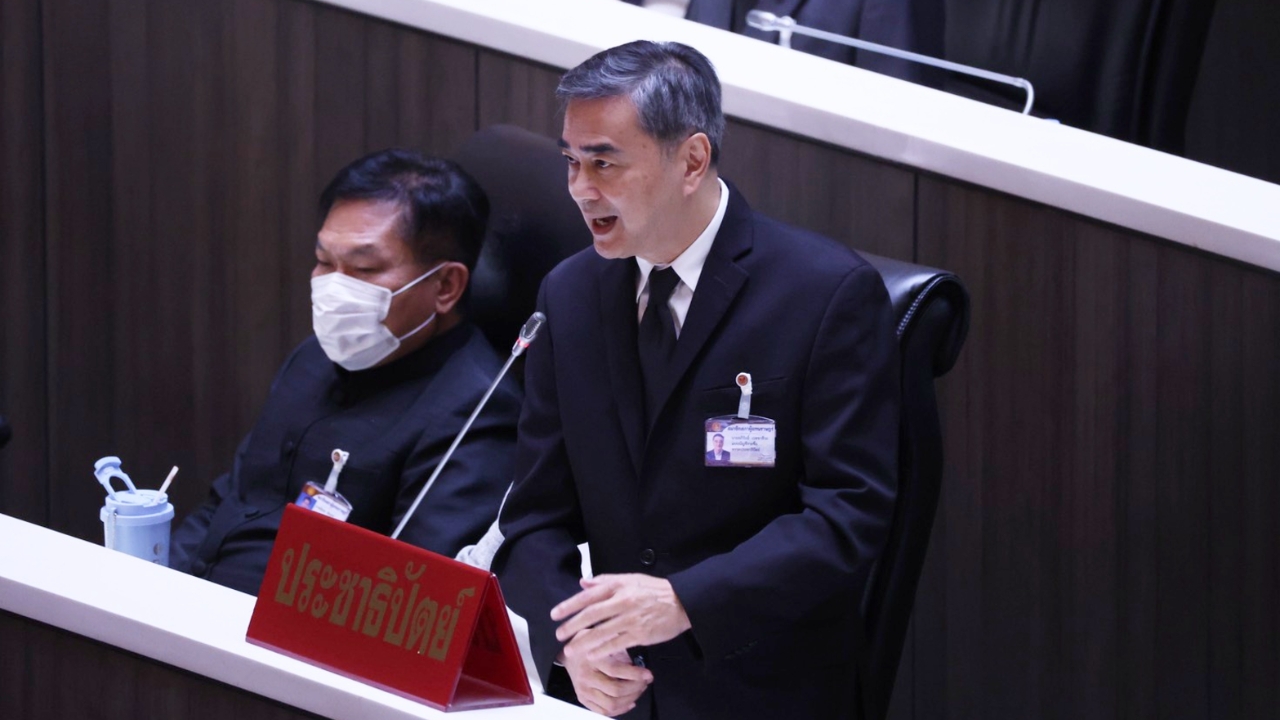
Abhisit challenges the public on who believes the Election Commission (EC) is honest and fair, criticizes the EC’s failures in organizing the Senate election, highlights loopholes allowing collusion, poses three questions demanding answers from society, and condemns the destruction of the Constitution’s intent as comparable to overthrowing the government.
At 16:00 on 16 Sep 2026 GMT+7. Mr. Abhisit Vejjajiva, party-list MP and leader of the Democrat Party. He spoke during a House of Representatives session reviewing the Election Commission’s annual performance reports for fiscal years 2024 and 2025, noting that the EC was established under the 1997 Constitution as an independent body combining legislative power (regulation issuance), executive power (election organization), and quasi-judicial power (penalty adjudication) to guarantee fairness and uphold democracy without distortion of the people’s intent.
“I simply ask—no need for report metrics—I challenge the chair to ask the public anywhere: who believes the 2024 Senate election and recent MP elections, prepared by the EC in 2025, were honest and fair? I challenge this. I don’t believe anyone would say so. Most tellingly, when I meet aspiring politicians, many say they cannot compete because they cannot break laws like others. Many MPs complain elections have become a bidding war and lawbreaking competition.”
Abhisit continued on the 2024 Senate election, saying that although the EC secretary once cited a 2019 Supreme Court ruling clearly setting a precedent that vote trading is unfair competition and illegal, in practice the EC did not design a system to prevent collusion in the Senate election. He raised the following observations.
1. The EC neglected the “zero-score” principle. The transitional provision clearly states that if many candidates receive zero votes, it should be conclusively presumed they colluded by not intending to run but to elect others. However, in 2024, the EC did not apply this principle and should have disqualified such candidates and rerun the election.
2. The EC was lax in verifying candidate occupational qualifications. Regulations checking professions, such as healthcare or mass communication, were not stringent, enabling systematic recruitment of candidates nationwide to collude in elections.
3. The EC facilitated cross-ballot voting by allowing ballots from eliminated candidates to remain unchanged in number during the afternoon national election phase, thus enabling candidates to easily vote according to pre-prepared ballot lists.

He then addressed the EC’s adjudicatory process, raising key questions: 1. The investigation was cut short at the local level because minority EC members admitted almost all complaints at district and provincial levels were dismissed, prompting the Department of Special Investigation (DSI) to intervene. The Constitutional Court has ruled this process lawful.
2. The investigation was narrowly limited, not extending to masterminds. Despite tracing financial trails to associates of high-ranking figures, the EC voted 4-3 not to consider this evidence and rejected DSI’s case files, using inquisitorial procedures that should ensure fairness but instead prematurely ended the inquiry.
3. There was suspicion over a witness who reversed prior testimony. Originally a suspect turned witness for cooperating, this person later declared the initial statements false. Why did the EC keep this individual as a witness rather than revert their status to accused and prosecute under Section 78 for false reporting and maliciously causing others to be punished?

“Why do the secretary and EC conclude this person did not violate Section 78 for giving false statements causing others to be wrongly accused—an act of malice—yet continue to protect the witness? If so, they must accept only the first testimony; they cannot accept both. Otherwise, people will suspect collusion in the protection.”
In summary, the EC’s over-two-year delay in handling the case has caused commissioners voting on it to have conflicts of interest, as four commissioners originate from the current Senate, undermining the EC’s original role as a neutral, fair independent body accepted by all to ensure honest elections. Now, this foundation is destroyed. Upcoming are DSI cases, potential Supreme Court investigations revealing incomplete EC consideration, numerous legal challenges, and possible criminal charges under Section 157 for official misconduct. The EC’s majority must prepare carefully; otherwise, what was constitutionally designed risks being overturned, akin to overthrowing the government itself.”