

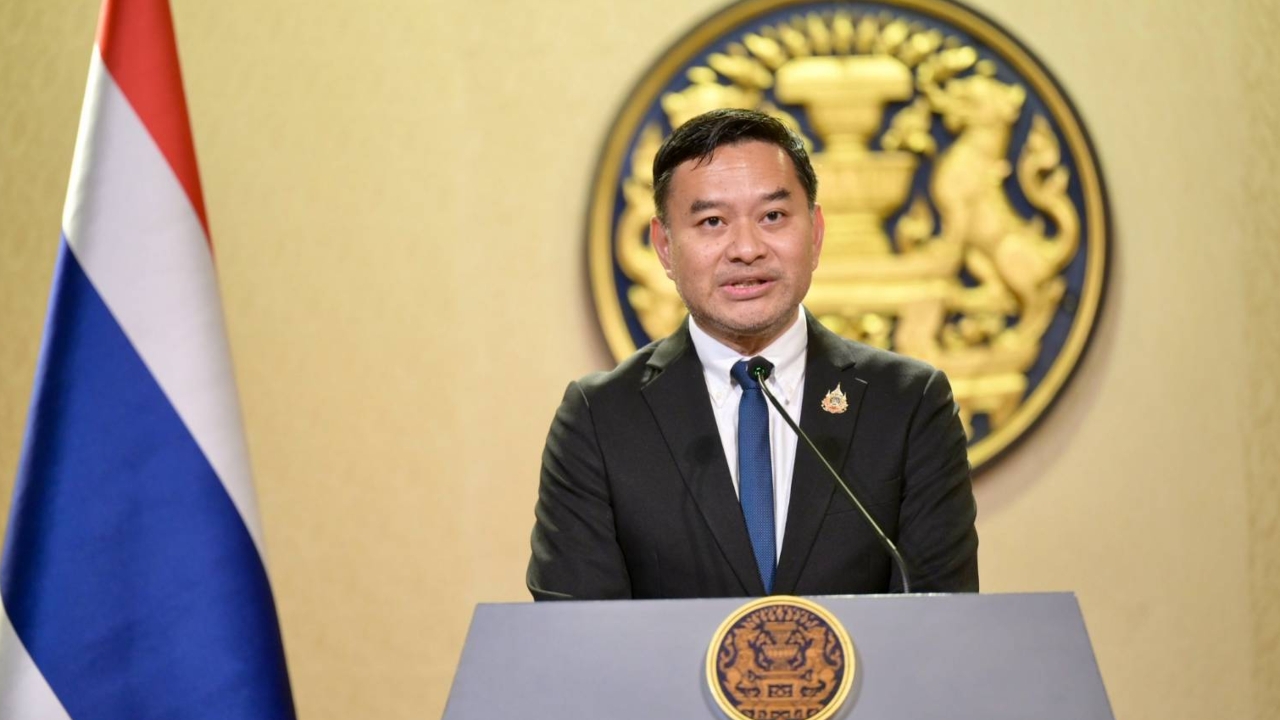
"Thailand is ready to engage in dialogue but will not concede its rights," the government emphasized six key Thai positions at the Thai-Cambodian mediation forum, reaffirming that the maritime matter does not involve Koh Kut. Thailand must protect its sovereignty and national interests.
Today (16 Sep 2026), Mr. Aekapop Piansiset, spokesman for the Office of the Prime Minister, spoke about the first meeting with the Thai-Cambodian Conciliation Commission under the United Nations Convention on the Law of the Sea (UNCLOS) in Singapore. He highlighted key points from the statement by Mr. Sihasak Puangketkaew, Deputy Prime Minister and Minister of Foreign Affairs, representing Thailand, that Thailand's stance is clear: the country seeks peace and is ready to discuss with Cambodia as a neighboring country. However, being good neighbors does not mean Thailand will relinquish its rights, sovereignty, or allow allegations it deems inaccurate to go unaddressed.
The government summarizes six important Thai positions as follows:
1. Thailand desires peace, but peace must not come at the cost of sovereignty.
Thailand follows a peaceful approach and dialogue within the existing bilateral framework because Thailand and Cambodia are neighbors who must continue to coexist. At the same time, Thailand has the duty to fully protect its sovereignty, sovereign rights, and national interests under international law.
"Thailand is ready to talk, seek solutions, and be a good neighbor, but when it comes to sovereignty and Thailand's rights, we must fully defend them."
2. The discussion concerns "maritime boundaries," not "land borders," and does not involve Koh Kut.
Thailand clearly affirmed to the commission that this conciliation process is strictly limited to determining maritime boundaries between Thailand and Cambodia in the Gulf of Thailand. It does not pertain to sovereignty over land territory, including Koh Kut. Thailand insists on maritime boundaries as per the Royal Decree dated 18 May 1973 and rejects the continental shelf boundary line unilaterally claimed by Cambodia in 1972, which Thailand maintains has no legal basis.
3. Thailand is ready to apply international law, but the law must be based on facts.
Thailand adheres to UNCLOS and international law and participates in the conciliation process in good faith. However, applying international law must be grounded in facts, not unilateral claims or attempts to use international forums to legitimize oneself. The government asserts that if Thailand is accused based on information it deems incorrect, distorted, or unfounded, it has the duty to clarify the facts and protect the nation's reputation.
4. The 2001 MOU is not an excuse to say Thailand has closed the door to negotiations.
Thailand clarifies that claims suggesting Cambodia has no choice but to enter the conciliation process after Thailand canceled the 2001 MOU are inaccurate according to Thailand's position. Over 25 years, only two official meetings were held under that mechanism, with no concrete progress. Meanwhile, Thailand has proposed that both countries return to direct negotiations on maritime boundaries. Thus, Thailand has not closed the door but has offered solutions and kept negotiations open continuously.
5. Thailand chooses "diplomacy plus law," not mutual accusations.
Thailand's approach is to use international law to safeguard national rights and diplomacy to seek solutions between neighboring countries. Conflicts should not become competitions over who can accuse the other more or portray themselves as greater victims. Thailand is ready to discuss sincerely, but sincerity must come from both parties. Restoring relations will occur only with trust and mutual respect.
6. This forum should have no winners or losers, but Thailand must not lose its rights.
Thailand's goal is to find a fair, practical, and sustainable resolution of maritime boundaries. Regardless of the outcome, Thailand and Cambodia will remain neighbors. Therefore, the government wants the existing issues resolved properly, leaving no conflict for future generations. Throughout this process, Thailand's national interests, sovereignty, and legitimate rights must be fully protected.
The spokesman for the Office of the Prime Minister concluded that the positions presented by Mr. Sihasak to the commission reflect the government's core principles: "Thailand does not seek to invade anyone, claim others’ land, or create conflict with neighboring countries. What Thailand seeks is simply to uphold its rights under international law. Thailand chooses peace, but not peace at the expense of sovereignty. Thailand chooses dialogue, but dialogue must be based on facts. Thailand is ready to be a good neighbor, but when false allegations arise, Thailand has the duty to clarify and fully protect the country. This is the Thai government's position."