

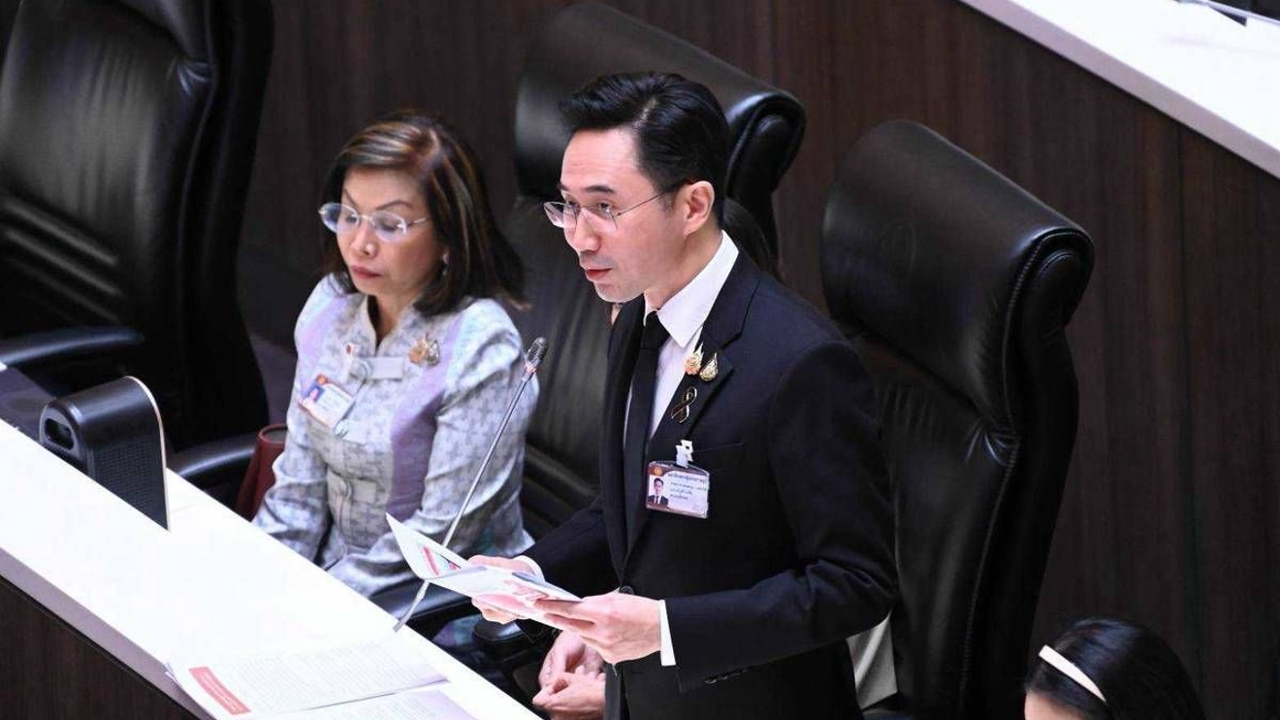
MP Chen proposes the Pheu Thai Party’s draft Domestic Violence Protection Act, emphasizing a victim-centered approach with rapid protection within 72 hours and a strict ban on mediation in sexual abuse and child cases.
On 17 Sep 2026 GMT+7, at the Parliament, Yotsanan Wongsawat, Deputy Prime Minister and Minister of Higher Education, Science, Research and Innovation, as a party-list MP of Pheu Thai Party, introduced the “Domestic Violence Protection Act” draft to the House of Representatives. He pointed out that the existing law is outdated, lacks effective risk assessment mechanisms, and prioritizes compromise over victim safety. Yotsanan stressed that the draft aims to maximize protection for victims with a focus on their safety, aligning with international human rights principles, and calls for updating the law to be more comprehensive, modern, and clear in its procedures.
During debate, Yotsanan cited an OECD report titled “Access to justice and the economic implications of crime and violence in Thailand,” which states that the total cost of crime and justice processes in Thailand amounts to a staggering 973 billion baht, or 5.6% of GDP. Alarmingly, more than half (51%) of this economic burden falls on victims and their families. Particularly, domestic violence and sexual abuse constitute a “silent crisis” causing economic losses of 279 billion baht annually. These figures represent only the tip of the iceberg.
Yotsanan reflected on these problems: “Official statistics cannot reveal everything. Today, the official reporting rate is only 4.1 per 100,000 people, which means many incidents go unreported due to shame. In truth, many more people are victims but are unable to disclose their experiences.”
A key revision in the law is expanding the definition of violence to cover new dimensions, including “economic violence” (such as restricting employment or withholding living expenses) and “sexual violence” (harassment or abuse without consent).
Additionally, the draft sets up a rapid protection system by requiring the appointment of a “Case Manager” within 72 hours who can relocate victims to safe spaces without waiting for legal prosecution.
Yotsanan explained the benefits of this system: “Officials must appoint a Case Manager within 72 hours. This is advantageous because victims typically do not want to repeatedly recount their experiences to multiple people. The Case Manager will assess the situation concerning violence.”
Another crucial change in the bill is establishing risk levels (low, medium, high) to issue appropriate protection orders. Importantly, it ends the culture of forced mediation in serious cases by strictly prohibiting mediation in sexual violence and child abuse cases. Yotsanan emphasized, “Mediation does not always provide solutions. For sexual violence and cases involving child victims, mediation is absolutely prohibited. This is non-negotiable.”
Finally, the bill designates the Ministry of Social Development and Human Security as the lead agency to create a national database system to support data-driven policy solutions. This marks a significant shift in Thai society's approach—from viewing domestic violence as a private family matter to recognizing it as an economic and social crisis, Yotsanan stated.