

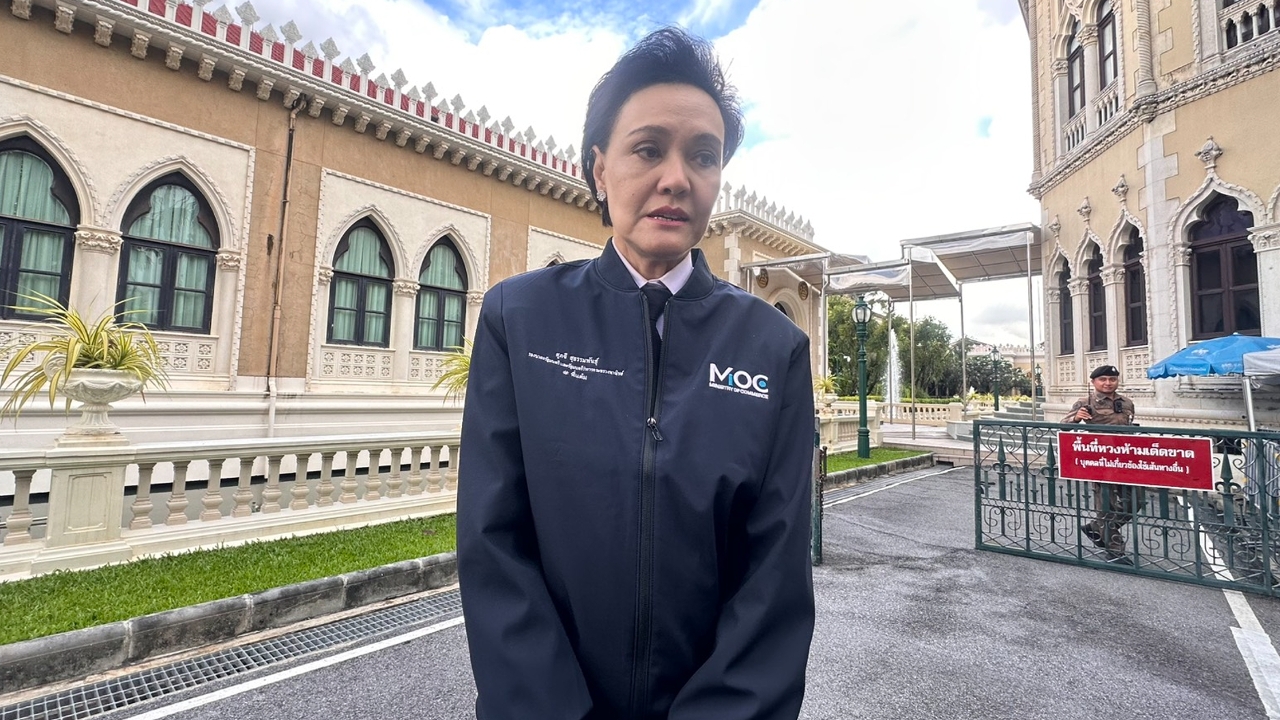
Supachai revealed the economic team is holding intensive discussions to tackle the energy crisis and is preparing to submit a support package for the public to the Cabinet on 22 September. She emphasized the need to clarify the Commerce Ministry's role in controlling price displays, which is not to set oil price structures.
At 10:50 a.m. on 18 September 2026, at the Government House, Supachai Sutthamanpan, Deputy Prime Minister and Minister of Commerce, revealed that on Monday, 14 September 2026, Ek Nath Niti Thantaprapas, Deputy Prime Minister and Minister of Finance, convened a meeting with Pakorn Nilprapunt, Deputy Prime Minister, Eknat Prompan, Minister of Energy, Warawut Silpa-archa, Minister of Industry, and herself to discuss approaches and measures to address the impact of rising energy prices. This was under the directive of Prime Minister Anutin Charnvirakul, who also serves as Minister of Interior. They expect to finalize the measures for submission to the Cabinet meeting on Tuesday, 22 September.
The Prime Minister assigned them to discuss integrated measures to assist the public involving multiple ministries. The Ministry of Commerce will be responsible for downstream matters, including prices of consumer goods, agricultural products, and promoting the use of bioenergy crops to generate income for farmers.
Meanwhile, Deputy Prime Minister Pakorn attended the meeting to consider legal and regulatory aspects for securing appropriate funding sources to manage energy prices. They examined regulations on whether funds could come from the energy fund, loans, or the 2026 central budget’s contingency fund, to identify the most suitable source. All measures must be approved by the Prime Minister before formal submission to the Cabinet.
Regarding the global energy situation, the Deputy Prime Minister and Minister of Commerce noted that international conflicts are likely to be prolonged and more severe than initially estimated, especially the closure of shipping routes in the Red Sea. This caused Brent crude oil prices to soar to as high as 126 US dollars per barrel, and Singapore oil prices reached 195 US dollars per barrel.
However, considering Thailand’s inflation rate during the first 7-8 months of the year, it remains below 2%, with the full-year forecast not exceeding the 3% target range. This rate is lower than neighboring ASEAN countries like Singapore, where inflation has already surged beyond 6%. Thailand’s oil prices remain comparatively low due to ongoing subsidies through the fuel oil fund. Diesel prices in Thailand are about 39–40 baht per liter, while diesel in Singapore has risen above 100 baht per liter, and gasoline there has reached 88 baht per liter. Additionally, current oil price management will learn from past subsidy experiences by allowing prices to move partially according to natural market mechanisms to avoid structural problems.
“Our oil prices are not high compared to our neighbors. The government continues to subsidize through the energy fund. This time, we must avoid previous problems, such as the 15-day price freeze that caused many issues. Now, we need to allow prices to move more naturally,” she said.
Supachai clarified public misunderstandings about the Commerce Ministry’s role, emphasizing that the authority to determine oil price structures lies with the Energy Policy Administration Committee (EPAC), which is governed by specific laws and regulations. The Commerce Ministry’s role is regulatory as a controlled goods authority, ensuring traders display prices clearly, sell at the posted price, and verify fuel dispensers provide full liters to protect consumers.
“People still mistakenly think the Commerce Ministry sets oil prices, but that is not true. The Ministry does not order or set lower prices but controls that if a price sign shows 40 baht per liter, they must sell at that price. For matters under specific laws, the Ministry cannot intervene. Price fixing is managed by another agency,” Supachai explained.