

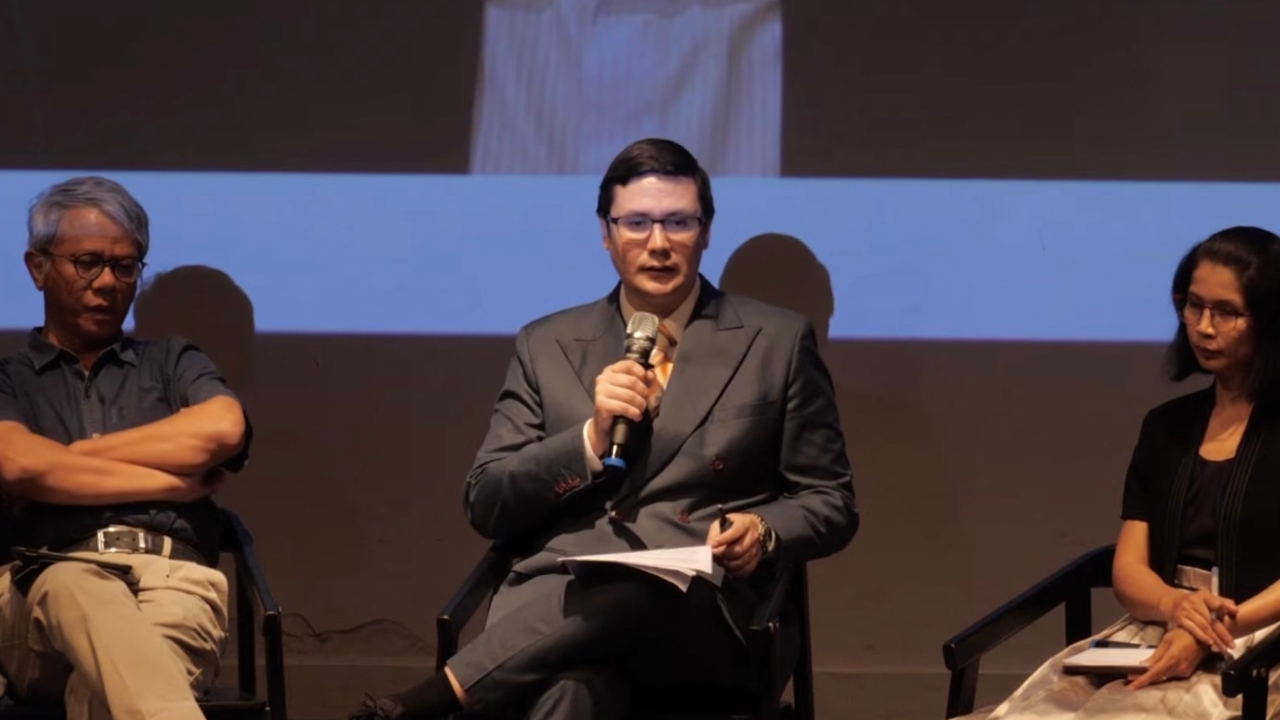
Rangsit Rome points out that 20 years after the September 19 coup, the tanks have returned to the barracks, but extrajudicial power remains. The aftermath of the coup is that extralegal power has shifted into the Blue Network.
On 19 September 2026, the Military Commission of the House of Representatives held a seminar marking the 20th anniversary of the 2006 September 19 coup, under the theme “Unfamiliar Memories: Scars, Coups, and the Lost Justice Process” at the Bangkok Art and Culture Centre (BACC). Rangsit Rome, a party-list MP from the Prachachon Party, participated in a panel discussion titled “The Coup and the Erasure of Its Aftermath.”
Rangsit Rome stated that today marks exactly 20 years since the tanks rolled out onto the streets of Bangkok. The question now is not whether a coup will happen again, but whether the 20-year-old coup has truly ended. If one sees a coup simply as bringing tanks in and declaring power, one might think it ended when the tanks and soldiers returned to their barracks. But if a coup means destroying the principle that “no one is above the law, no one is above the people, and everyone must be held to the same standard,” then the coup may have never really gone away. It has only changed its uniform—from soldiers to the constitution, from tanks to laws—and over time, extrajudicial power has transformed into a power network operating within the system itself.
Looking at recent news, the first was on 14 September when 77 people faced prosecution, yet only 26 current senators were involved, with no key figures from inside or outside the Blue Network named, despite substantial evidence. The second involved the chairman of the U.S. House Foreign Affairs Committee sending letters to the U.S. Secretary of State and Treasury Secretary to investigate and consider sanctioning 28 individuals linked to a scammer gang, including Vorapak Thanyawong, a former Thai Deputy Finance Minister.
Both cases raise the same question: when political power can interfere with oversight mechanisms, who monitors those in power? If those under scrutiny can influence the very structures tasked with oversight, can this still be called the rule of law?
The Senate holds authority to approve appointments to many constitutional organizations. Therefore, anyone who builds a network in the chamber is not merely seizing that organization but is also controlling the entire oversight system. Such mechanisms are becoming increasingly visible today.
If the delay in addressing the Senate election fraud continues, the verdict may shift from a 5:2 to a unanimous 7:0 decision. This is what the so-called “anti-corruption constitution” handed down by the coup junta has yielded, and we have witnessed systematic corruption by those who dream that the Blue Network regime will last forever.
During the 2024 Senate election, clips and testimonies referenced a “mission for the higher-ups” or claims that “the higher-ups ordered the Blue side to act to block the Orange side,” including clips alleging the formation of various governments. I do not want people to argue over what “the higher-ups” means, but no one should be allowed to use such terms to build power for themselves. The phrase “pulling the sky down” best explains this, because what is called ideological conflict is often just a matter of “interests.” The correct question is not who loves the nation or is more loyal, but who stands to lose what.
When politics loses credibility and oversight is weak, issues like transnational crime involving Vorapak become critical. Why does the U.S. know about money laundering and scammer connections while Thailand does not? Thailand should be closest to this information, yet something seems to suppress action, forcing silence. We must wait to see what the U.S. will do, and the government should not treat this as a personal matter, as it severely damages the country's image.
Another problem is local exam fraud. According to investigations by the Law, Justice and Human Rights Commission, at least 5,100 to 5,900 people are involved, yet charges only reach the level of department directors. Evidence suggests this network extends beyond that level. The fraud causes three harms: first, it destroys meritocracy, making dedication worthless compared to connections and money; second, it wastes taxpayers' money on salaries and benefits for corrupt officials; third, the Blue Network keeps records on these corrupt officials to coerce them into lifelong servitude. This is not merely exam fraud but stealing government positions from rightful candidates and forcing citizens to pay for producing loyal tools for the Blue Network.
. He concluded by saying these are the consequences of the coup: teaching society to accept that having enough power means being above the rules. If we let this logic persist, one day there will be no need for tanks—just networks, money, positions, insiders, and oversight bodies ready to invoke higher authority. Extralegal power can exist cloaked in legality. This is why we must eradicate the coup's aftermath, not for revenge but to break the future cycle and restore the true meaning of the rule of law.
“Twenty years after the 2006 September 19 coup, we no longer need to ask if the coup left scars—the scars are in front of us all. The question is how many generations we will allow these scars to be passed down. The most dangerous coup is not the one with tanks on the street but the one where the tanks return to the barracks while extralegal power remains. As long as people in Thailand say ‘the law applies to others but not to me,’ the mission to eradicate the coup’s legacy remains unfinished,” Rangsit said.