

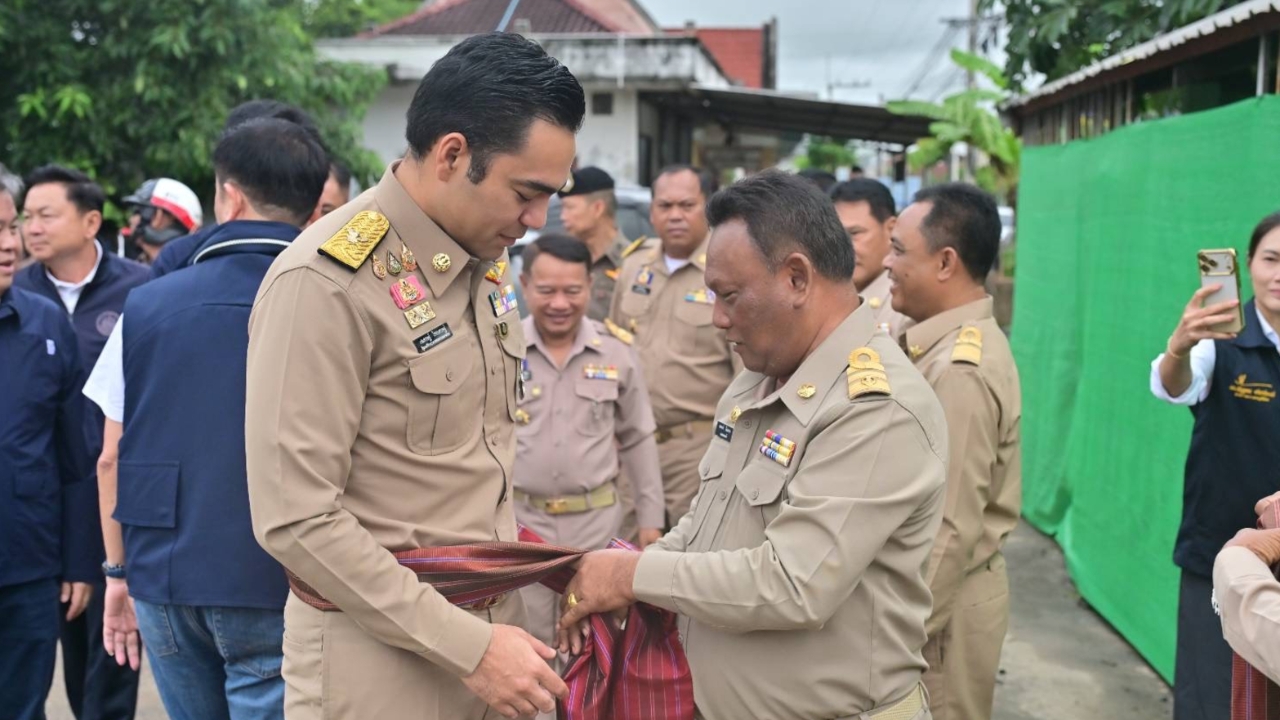
“Je Seth” visited Khwao Sinarin and Sikhoraphum districts in Surin Province to monitor water resource development and advance five urgent missions of the Ministry of Interior. He stressed the Provincial Disaster Prevention and Mitigation Office must quickly send disaster alerts via Cell Broadcast messages.
On 21 Sep 2026 GMT+7, Deputy Minister Je Seth Thai-seth of the Ministry of Interior visited Surin Province to oversee water resource development and landscape improvement projects. He also held a meeting to deliver policy guidance and monitor implementation according to the Ministry’s directives. This mission covered both Khwao Sinarin and Sikhoraphum districts.
Je Seth said government agencies should not wait for problems to escalate but must go into the field to listen directly to the people. They should use local data and facts to develop solutions that genuinely meet community needs, based on transparency, accountability, and prioritizing public interest. In the morning, he visited Nong Khok Pond in Village 3, Khwao Sinarin Subdistrict, Khwao Sinarin District to monitor the urban development and landscape improvement project. The goal is to restore the area around the water source to full potential as a public space for relaxation, exercise, and community activities.
He then traveled to Ban Phansee, Charaphat Subdistrict, Sikhoraphum District, Surin Province, to follow up on community water resource development. He inspected the landscape improvement at Nong Charoen Pond, Village 5, Charaphat Subdistrict, where the Department of Public Works and Town & Country Planning is enhancing the area’s usability and upgrading the surrounding environment.
During the policy monitoring meeting of the Ministry of Interior, Je Seth emphasized the integration of all sectors’ work, focusing on five urgent missions:
1. Driving the grassroots economy and reducing living costs by promoting the “Thai Help Thai” project.
2. Enhancing safety of life and property by organizing society, suppressing influential figures and illegal activities, and ensuring safety on roads and public areas.
3. Preparing for disaster response by having local authorities work closely with the Disaster Prevention and Mitigation Office from surveillance and warning to rapid assistance for citizens.
4. Improving public services by pushing for convenient, fast, transparent, and accessible government services, especially utilities related to daily life.
5. Preventing and resolving drug problems by advancing community-based treatment for users alongside cutting drug supply chains, with government agencies working closely with citizens to address root causes.
Je Seth also urged the Surin Provincial Disaster Prevention and Mitigation Office to integrate with local authorities and communities to prepare disaster response plans, equipment, machinery, and personnel. He emphasized that district chiefs must quickly verify information to send Cell Broadcast messages to the public effectively.