

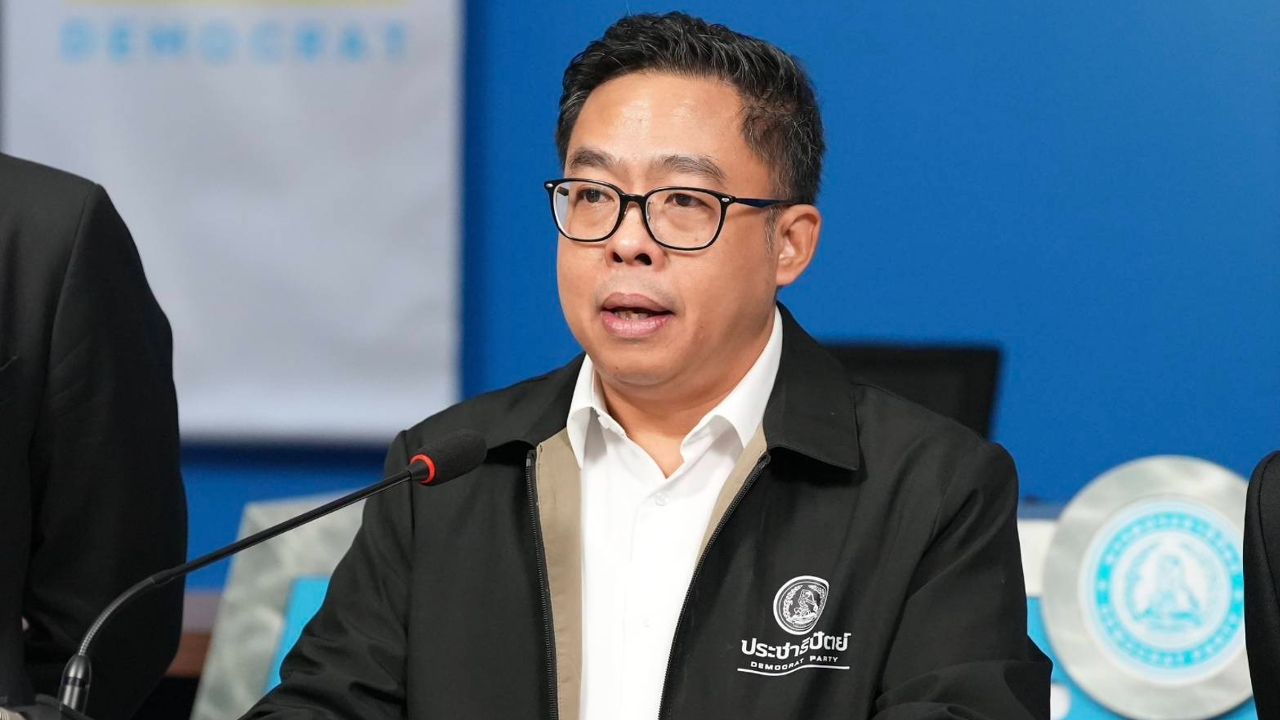
The Democrat Party explained its rejection of the 400-billion-baht loan decree due to suspicious elements and hidden issues, urging an urgent and serious reform of the oil pricing structure rather than exaggerating achievements that have yet to materialize.
On 21 Sep 2026 GMT+7, Mr. Pornchai Maranet, Secretary of the Democrat Party Policy Committee, responded to Mr. Pongpol Yodmuangchareon, spokesperson for the Ministry of Energy, who criticized the Democrat Party's role in proposing solutions to the oil price problem. Pornchai said the party needed to clarify facts to the public and pointed out that the Energy Ministry spokesperson did not understand the principles and role of Members of Parliament (MPs). This may be because the spokesperson had never served as an MP elected by the people and thus did not grasp the process of oversight and checks on executive power.
Mr. Pornchai further explained four key points: 1. The reason the party voted against the 400-billion-baht loan decree was due to suspicions and doubts about the process. The vote on 26 August was not a refusal to help the public but stemmed from concerns over value and inconsistencies with the urgent needs claimed by the government. MPs’ duty is to protect taxpayers' money, not blindly approve questionable budgets—especially the 200-billion-baht portion for energy transition, for which the government lacks clear plans to reduce living costs for most vulnerable groups.
2. The role of MPs does not end with the parliamentary vote. Although the loan decree passed with the government's majority, opposition MPs still have the right to express opinions and propose the best interests of the public. All Democrat MPs have equal dignity and representation as government MPs. Therefore, they have full rights and duties to suggest that government funds should be used precisely to address the root cause—reducing living costs through diesel fuel prices—instead of occasional cash handouts that only provide temporary relief.
3. The government conceals problems by propping up diesel prices while the fuel fund's deficit has exceeded 80 billion baht, which will become a debt burden on all Thai citizens in the future, in addition to the 400-billion-baht loan. Although the Ministry of Energy claims to have used refinery profits seven times, totaling 24 billion baht, since 7 July 2026 GMT+7, diesel prices at the pump remain high, burdening the public, and the fuel fund deficit remains massive. These facts are hidden by the government and should not be claimed as achievements because ultimately, the debt will fall on Thai consumers using diesel-powered transport.
4. The restructuring of oil prices by removing phantom transport and insurance fees has been announced for months, but the Ministry of Energy has yet to implement it. The spokesperson has promoted this for a long time, but merely preparing or considering is not a real accomplishment. The Democrat Party asks the Ministry of Energy when it will actually act and reduce pump prices for the public.
The Democrat Party suggested in good faith that the government and Ministry of Energy should focus on producing tangible results by adjusting the oil price structure to reflect reality and preserving government credibility, rather than spending time discrediting or countering parliamentary oversight by opposition representatives.