

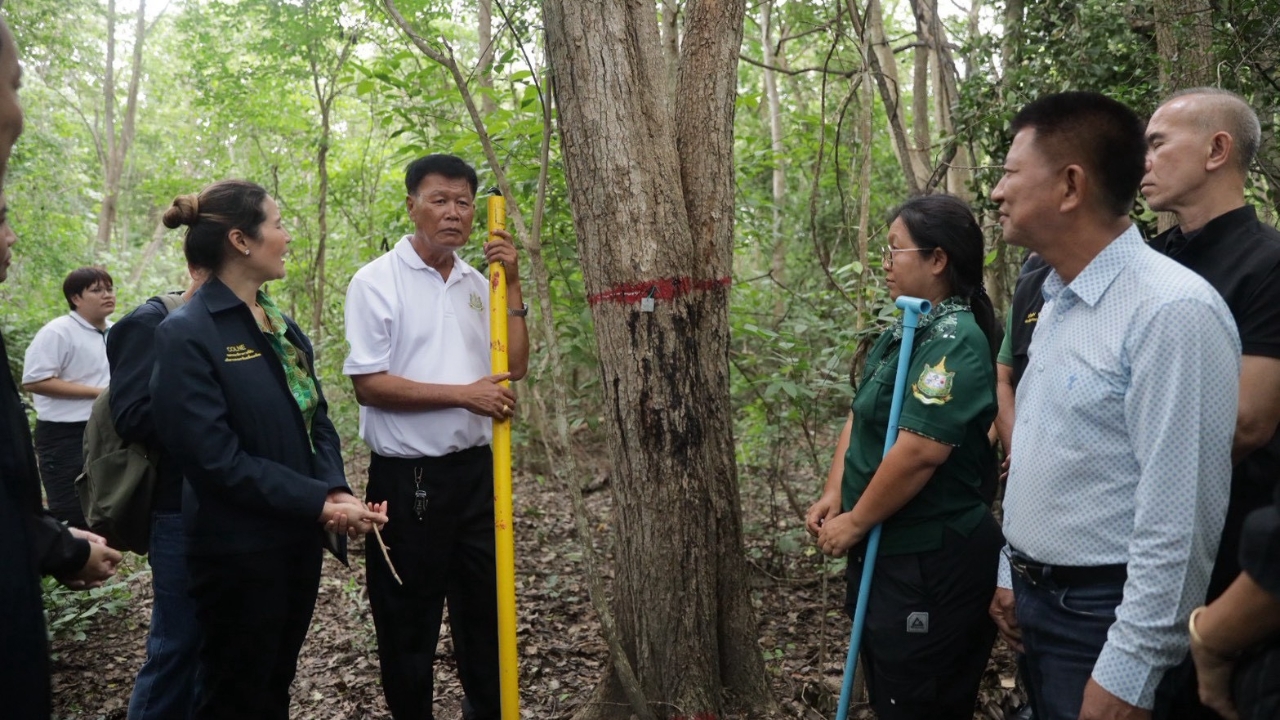
The Land Commission visited the Kho Tang Bang community forest, emphasizing that those who care for the forest must benefit and pushing for carbon credit income to reach local villagers as a result of their stewardship.
On 22 September 2026, Ms. Kulwalee Nopmorabodee, Chairperson of the Land, Natural Resources, and Environment Commission of the House of Representatives, led the commission to Phetchaburi Province. They held a joint meeting with the Phetchaburi governor, the Forestry Department, and related agencies at the provincial hall before proceeding to Tha Mai Ruak Subdistrict Municipality and the Kho Tang Bang community forest in Tha Yang District. The visit aimed to study the community’s real work in conserving and restoring the forest, which has enabled income generation from "carbon credits."
The carbon credit mechanism involves estimating the amount of greenhouse gases that trees absorb and store, then selling this amount to private sectors seeking to offset their emissions. This process transforms community-managed forest areas into sources of income that return benefits to the local community.
However, although the Kho Tang Bang community forest has been highlighted as a successful model at parliamentary commission meetings, significant limitations remain. These include the high costs of assessment and certification, which pose barriers for small or underfunded community forests, and legal restrictions on the community forest committee’s authority to enter contracts and receive funds. This visit focused on gathering information from practitioners, demonstrating tree measurement techniques for carbon calculation, surveying forest conditions, and discussing with villagers ways to utilize the forest, manage wildfire risks, and their support needs from the government.
Ms. Kulwalee revealed that the forest’s sustainability depends on caretakers receiving tangible benefits. The intentions of the Kho Tang Bang villagers have proven that real income generation is possible. The commission plans to use the gathered information to advance three main issues: equitable and transparent income distribution mechanisms that allow villagers to understand transaction values and allocation steps clearly; reducing costs and procedural burdens by lowering measurement and certification expenses to enable small community forests nationwide to access the carbon credit system; and expanding knowledge support by assigning the Forestry Department to seek funding from the Environmental Fund to disseminate carbon credit knowledge throughout community forests across the country without relying solely on large private companies.
"The benefits extend beyond financial gains. A healthy forest helps create water sources, clean air, mitigates global warming, and reduces wildfires, which cause haze problems. When people earn income from forest conservation, the forest remains preserved for future generations. The commission will expedite follow-up to ensure these outcomes become concrete," Ms. Kulwalee concluded.