

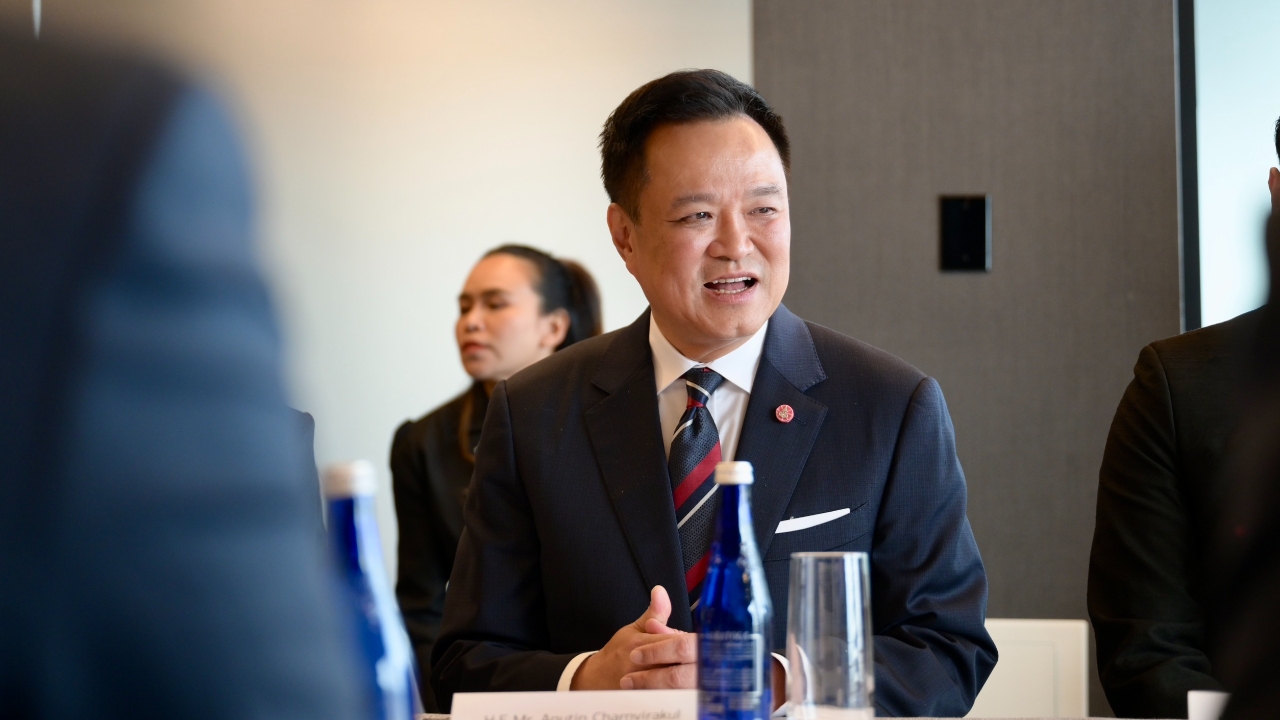
The government spokesperson revealed that the private sector and capital markets are pleased as U.S. funds listened to Anutin’s vision during a successful roadshow in New York, aiming for Thailand to become a high-income country by 2037.
On 24 September 2026, Mr. Ekaphop Pienpiset, spokesperson for the Prime Minister's Office, stated that on 22 September 2026, investors from financial institutions, led by major U.S. fund managers and Bank of America (BofA), showed strong interest in meeting with Prime Minister Anutin Charnvirakul during the “Thailand Roadshow.” The event gathered investors and U.S. fund managers, with senior executives from both government and private sectors attending, including Deputy Prime Minister and Minister of Commerce Supachai Suwansapand, Minister of Digital Economy and Society Chaichanok Chidchob, and private sector representatives such as Mr. Paiboon Nalinthrangkura, Chairman of the Thai Capital Market Business Council, and Mr. Assadech Kongsiri, Director and CEO of the Stock Exchange of Thailand. They presented visions and opportunities for Thailand’s economy, targeting high-income country status by 2037, promoting the digital economy and renewable energy.
After meeting with investors, Mr. Paiboon Nalinthrangkura, Chairman of the Thai Capital Market Business Council, told the press that New York is one of the toughest places to organize investor roadshows because funds there focus on long-term investments and invest only when genuinely interested. The large presence of senior executives from leading funds is therefore a very positive sign. Amid global economic polarization, Thailand’s neutrality is its greatest strength. Over the past three years, about 500 billion baht of foreign capital flowed out of the Thai stock market, but approximately 10% has returned this year, indicating much potential remains. The Thai stock market has over 65 large-cap companies suitable for institutional investors, supported by infrastructure funds. At the same time, building a domestic investor base is essential, such as promoting the personal investment savings account (TISA) effectively.
Mr. Assadech Kongsiri, Director and CEO of the Stock Exchange of Thailand, explained that before foreign institutional investors decide to invest in listed companies, they need to understand the country’s direction. Therefore, the Prime Minister’s personal presentation of policies—such as the goal to become a high-income country by 2037 and the transition to renewable energy—along with capital market information like the JUMP+ project to enhance listed companies’ value and the BOI to IPO initiative to bring new businesses to the stock market, directly addresses investors’ concerns. Additionally, many foreign investors view current geopolitical volatility as an opportunity for Thailand; maintaining balance would attract investment from various countries. The Stock Exchange, together with BOI and the SEC, has adjusted criteria to allow new economy businesses to raise capital in Thailand’s markets and will continue to invite these enterprises to list.
Ms. Orakanya Pibultham, President of Bank of America National Association, said it is encouraging that nearly all major global funds promptly accepted the invitation to Thailand’s roadshow. About 25 leading funds with combined assets under management of approximately 40 trillion U.S. dollars participated, many requesting private meetings with the Prime Minister, with all attendees being senior executives. The questions received reflected investors’ strong understanding of Thailand’s logistics, data infrastructure, energy, and aging society. Large investors also noted that global capital is overly concentrated in the U.S., making Asia an attractive long-term market.
Dr. Pipat Luengnaruemitchai, Chief Economist and Assistant Managing Director of Kiatnakin Phatra Financial Group (KKP), a Bank of America partner, commented that the Thai stock market has regained investor interest as one of the best-performing markets. Positive factors include increased political stability and Moody’s favorable outlook, which boost confidence. The next steps require listed companies to demonstrate profit growth, aim to raise investment-to-GDP ratio to 30%, and commit to reforms through OECD membership to enhance Thailand’s market appeal. Additionally, Thailand’s lower interest rates compared to other countries help keep borrowing costs relatively low, but the country must maintain fiscal discipline and stability to sustain long-term investor confidence.
“The success of this roadshow is a promising sign for driving Thailand’s economy toward the high-income country goal by 2037, as committed by the Prime Minister. It will also be a crucial force attracting foreign investment flows back into the capital market and economy steadily, leading to increased investment and spending at both industry and community levels,” concluded Mr. Ekaphop.