

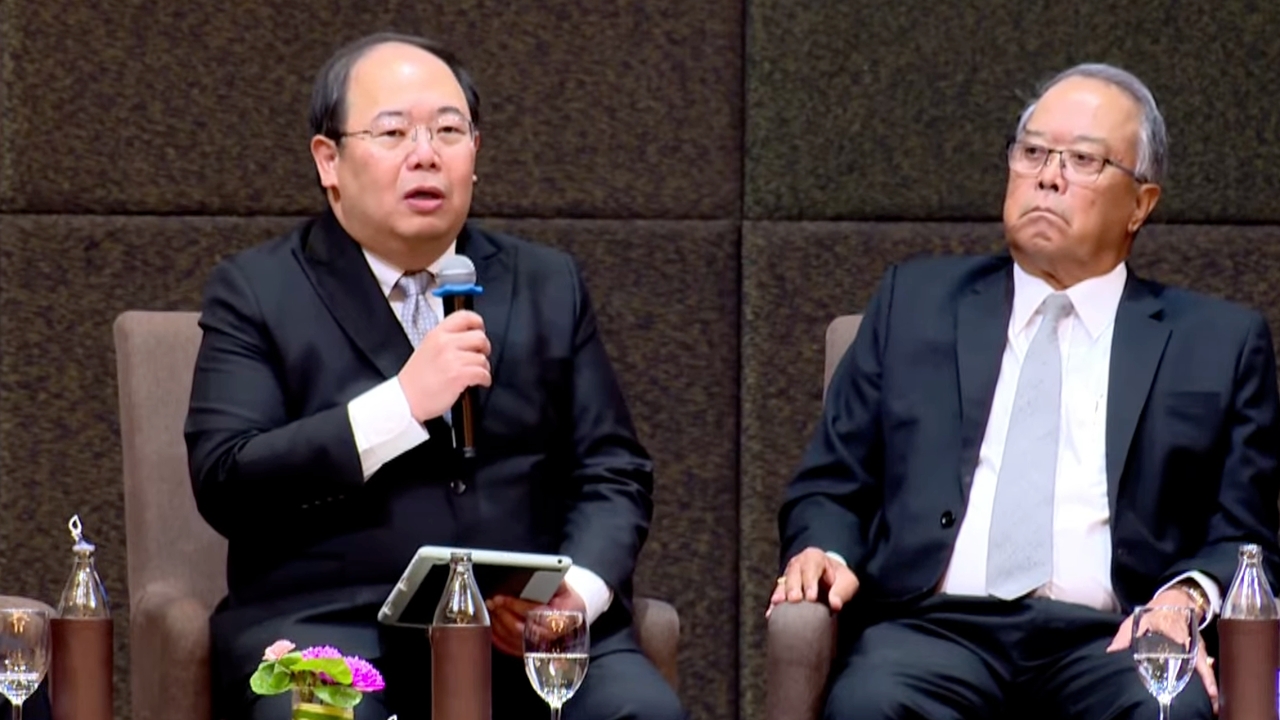
Yutthaporn pointed out that legitimacy is not measured only by legal correctness but must rest on transparency, accountability, and fairness. Attention is focused on the 2026 election having the lowest voter turnout in 20 years.
On 25 September 2026 at the Centara Life Hotel, Government Complex, the House of Representatives' Committee on Law, Justice and Human Rights held a seminar titled “Re-examining the Parliamentary Election Law.” Dr. Yutthaporn Isarachai, a political science professor at Sukhothai Thammathirat Open University, spoke on the importance of learning from elections, saying that elections must serve as a tool to reflect and transmit the political will of the people into the House of Representatives. Elections are designed to support representative politics, allowing the voices, needs, and political and social aspirations of the people to be represented in the political system.
At the same time, elections must transform power struggles from violent means to nonviolent processes. Using the analogy, this is a shift from “Bullet” to “Ballot.” Thus, elections serve as a means to ensure that the process of gaining power is legitimate and peaceful.
Dr. Yutthaporn emphasized that political legitimacy cannot be judged solely by legal correctness but must come from public acceptance, which is fundamentally based on trust. Building trust involves three key principles: transparency, accountability with verifiability, and fairness.
Applying these three principles to the 2026 election raises many questions regarding transparency, verification processes, and fairness—whether the election was conducted honestly and whether it instilled public confidence. Attention is also on the upcoming Monday ruling about whether the February 8, 2026, voting process was conducted secretly.
Dr. Yutthaporn also presented historical voter turnout data, noting that in 1988 turnout was 63.56%, rising to 69.94% in 2001—the first election under the 1997 Constitution—and significantly above trend lines.
Factors increasing voter interest during that period included the 1997 Constitution, the 1997 Asian financial crisis prompting questions about political governance, the May 1992 events encouraging public participation, and political parties shifting to compete with systematic policy platforms, making people feel elections could bring change.
This trend continued in the 2004, 2007, and 2011 elections, but declined in the 2019 election, which followed the 2014 coup and was held under the 2017 Constitution. Some citizens felt the election rules did not arise from genuine public participation.
Meanwhile, the 2023 election had the highest turnout in Thai history, exceeding 75%, due to the political atmosphere, the easing of coup-era control, and party competition offering not just policies but clear ideologies and political stances.
However, the February 8, 2026 election saw only just over 71% turnout, the lowest in 20 years and below 2004 levels, clearly reflecting a significant drop in public interest in elections.
Dr. Yutthaporn believes this phenomenon is not merely due to political fatigue, weather conditions, or travel difficulties—factors that are only immediate—but signals a broader “democratic backsliding” caused by public loss of confidence in institutions and political processes, especially elections.
Although democracy is not defined solely by elections, elections are the first gateway and the minimum guarantee of fundamental rights for citizens. Without the right to vote, other rights such as freedom, human dignity, and human rights cannot truly be realized.
The election process comprises three phases.
It begins with the pre-election phase, covering laws and regulations, election planning, the role of the Election Commission, electoral districting, voter registration, party and candidate registration, public communication spaces, and campaign finance regulation to ensure fairness.
The second phase is election day, including secret balloting and vote counting processes, which must be verified as accurate and error-free and able to build public confidence.
The final phase is post-election, involving the announcement and reporting of results as well as dispute resolution both before and after certification.
He emphasized that every step in the election cycle is an indicator of whether each election will be accepted by society and citizens and the extent of its genuine political legitimacy.