

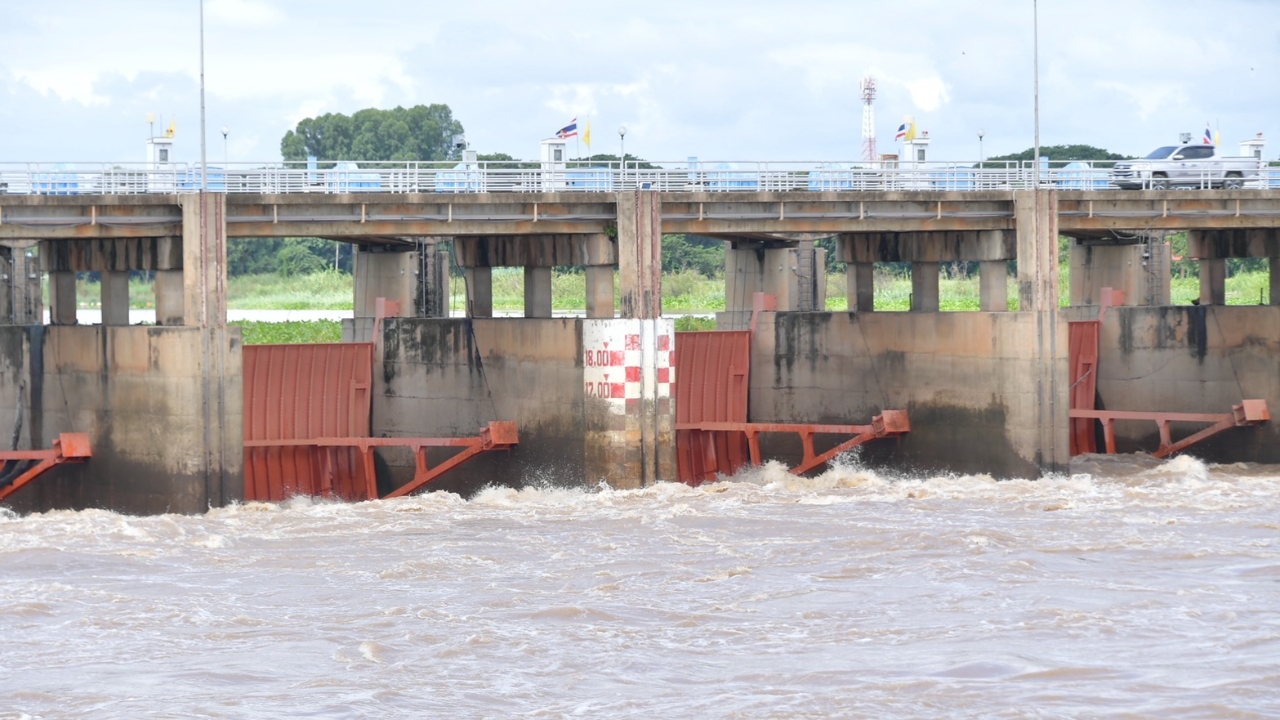
The Royal Irrigation Department is closely monitoring rainfall and managing Chao Phraya water flow according to the situation. Currently, water discharge through the Chao Phraya Dam is controlled not to exceed 2,000 cubic meters per second to reduce impacts on downstream areas.
On 25 September 2026, Witthaya Kaewmee, Director-General of the Royal Irrigation Department, stated that following orders from Suriya Jungrungreangkit, Minister of Agriculture and Cooperatives, the department is closely monitoring and assessing water conditions, especially rainfall and water volumes from upstream areas. They are adjusting water management plans to align with the situation to accommodate floodwaters and minimize impacts on people and agricultural lands. Accordingly, the Royal Irrigation Department continuously monitors the Chao Phraya basin water situation and manages water in the area suitably.
Weather monitoring shows a strong low-pressure area over the eastern region moving to cover the lower northeastern and central regions, including Bangkok and its vicinity. Meanwhile, the southwest monsoon over the Andaman Sea, southern region, and Gulf of Thailand is strengthening, causing heavy rain in many areas of the north, lower northeast, central region, Bangkok and vicinity, east, and south, with some places experiencing very heavy rainfall.
As for the water situation in the Chao Phraya basin, currently (25 September 2026) at 06:00, water flow at station C.2 in Mueang District, Nakhon Sawan Province is approximately 1,795 cubic meters per second, with an increasing trend. Additionally, water from the Sakae Krang River is about 99 cubic meters per second along with tributary flows, resulting in about 2,261 cubic meters per second above the Chao Phraya Dam. The Royal Irrigation Department manages water discharge into the irrigation systems on the east and west sides totaling about 511 cubic meters per second and discharges approximately 1,750 cubic meters per second through the dam.
The Royal Irrigation Department continues to manage water discharge based on inflow volumes, rainfall conditions, and irrigation system capacity. Currently, discharge through the Chao Phraya Dam is controlled not to exceed 2,000 cubic meters per second, as authorized by the Subcommittee on Water Resource Management, to align discharge with the situation and minimize impacts on downstream and low-lying areas as much as possible.
Regarding water management entering the western irrigation system, currently about 60 cubic meters per second is discharged into the Tha Chin River through the Phon Thep water gate. Due to rainfall and rising water levels in the Tha Chin basin, the area may not be able to receive additional water at this time. Meanwhile, about 120 cubic meters per second is discharged into the Noi River via the Borom That water gate to help convey water into the irrigation system and gradually supply water to areas capable of receiving it without causing harm, including Thung Phak Hai, Thung Pa Mok, and Thung Chao Chet, with a total intake of about 9.5 million cubic meters.
For water management entering the eastern irrigation system, currently about 186 cubic meters per second is discharged into the Chainat-Pasak Canal via the Manorom water gate, and about 180 cubic meters per second through the Roeng Rang water gate, flowing into the Pasak River. Additionally, about 55 cubic meters per second enters the Chainat-Ayutthaya Canal through the Maharaj water gate, and approximately 144 cubic meters per second is directed into the Raphiphat Canal. Water is gradually supplied to some low-lying areas, including Thung Chiang Rak and Thung Tha Wung, totaling about 2.1 million cubic meters.
Witthaya added that the forecasted water flow at station C.2 in Mueang District, Nakhon Sawan Province, is expected to be between 1,800 and 2,200 cubic meters per second, with a peak around 2,000 cubic meters per second on 2 October 2026, after which the volume is projected to gradually decrease. Therefore, the Royal Irrigation Department has prepared and planned water management measures in advance to handle possible scenarios.
"The Royal Irrigation Department has instructed all local units to closely monitor rainfall, upstream water volume, and inflow to the area, while forecasting in advance and managing water according to local conditions. This includes balancing water discharge to accommodate increased inflow, minimizing impacts on people and agricultural lands, and managing water resources appropriately, in line with the Minister of Agriculture and Cooperatives' directives," Witthaya said.
The Royal Irrigation Department will continuously monitor and assess the water situation, focusing on rainfall, upstream water volume, inflow into the Chao Phraya River, and tidal surge in the lower Chao Phraya basin, which could affect water levels and drainage efficiency. The department will manage and control water discharge through the Chao Phraya Dam to match the situation at full capacity, aiming to minimize impacts on downstream and low-lying areas.