

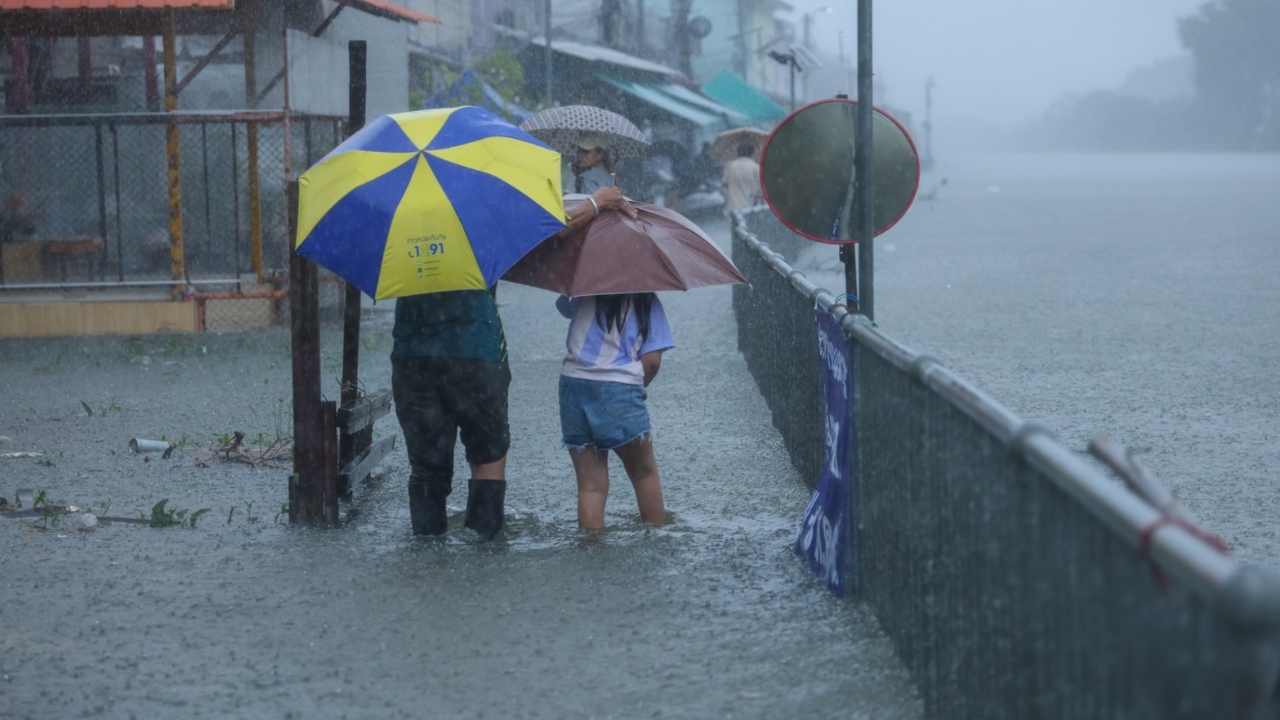
The government has ordered urgent assistance for flood victims nationwide, deploying personnel and machinery to support 24-hour monitoring. Meanwhile, the Department of Disaster Prevention and Mitigation (DDPM) revealed that flooding has already affected 21 provinces, impacting over 84,000 people.

On 26 September 2026, Ms. Lalida Pertviwat, Deputy Spokesperson of the Office of the Prime Minister, stated that the government is closely monitoring the flood situation. Deputy Minister of Interior Je Seth Thaisesat has instructed the DDPM to continuously track water and rainfall conditions, deploy personnel and disaster machinery to support affected areas, and immediately alert the public when risks are detected to help prepare and minimize damage to lives and property.
According to DDPM data as of 07:00 on 26 September 2026, flooding continues in 21 provinces across 93 districts, 350 subdistricts, and 1,425 villages. A total of 27,109 households, or 84,605 people, have been affected. In Bangkok, there are still 44 flood-affected traffic points, but overall water levels tend to be decreasing.
Ms. Lalida added that between 16 and 26 September 2026, floods cumulatively affected 36 provinces, 143 districts, 506 subdistricts, and 1,966 villages, impacting 33,302 households or 102,957 people, with Bangkok’s 22 districts experiencing flooding at 66 locations.
The latest situation shows rising water levels in Suphanburi, Chachoengsao, and Sa Kaeo provinces. Water levels have stabilized in Nakhon Sawan, Phitsanulok, Lopburi, Singburi, Nakhon Pathom, Ayutthaya, Prachinburi, and Trat. Meanwhile, water levels are declining in Chiang Mai, Phetchabun, Uthai Thani, Saraburi, Pathum Thani, Samut Prakan, Chonburi, Rayong, Chanthaburi, and Nakhon Ratchasima.
Mr. Je Seth has instructed the DDPM and regional DDPM centers to closely monitor areas where water levels are still rising, prepare personnel and disaster machinery to provide immediate assistance, coordinate closely with provinces, and maintain 24-hour monitoring and emergency response teams.
Ms. Lalida further explained that the DDPM uses an alert system to send warnings directly to the mobile phones of residents in risk areas. This morning, alerts were sent to people in Nonthaburi Province due to continuous rainfall expected to cause persistent flooding. Residents in low-lying areas are urged to move belongings to higher ground, avoid traffic, and check travel routes before departing.
Additionally, alerts were issued regarding Chaeng Watthana Road, where both inbound and outbound lanes have high water levels from continuous rain, making it impassable for small vehicles. Traffic has been closed from Khlong Prapa to the city bypass U-turn, and the public is advised to avoid this route.
“Mr. Je Seth emphasized that alerts must reach residents quickly, especially in areas with ongoing rain and rising water levels, so people have time to prepare, move belongings to safety, plan travel, and avoid risky areas. At the same time, officials must be ready to provide immediate assistance when incidents occur,” Ms. Lalida said.
Disaster management in the affected areas is classified as level 2, with provincial governors or the Governor of Bangkok having command authority. The DDPM and related agencies are ready to support with personnel and machinery to continuously assist the public.
Ms. Lalida stressed that although water levels have generally decreased in many areas, some provinces still face rising levels and ongoing rain. The government urges residents not to be complacent, to closely monitor alerts from the DDPM and official announcements, and to seek help immediately from local administrative organizations, village heads, or officials if assistance is needed for prompt coordination.