

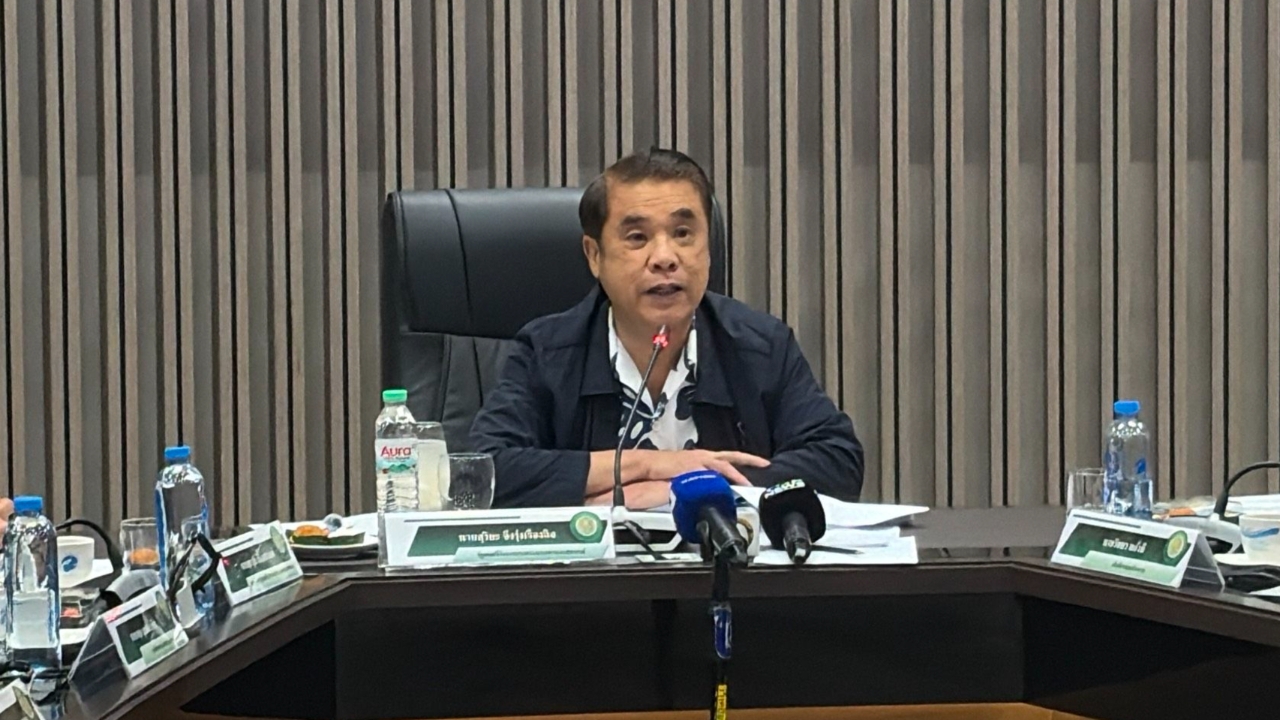
Suriya held an emergency meeting to closely monitor the water situation in the Chao Phraya basin, increasing the Chao Phraya Dam’s discharge to 1,850 cubic meters per second. Meanwhile, the Ministry of Natural Resources and Environment ordered mobilization of water pumps to assist Prachinburi, Singburi, and Saraburi provinces.
On 26 Sep 2026 GMT+7, Mr. Suriya Juangroongruangkit, Minister of Agriculture and Cooperatives, chaired a water situation monitoring meeting with ministry executives at the Royal Irrigation Department’s Smart Water Operations Center (SWOC) in Samsen, Bangkok. The minister received updates on water management status.
Mr. Witthaya Kaewmee, Director-General of the Royal Irrigation Department, reported that the current water level at the Chao Phraya Dam front is 16.94 meters, nearing the control threshold of 17 meters. The department must maintain water below this level to prevent overflow flooding upstream and to protect dam integrity. Continuous monitoring shows water levels rising about 1 centimeter per hour, prompting incremental discharge increases of 20 cubic meters per second hourly, reaching 1,850 cubic meters per second this morning, up from 1,750 cubic meters per second yesterday. This remains within the planned maximum discharge of 2,000 cubic meters per second, as previously notified to the National Water Resources Office.

It was confirmed that the recent increase in water level at the dam front is not due to increased discharges from upper large dams, as the Royal Irrigation Department is holding back water from Bhumibol and Sirikit dams as much as possible. The flow at station C2 in Nakhon Sawan province this morning was 1,827 cubic meters per second. The situation at C2 is currently not a concern, but the stretch from Nakhon Sawan to Chainat requires attention due to rainfall and tributary inflows causing accumulation in the upper Chao Phraya and rising levels above the dam. Regarding the Pasak basin, water volume is relatively high, so the department is holding water in Pasak Jolasid Dam in Lopburi and managing downstream discharge to stagger inflows and prevent simultaneous surges.
Downstream, the Royal Irrigation Department has opened the sluice gates of Khlong Lat Pho in Samut Prakan province to accelerate water flow by creating a shortcut through Bang Kachao bend, reducing travel time from about 5 hours to approximately 10 minutes before discharging into the Gulf of Thailand.
Mr. Witthaya added that the current water management strategy is to hold water upstream, control midstream volumes, and accelerate downstream discharge to the sea, preventing simultaneous water surges and minimizing impact on riverside areas. In the eastern region, especially Sa Kaeo and Prachinburi, heavy and accumulated rainfall requires close monitoring, as runoff may cause localized flooding. The department has deployed pumps and water pushers to expedite drainage in affected areas.
Following the meeting, the Ministry of Agriculture and Cooperatives will hold a press conference to announce results and water management plans to address the situation.
Ministry of Natural Resources and Environment Orders Mobilization of Water Pumps to Assist Prachinburi, Singburi, and Saraburi
Ms. Lalida Pertvivatana, Deputy Spokesperson for the Prime Minister’s Office, stated that the government is accelerating assistance to residents affected by continuous rain and flooding in multiple areas. Mr. Suchat Chomklin, Minister of Natural Resources and Environment, has instructed relevant agencies to closely monitor the water situation and ordered Water Resource Offices 2 and 6 to deploy machinery, water pumps, and personnel to Prachinburi, Singburi, and Saraburi provinces to expedite floodwater drainage, alleviate hardships, and minimize disruption to residents’ lives promptly.

In Prachinburi province, Water Resource Office 6’s mechanical division installed one 10-inch water pump near Chao Phraya Abhaibhubejhr Hospital to speed floodwater drainage on roads, facilitating access for approximately 3,000 daily visitors. Additionally, three 24-inch pumps were installed at the Bang Krachert Canal sluice gate to accelerate drainage and relieve local conditions.


In Singburi province, Water Resource Office 2 installed one 12-inch water pump at Ban Ta Kep sluice gate, Bang Man subdistrict, Mueang Singburi district, to quickly drain floodwater from communities into the Chao Phraya River, easing difficulties for about 150 households or over 700 people.
In Saraburi province, Water Resource Office 2 set up one 30-inch hydraulic water pump along the irrigation canal in Village 5, Huai Bong subdistrict, Chaloem Phra Kiat district, to rapidly drain floodwater from roads into drainage canals, reducing transportation and daily life impacts for local residents.

Ms. Lalida emphasized the government’s commitment to caring for affected residents, with the Ministry of Natural Resources and Environment coordinating all affiliated agencies for full support, including accelerated drainage, situation monitoring, and access to disaster areas to ensure swift and comprehensive assistance.
“Minister Suchat stressed, ‘When water comes, the Ministry of Natural Resources and Environment must reach the people,’ instructing all agencies to closely monitor the situation, prepare personnel and equipment, be ready to assist affected residents immediately, and continue supporting solutions until the situation resolves,” Ms. Lalida said.