

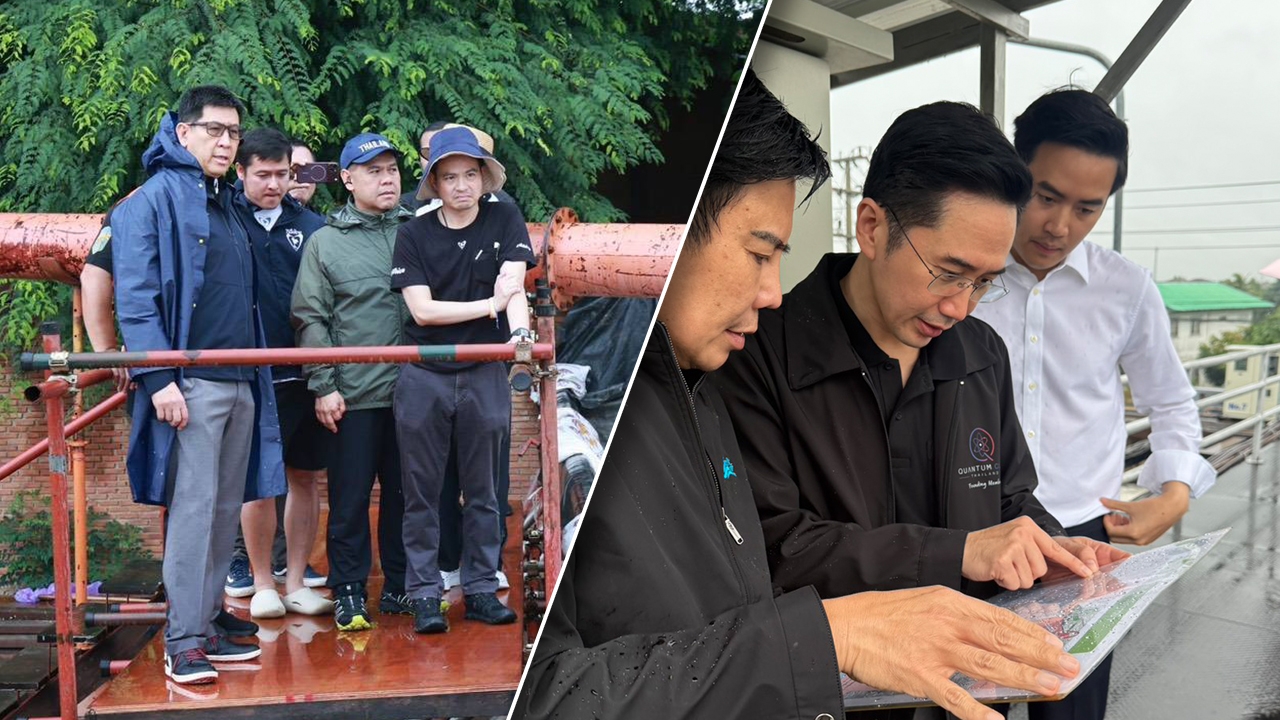
Deputy Prime Minister Ekkaniti led Ministers Warawut and Pradorn to Ayutthaya to order proactive water management and strengthen defenses for critical areas. Meanwhile, Deputy Prime Minister Yotsanan inspected the Khlong Rangsit pumping station and instructed the Ministry of Higher Education to adjust learning formats. Minister Nikorn ordered the Ministry of Social Development to urgently care for vulnerable groups and prepare shelters and evacuation plans.
On 26 Sep 2026 GMT+7, Ms. Lalida Pertvivattana, Deputy Spokesperson of the Prime Minister’s Office, revealed that the government is intensifying flood management in the central region. Deputy Prime Minister and Finance Minister Ekkaniti Nitithanprapas, as Chair of the Committee on Flood and Drought Prevention in the Central Region, along with relevant agencies, visited Ayutthaya province to monitor water levels, reinforce defenses for key areas, and ensure readiness to assist citizens. He emphasized a “prevention first” approach and systematic water management to reduce downstream impacts.
The delegation inspected flood defenses at Wat Chaiwatthanaram, where the Fine Arts Department installed 138 prefabricated flood barrier panels, each 1.90 meters high and about 165 meters long, along with tarps, sandbags, and automatic pumping systems. They also checked readiness at Wat Kasattrathirat Worawihan, where a knockdown flood barrier about 120 meters long and 1.90 meters high, plus two pumps, is being installed to prevent water from the Chao Phraya River entering key areas.
Ms. Lalida stated that Deputy Prime Minister Ekkaniti instructed all units to closely monitor incoming water from upstream areas, water releases downstream of the Chao Phraya dam, and rainfall amounts. They are to accelerate water management by diverting water to side areas and using floodplains appropriately to reduce volume flowing downstream. During the visit, water was being released from the dam at 1,900 cubic meters per second, requiring coordinated management across regions to prevent cumulative impacts on residents.

Minister Pradorn Prissanantakul, Minister attached to the Prime Minister’s Office, stated that the government is applying a water management approach called “fishbone” which disperses water to both sides of the Chao Phraya River to reduce flow in the main river channel and downstream areas. Provinces, districts, the Department of Disaster Prevention and Mitigation, and related agencies have been instructed to survey risk areas, prepare water pumps, transport equipment, tents, and evacuation sites, and continuously monitor rainfall, water levels, and tidal surges.
Meanwhile, Minister of Industry Warawut Silpa-archa inspected industrial areas in Ayutthaya province. Industrial estates have prepared dikes and embankments for flood defense and are closely monitoring water levels to minimize impacts on production while ensuring the safety of workers and surrounding communities.
Ms. Lalida added that the Ministry of Interior and the Department of Disaster Prevention and Mitigation have instructed local authorities to work proactively, inspecting risk areas and weaknesses in flood defenses down to the community level. They are to prepare evacuation plans and safe zones in advance, especially for low-lying areas, riverside communities, and zones at risk from rising water levels. They also prepare personnel, pumps, boats, transport vehicles, and disaster machinery in vulnerable areas, maintaining 24-hour surveillance.
Ayutthaya province has declared disaster zones and assistance areas covering 5 districts, 64 subdistricts, 301 villages, and 14 communities. Measures have been enhanced to protect communities, lowlands, agricultural zones, historic sites, and industrial areas, along with preparation for assistance and evacuation, with special attention to vulnerable groups.
“The government has ordered all units to act proactively, not waiting for situations to affect citizens before responding. This includes water management, reinforcing defenses, preparing machinery and evacuation areas, and issuing early warnings. The primary goal is to ensure public safety and minimize impacts on communities, economic zones, and critical areas as much as possible,” Ms. Lalida said.

At 13:30 on 26 Sep 2026 GMT+7, Deputy Prime Minister and Minister of Higher Education, Science, Research and Innovation (MoHESRI) Professor Dr. Yotsanan Wongsawat visited the Khlong Rangsit pumping station to monitor the Royal Irrigation Department’s operations coordinating with Bangkok Metropolitan Administration to expedite solutions for the public. He issued urgent directives to the ministry and all supervised agencies, especially irrigation units, to systematically accelerate emergency assistance measures to deliver help efficiently and promptly to affected people.
Additionally, as Chair of the Northern Flood Prevention Committee appointed by the Prime Minister, Professor Dr. Yotsanan ordered northern agencies to prepare for increased rainfall expected over the next 1–2 days.
He also directed agencies and universities nationwide to urgently adjust learning formats, recommending that schools in affected or at-risk areas suspend on-site activities and switch to online learning for safety.
He instructed frontline MoHESRI units in affected areas to coordinate with central offices to set up shelters, rest stops, and health service units for disaster victims.
For post-flood recovery plans, he emphasized preparing personnel to assist in repairing housing, vehicles, and addressing public health once the situation improves.

Minister of Social Development and Human Security Nikorn Somkalang expressed concern over ongoing heavy rains causing floods nationwide. He emphasized special care for vulnerable groups including children, the elderly, and disabled persons. The ministry has been instructed to monitor situations closely and provide attentive care to service recipients, preparing for their evacuation to safe locations or shelters provided by the state or local authorities. The ministry’s own facilities are also being prepared as shelters to support vulnerable populations or flood-affected citizens, with daily monitoring of assistance efforts.
“If citizens suffer from flooding, they can seek help at the Ministry’s Rapid Response Center for Public Welfare via the 24-hour free hotline 1300. The ministry is ready to coordinate assistance with all relevant sectors to help people overcome this crisis together,” Minister Nikorn stressed.

Minister Supamas orders the Public Relations Department to enhance surveillance and warnings for the public.
Minister attached to the Prime Minister’s Office Supamas Isarapakdi said that due to heavy rain and flooding in many areas, she has instructed supervised agencies, especially the Public Relations Department and provincial public relations offices, to closely monitor the situation. They must promptly and accurately communicate warnings, surveillance information, and assistance channels to all groups, preparing to visit provinces under their supervision soon. Coordination with provincial governors and relevant agencies is underway to assess the latest situations and identify priority areas for urgent public assistance.
The Public Relations Department has been tasked with elevating proactive crisis communication by coordinating information with the Meteorological Department, Department of Disaster Prevention and Mitigation, Royal Irrigation Department, Bangkok Metropolitan Administration, and local agencies to cover public care before, during, and after disasters.
