

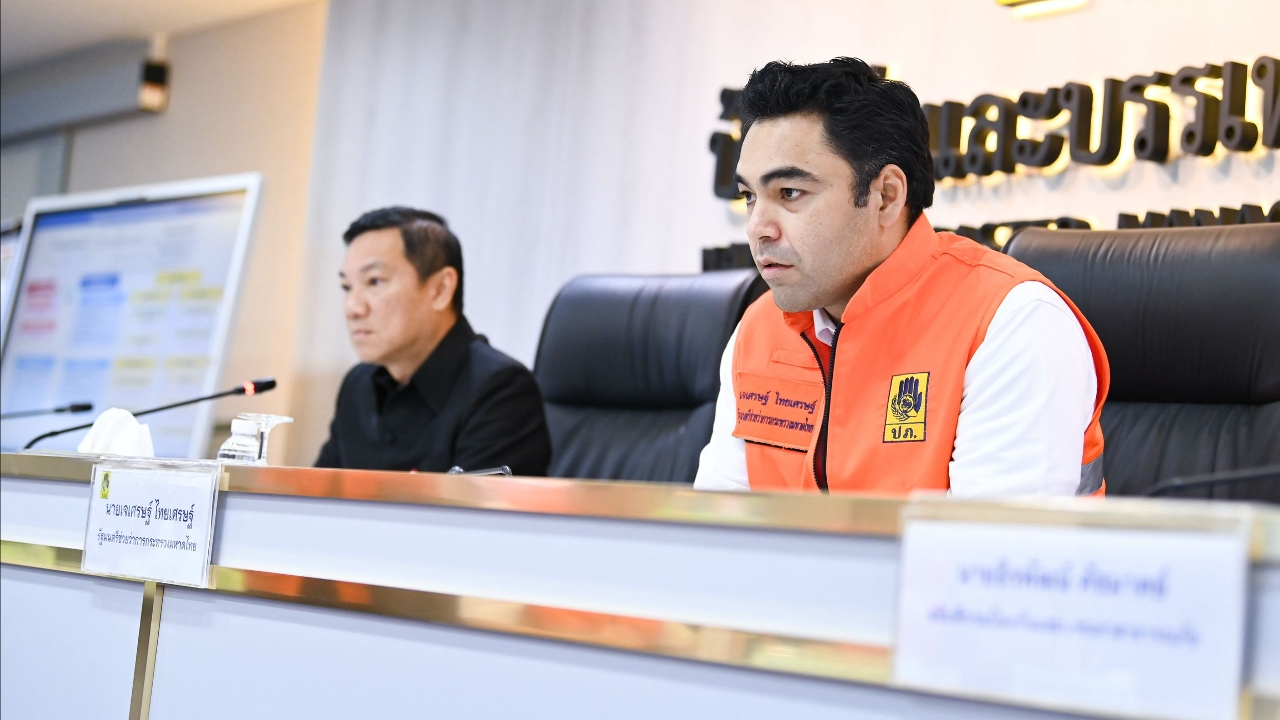
Deputy Minister Jeset issues an urgent nationwide order to prevent any interruptions to water and electricity supplies in hospitals and evacuation centers. He directs provincial governors to serve as central coordinators and assigns deputy governors the responsibility to oversee water supply systems.
At 9:30 a.m. on 29 Sep 2026 GMT+7, at the National Disaster Prevention and Mitigation Command meeting room, the Department of Disaster Prevention and Mitigation, Prime Minister and Minister of Interior Anutin Charnvirakul delegated Deputy Minister Jeset Thaiyasut to chair a meeting of the Central Disaster Prevention and Mitigation Command. The meeting, held via video conference, monitored flood situations and preparedness to assist flood victims. Permanent Secretary of Interior Atsit Sampantharat, acting as Deputy Commander of National Disaster Prevention and Mitigation, along with Director-General Theerapat Kachamat of the Department of Disaster Prevention and Mitigation and other department executives attended at the department. Provincial governors and deputy governors joined online.
During the meeting, updates on the situation were reported from the provinces of Nakhon Nayok, Pathum Thani, Kanchanaburi, Rayong, Kamphaeng Phet, and Chonburi, where governors and deputy governors remain on site managing ongoing situations.
Deputy Minister Jeset stated that following discussions with the Prime Minister and Minister of Interior, instructions and emphases were given to provincial governors and relevant agencies for managing flood situations in affected areas, monitoring zones, and places where water levels are stabilizing or receding.
Regarding public utilities, deputy governors are assigned direct responsibility for overseeing water supply systems, including pumping stations and water treatment plants. Personnel are allocated to place sandbags and operate pumps continuously. In case of system damage, coordination with the Provincial Waterworks Authority for urgent repairs is required. Water trucks will distribute potable water to residents. When water levels drop, officials must inspect electrical systems for safety before restoring electricity to homes promptly.
"For critical sites, utmost priority is placed on protecting and supporting hospitals and temporary shelters (evacuation centers). Electricity and water systems must be maintained without any shortages or interruptions. Coordination with local administrative organizations and military units will establish and expand kitchens to prepare and deliver food and drinking water to vulnerable groups and residents trapped in their homes first, before assisting those able to travel to relief centers." .
Deputy Minister Jeset added that provincial governors are to act as central integrators of personnel, machinery, and resources in cooperation with external agencies. If disaster prevention and mitigation centers face shortages of operators for machinery, integration with the Territorial Defense Volunteers (Or Sor) or rescue personnel is to be activated under memoranda of understanding with rescue foundations nationwide. This allows redeployment of rescue teams to support delivery of food, water, and victim search and rescue. The Department of Disaster Prevention and Mitigation is to prepare plans to rotate machinery into recovery and rehabilitation as soon as water recedes, coordinating with the Ministry of Interior and Bangkok Metropolitan Administration on area rehabilitation plans.
Continuous monitoring and assessment of water levels are required. If water rises beyond containment capacity, operational plans must shift immediately from prevention to safety assistance and evacuation. He emphasized water management, especially where public opinions differ among districts. District chiefs must mediate and promote understanding, prioritizing provincial and national overall plans. Where necessary, floodgates must be opened or raised to improve overall drainage. Prolonged disputes causing isolated flooding complicate water management further.
"Most importantly, I thank all personnel working around the clock. From now on, every location must report their situation. If any area faces problems or lacks resources, urgent coordination for additional support is required," he said. Deputy Minister Jeset stated.
Permanent Secretary Atsit emphasized "the importance of water pumping, " noting coordination with the Royal Irrigation Department shows that operating pumps at full capacity will improve water and drainage efficiency. Then, provincial governors are instructed to expedite damage assessments after water levels recede, to enable rapid compensation disbursement to residents in line with the policies of the Prime Minister and Minister of Interior. Disaster assistance committees at district and provincial levels must consolidate data for budget disbursement. Public awareness on government measures and administrative procedures must be enhanced during the pre-disaster preparation, the response phase, and recovery and rehabilitation phases, and all parties must accelerate restoration of damaged basic public utilities to return them to full operation as quickly as possible. . . .