

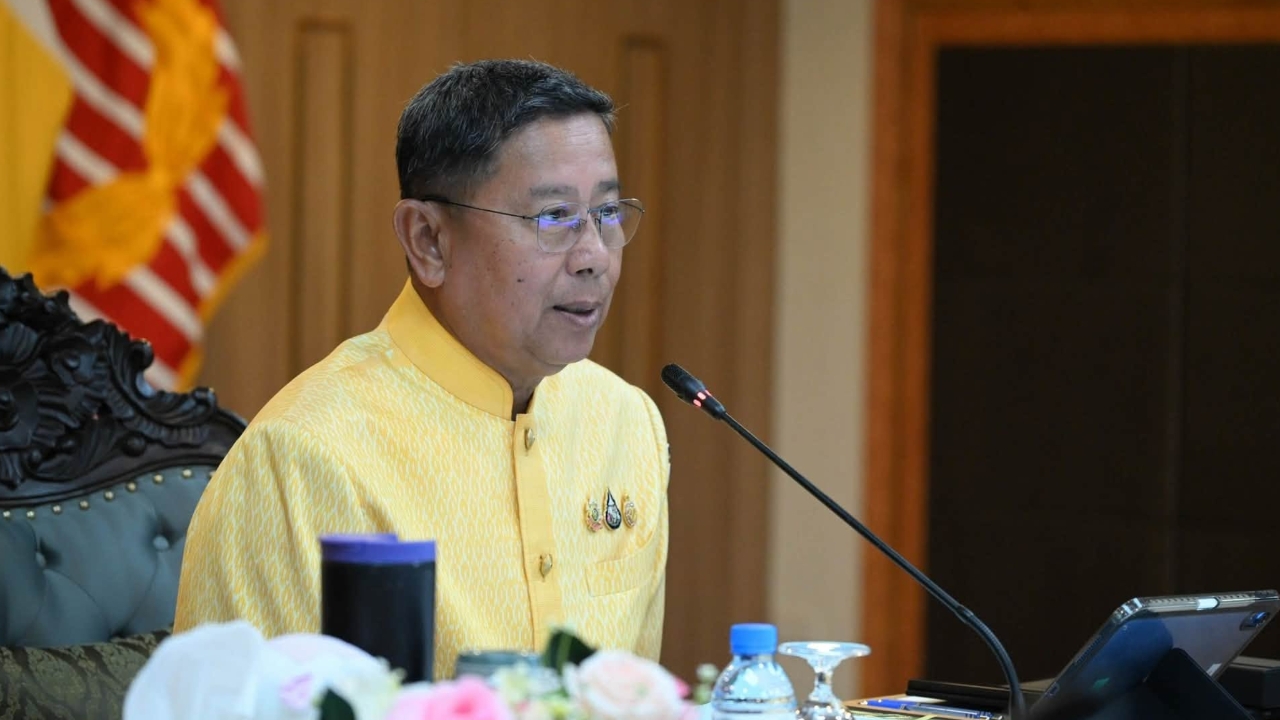
Ekapop revealed that the Prime Minister has assigned the Defense Minister to oversee the Bangkok flood situation, assuring that the Chao Phraya River in the Bangkok area can still handle an additional 1.8 meters of water. He pointed out that the Prime Minister has visited areas never visited before and boasted that disaster insurance enables quick compensation.
On 29 September 2026 at 14:00 at the Government House, Ekapop Pianphiset, spokesperson for the Prime Minister's Office, held a press conference following the Cabinet meeting regarding directives from Prime Minister and Interior Minister Anutin Charnvirakul. The Prime Minister has issued orders for assistance, relief, and recovery related to the floods. Previously, he assigned the Deputy Prime Minister and Ministers attached to the Prime Minister's Office to oversee specific inspection areas, but none included Bangkok because it is a special zone governed by local administrative organizations with elected leaders and specific laws. Due to the current flood situation, the Prime Minister ordered General Adul Boonthamcharoen, Defense Minister, to bring military equipment and personnel from various branches to assist and alleviate difficulties effectively. To ensure smooth and continuous flood management in Bangkok, the Prime Minister additionally assigned the Defense Minister to oversee the Bangkok area for this flood issue. Furthermore, the Interior Ministry’s Permanent Secretary was instructed to direct provincial governors to attend meetings with the Deputy Prime Minister and Ministers deployed to flood areas and to remain on site for swift command. Any agency facing operational obstacles must report directly to the Prime Minister so he can exercise his authority to resolve the problems.
Ekapop stated that regarding the water situation in the Chao Phraya River, due to rainfall upstream of the dam, the subcommittee on flood and drought prevention and mitigation for the Chao Phraya basin, chaired by Tourism and Sports Minister Surasak Pancharoenworakun, resolved to increase the water discharge at the Chao Phraya Dam from the previous 2,000 cubic meters per second to a maximum of 2,200 cubic meters per second. This increase will be stepped according to conditions rather than releasing an additional 200 million cubic meters at once, which would raise downstream water levels by 30 centimeters. They emphasized accelerating water drainage from the fishbone-patterned flood retention areas efficiently while considering farmers’ crop harvests. Adjusting dam discharge may impact Phra Nakhon Si Ayutthaya, Ang Thong, Singburi provinces, and the water passing through Bangkok. He reassured that the river section through Bangkok can still safely handle an additional 1.8 meters of water, so residents need not worry. Additional pumps have been installed by the Royal Irrigation Department to expedite drainage toward the Gulf of Thailand. The government is committed to ensuring all citizens, regardless of location in Thailand, are well cared for and safe.
Ekapop said that according to information from Bangkok authorities, dry roadways in Bangkok will be restored within 2–3 days, with low-lying areas expected to recover within 7 days, pending further announcements from Bangkok officials. He confirmed that all agencies are cooperating with Bangkok to expedite solutions. Asked whether the main problem solver in Bangkok's flood situation is the government or the Bangkok Governor, Ekapop explained that legally, Bangkok is managed under the governor’s authority. However, when the governor declares a disaster area, the government steps in to provide tools and equipment to fully support citizens. The Cabinet and responsible officials also assist on site. When asked if clarifications by the Prime Minister’s Office spokesperson might increase criticism of the government, Ekapop responded by asking the reporter, "Being criticized?" The reporter explained that since the governor is the main figure in flood management and the government only supports, why doesn’t the government take a more leading role? Ekapop replied that the government is already deeply involved in all aspects.
"Moreover, the Prime Minister has visited areas that no one has reached before. Criticism is inevitable. What we must do today is to review responsibilities before this flood. The cause of flooding is heavy rain exceeding drainage capacity. Before this rainfall, water was released to reduce levels through the drainage system. This involved cooperation between the National Water Resources Office and Bangkok. However, with 300 millimeters of rain, Bangkok’s drainage system can only handle 51 million cubic meters per day, which is insufficient for such rainfall," Ekapop explained.
Ekapop stated that when problems arise, all provincial governors in Thailand conduct initial responses. According to the Disaster Prevention and Mitigation Act, local authorities handle initial care; if overwhelmed, the issue escalates to district, then provincial, then national levels. Once the Bangkok Governor declares a state of emergency, the government fully supports with authority and cooperation, involving all relevant agencies. Collaboration has existed from the start, but the main responsibility lies with the Bangkok Governor, with government agencies supporting. This shows that blame should not be placed on any party or responsibility shifted, but rather shared accountability to quickly restore citizens’ normal lives.
Ekapop explained that regarding compensation measures, conditions differ between the Department of Disaster Prevention and Mitigation (DDPM) and Bangkok authorities. Currently, DDPM, Bangkok, and the Budget Bureau are discussing how to provide relief. Previously, the process required case-by-case discussions for each disaster’s nature and location to determine compensation. The government is proposing a new model using insurance, which eliminates repetitive negotiations. All risk is transferred to insurance companies under government contracts, with predetermined funds. This means the government no longer negotiates compensation amounts, as insurance companies will promptly provide compensation to affected people.