

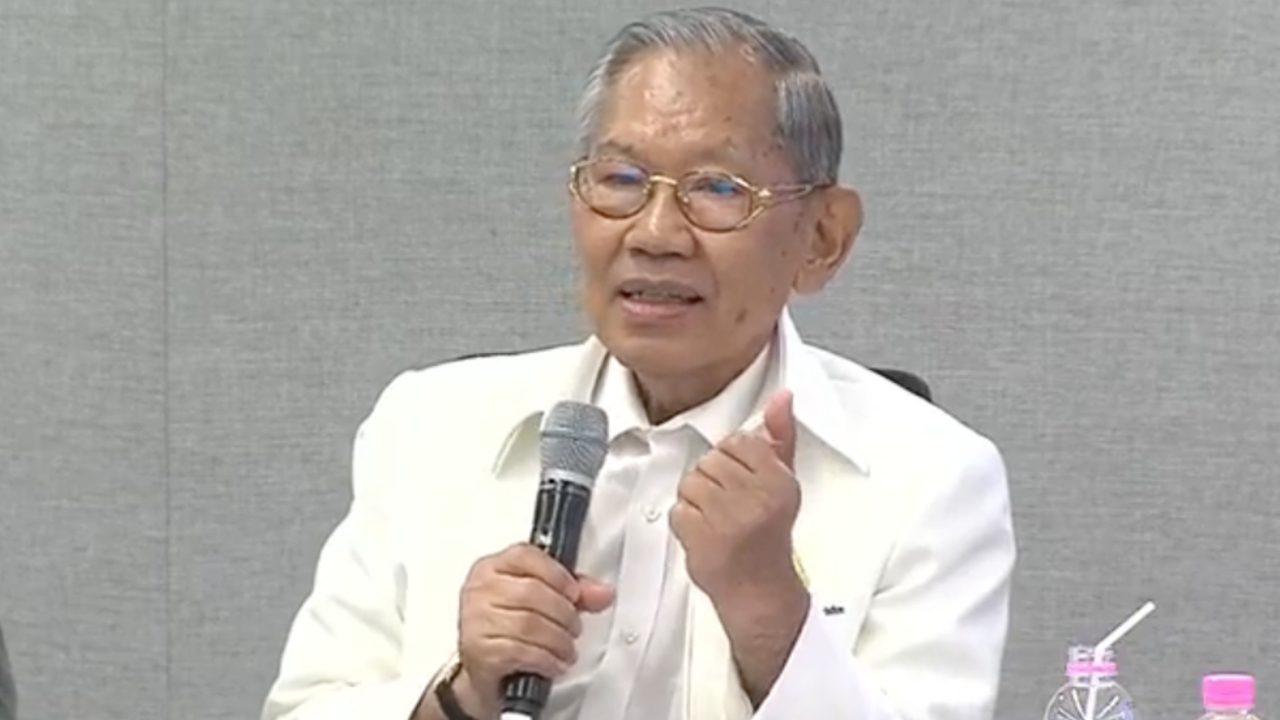
Special Professor Vicha Mahakun highlights the severe threat posed by Senate collusion, urging the Election Commission and the Supreme Court to employ an inquiry system to purge these collusion networks. He warns that if this system continues, democracy will be destroyed and insists the issue must be resolved within three months to prevent this.
On 30 Sep 2026 GMT+7, Special Professor Vicha Mahakun, former commissioner of the National Anti-Corruption Commission (NACC), began by saying he had listened to the somewhat intense academic views of Special Professor Charan Phakdeethanakul. He observed that Thailand seldom practices true democracy because it is seen as slow and problematic, with political organizations or officeholders seeking personal gain. Thus, this seminar aims to help uphold the democratic system, which has not lasted long enough to prove whether our people are ready to exercise their rights and freedoms honestly and fairly as the constitution requires.
Special Professor Vicha also explained the origin of the term “collusion.” Its Chinese root means cooperation, but in the context of dishonest price-fixing, it destroys free competition. Previously, the Supreme Court regarded contractors' agreements as freedom of contract and not void. However, as collusion in bidding grew severe—with influence, coercion, threats, and even fatal violence—the Supreme Court set a new precedent: “collusive bidding is immediately void” because it violates public order and good morals.
Furthermore, a statute was enacted criminalizing collusive bidding in government contracts, considered a serious offense under the NACC’s jurisdiction, with penalties up to life imprisonment—harsher than criminal code section 157. Contractors often misunderstood collusion as minor, but courts and the NACC have seriously punished it, as seen in cases like the rice pledging corruption scandal.
A key issue raised as a societal warning is the frightening development of “political collusion,” equivalent to the English term "Collusion," meaning a conspiracy to exploit others and benefit cronies. It involves groups or politicians planning, organizing, and fixing political outcomes together.
Special Professor Vicha further said that in the recent Senate election, the constitutional mechanism requires self-selection and cross-voting among professional groups, unlike House of Representatives elections where the general public votes. This loophole was exploited by hiring candidates to block votes, recruiting people from political and interest networks, paying them to register in various professional groups without intending to be senators themselves but to act as vote controllers, voting according to orders without voting for themselves. These collusion lists with prearranged candidate names and numbers signal networks to vote according to these cross-voting lists, causing genuine independent candidates to be effectively “locked in midair” with only their own votes counted.
Special Professor Vicha also suggested solutions, supporting legal channels to submit cases to the Constitutional Court and the Supreme Court’s Election Division for consideration.
Regarding whether collusion in Senate elections violates the constitution under the Constitutional Court’s authority, the key is to examine whether the Election Commission’s inquiry finds the process dishonest and unfair, leading to case referral for the same purpose: letting the Supreme Court’s Election Division handle the case.
Relying on the Election Commission’s case file as the basis still allows gathering additional evidence to resolve doubts, similar to the criminal court system for political officeholders and corruption cases, operating as an inquiry system. It is based on the NACC’s files and can investigate until all doubts are resolved, without applying the criminal principle of presuming the defendant innocent when doubt remains.
“If any Election Commission members or Supreme Court Election Division judges think they must prove the case beyond any doubt and, if uncertain, give the benefit of the doubt to the defendant, that is fundamentally wrong and utterly impossible in political case adjudication,” Special Professor Vicha said, emphasizing this point.
This case is not criminal but concerns political system integrity, which must be honest and fair. The Election Commission’s screening does not require proof beyond doubt but rather credible evidence sufficient to refer the case to the Supreme Court, which will then decide whether to revoke electoral rights.
“Thai law is a mixed system—one might call it a big blend—taking the best parts from various systems. We usually avoid lengthy, complicated proofs because they are troublesome, so there tend to be judges who doubt excessively and acquit many cases,” Special Professor Vicha observed.
Special Professor Vicha also sees the need to clarify to the court initially how Senate election collusion arises, emphasizing that the constitutional mechanism requires self- and cross-selection among professional groups, unlike House elections. Without general public voting, this loophole enables collusion, as candidates register without voting for themselves, violating the principle of honest member selection. They enter not intending to be chosen but to vote as directed, with prearranged collusion lists and agreements.
Thus, candidates are hired to block votes, and political and interest networks recruit people to act as vote controllers or vote for predetermined candidates. The candidates do not intend to be senators but to vote as ordered. This must be fully incorporated into case files, especially collusion lists that cause sincere candidates to be disqualified or “knocked out midair,” receiving only their own votes. Without vote arrangements, they get no votes. There are also gatherings and off-the-record meetings.
“These practices undermine the constitution’s intent, which designed the system to yield senators representing diverse professional groups with sincerity. It was not designed for collusion like this. This loophole allows interference and collusion—a game by financial groups and some political parties aiming to dominate the upper house. Their intent is to influence appointments to independent bodies, thus placing control in the hands of many senators. I won’t name any groups because the Prime Minister said not to discuss it, so just understand,” Special Professor Vicha stated.
He views this as contrary to power checks and balances. The Senate should serve as a council of experts overseeing the House of Representatives and government and appointing independent agencies. If senators come from collusion networks tied to political groups or parties, then those parties effectively control the country’s entire oversight mechanism.
He also believes such senators lack connection and legitimacy with the people, as they do not represent Thai citizens but those behind the scenes. “Is this from a whisper system, Prime Minister?” They become representatives of money and influence who determine representatives, laws, and decisions, lacking trust and undermining faith, trust, and confidence in state institutions, which will be destroyed immediately.
Special Professor Vicha added that loss of trust leads to lack of ethics among organizations or political officials. Those lacking trust must be immediately removed, necessitating ethical standards processes involving the NACC and Supreme Court.
He also sees this as creating inequality and destroying the rule of law by allowing lawbreakers to use money and influence to infiltrate state power, seriously undermining legal principles. This must be done without partiality or heavy-handed power. Good people with knowledge and ability have no chance, seriously violating the constitution in a democratic system.
“If we allow this system to persist, democracy will be destroyed and the dictatorship we reject will come. We must fix this. Those with justice in their hearts who want democracy to survive must cooperate to solve this problem as soon as possible. Six months is already too long; it must be done within three months,” Special Professor Vicha emphasized.