

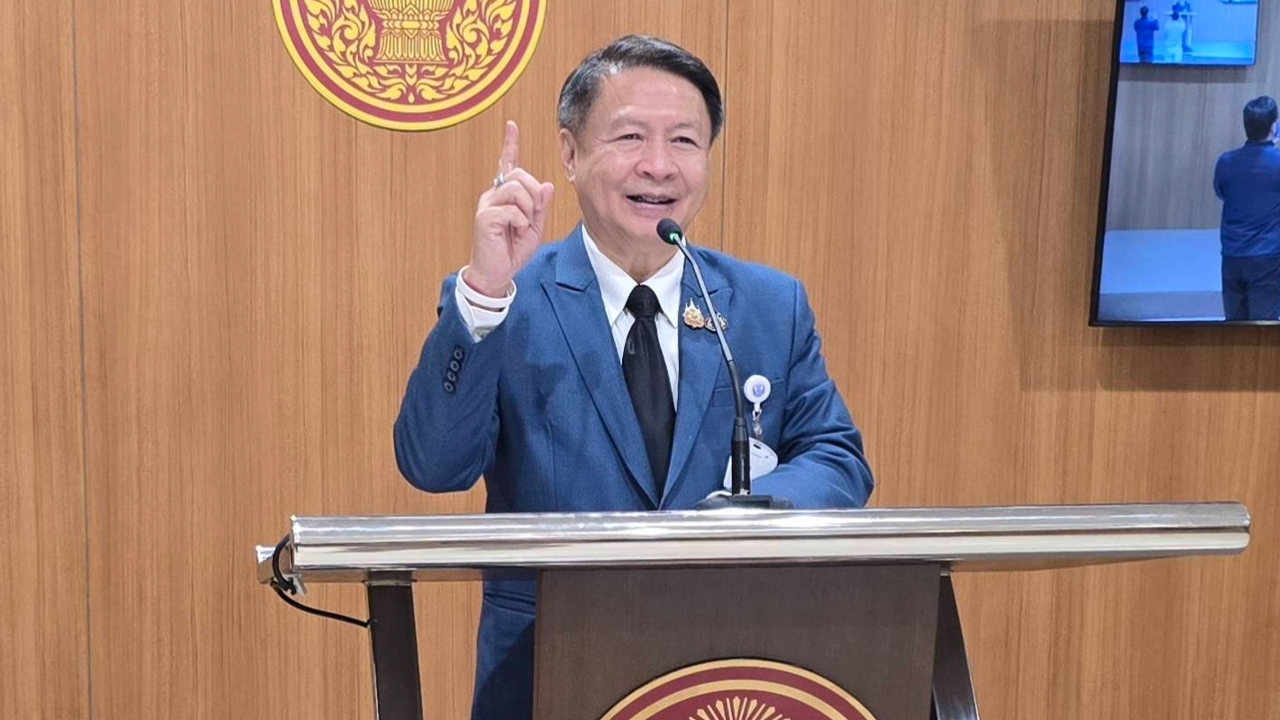
Senator Premsak sharply criticized Prime Minister Anutin for his complete failure to resolve the flood crisis, highlighting the absence of the "single command" system previously promoted during his campaign. He declared the situation as a completely different story and called the distribution of 1,000 baht cash a short-sighted method. He also questioned where the National Water Resources Office (NWRO) was during the crisis.
On 30 Sep 2026 GMT+7 at the parliament, Dr. Premsak Piyayura, senator, criticized Prime Minister and Interior Minister Anutin Charnvirakul’s flood response, expressing deep disappointment over the government’s assistance to the public. He stated that the government had not learned from the Hat Yai flood situation to improve their operations, especially regarding unified command and systematic orders, which remain unresolved. The Bhumjaithai Party had proposed policies to establish a disaster fund and use technology for disaster management, gaining public support, but no tangible progress has been seen. Meanwhile, the government seems to prioritize borrowing money for populist policies. Furthermore, party and government officials, including ministers and communicators, focus more on rhetorical disputes than addressing the victims’ urgent needs. He urged the prime minister to refocus work principles to prioritize helping the people first.
Regarding the prime minister’s visit on the night of 29 Sep, when he personally gave 1,000 baht to villagers as reported in images and news, Dr. Premsak said this approach is inappropriate for a prime minister because he cannot personally give money to all victims, and the amount is insufficient for their hardships. Such behavior is unbecoming of a prime minister, who should adopt more targeted solutions. He views the government’s disaster response as a repeated failure. He suggested adopting Deputy Prime Minister and Minister of Higher Education, Science, Research and Innovation Prof. Dr. Yossanan Wongsawat’s idea to use drones to locate victims and provide coordinates to rescue teams. This method suits the situation and speeds access to victims. The government should modernize operations by employing technology in areas where flat-bottomed boats or personnel cannot reach, instead of traditional field visits that often serve only as photo ops. Since both technology and budget exist, he questioned why they are not fully utilized to benefit the people.
Dr. Premsak also criticized the prime minister’s overseas trip during the disaster, accompanied by the permanent secretary of the Ministry of Interior, raising doubts about the continuity of command and problem-solving efforts. The public questioned why the permanent secretary was not left to oversee the situation domestically to ensure timely aid. He also criticized the Cabinet’s approval of the 160 billion baht Khanom flood drainage canal project from Chainat–Pasak–Gulf of Thailand, scheduled to begin in 2027 and complete in 2034. Given its huge budget, he urged careful consideration, especially as the country still carries large loan burdens.
He asked whether the timing of approving the project during the major flood was an attempt to exploit public hardship to justify it or if other motives were involved. The recent flooding was not due to a lack of dams but rather reflected government mismanagement of water resources. The prime minister has authority over national water management through the National Water Resources Office (NWRO), but its proactive role was absent during the 2026 flood crisis. The NWRO was established to integrate the country’s water resource plans, with allocated budgets and staff. He openly questioned its purpose and failure, noting that during crises it should be the first agency to act. He called on the NWRO to clearly coordinate and drive problem-solving efforts to ensure systematic, timely assistance to flood victims.