

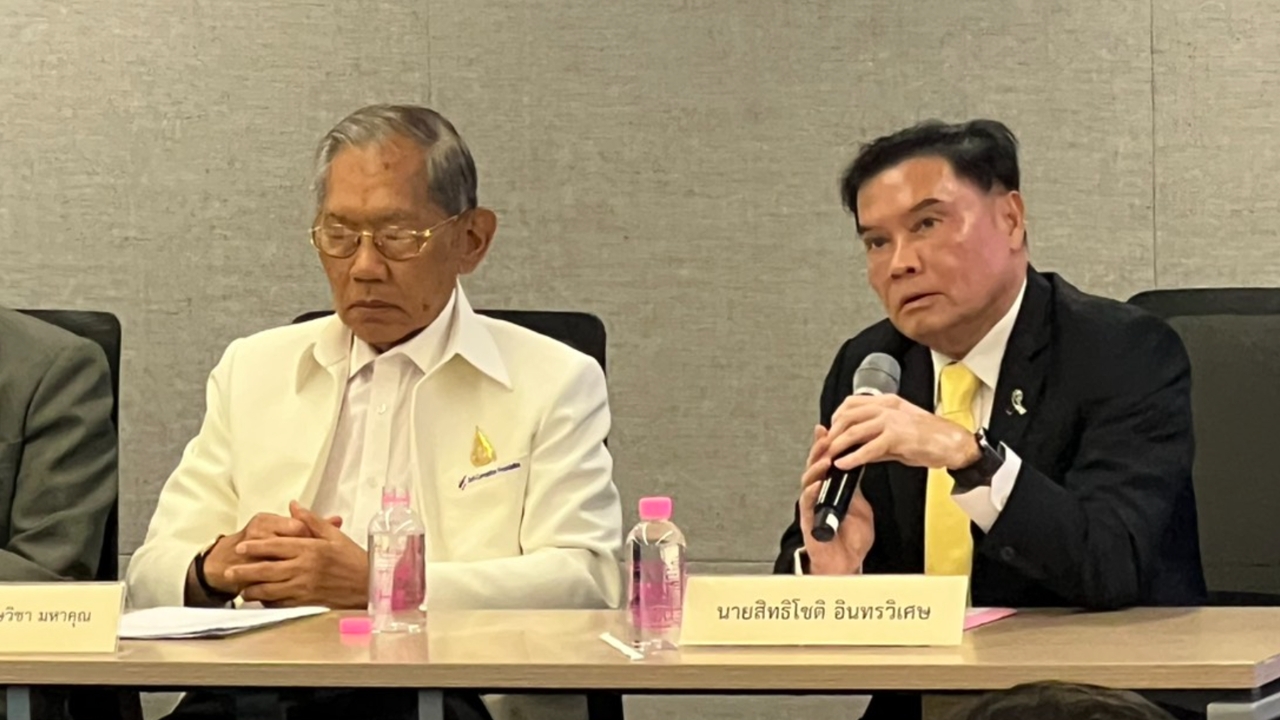
Sitthichot, the minority Election Commission member, explained his personal view on the Senate collusion case, noting signs of disorder from the very first day it was handed over to local administration. He pointed out the discovery of candidate notes scattered throughout the restrooms and clarified that Committee 36 is not a rival panel but rather a special seven-member subcommittee for case screening. Tags: [Election Commission, Senate Election, Collusion Case, Committee 36, Local Administration]
On 30 September 2026, the Royal Institute organized a seminar in collaboration with the Medical Council and the Royal Institute on the topic "The Senate Collusion Case: The Truth All Thais Should Know" to provide a platform for exchanging factual information on this important national issue. The event featured prominent figures including Mr. Kocham Areeya, former election commissioner; Mr. Charan Phakdeethanakul, former Constitutional Court president; Mr. Wats Tingsamit, former National Human Rights Commission chairman and senior Supreme Court judge; Mr. Wicha Mahakun, former National Anti-Corruption Commission member and former Supreme Court division chief; and Mr. Sitthichot Intharawiset, minority Election Commissioner and former Supreme Court election case chief, who all participated in the discussion.Tags: [Seminar, Senate Election, Royal Institute, Election Experts, National Issue]
Mr. Sitthichot spoke first, saying this was his first platform to share his views and that he would not discuss the matter elsewhere. He emphasized that his comments were personal opinions and did not involve or implicate any individuals. He explained that, according to the law, the structure for electing Senators involves three levels: district (928 districts), provincial, and national, with a total of 48,226 candidates divided into 20 occupational groups. However, the Election Commission has only about a thousand staff nationwide, making it impossible to manage all tasks directly. Therefore, the law delegates primary responsibility to local administration, with district chiefs chairing at the district level and provincial governors at the provincial level.Tags: [Election Law, Senate Election, Candidate Structure, Election Commission, Local Administration]
.Tags: [] He acknowledged that the confusion began at the registration stage because the law requires the secrecy of candidate names and numbers. In reality, local management processes involved manipulating occupational groups by transferring candidates to other groups when a group had few members, resulting in disorder and leaving the local administration genuinely in charge from the outset.Tags: [Election Registration, Candidate Secrecy, Local Management, Occupational Groups, Administrative Challenges]
There were complaints from Samut Sakhon province where a candidate registered under the “salt farmer” occupation ran in the agricultural group, leading to a petition to the Supreme Court to revoke the registration. The Election Commission clarified to the public that the Supreme Court dismissed the petition on procedural grounds, noting that the law allows candidates to select their group with proper documentation, and the district chief, as the initial election director, acted correctly. However, the Supreme Court's ruling did not guarantee the accuracy of the candidate’s actual occupation, which remains the Election Commission’s responsibility to investigate and decide based on evidence. He urged the public not to lose hope in the Election Commission’s ability to act.Tags: [Complaint, Candidate Occupation, Supreme Court, Election Commission, Investigation]
Mr. Sitthichot continued,Tags: [] During the national-level election held at IMPACT Muang Thong Thani, dishonest activities became evident. In the morning round of voting, officials found numerous “candidate introduction” notes discarded in restrooms, strongly indicating election collusion.Tags: [National Election, IMPACT Muang Thong Thani, Election Fraud, Evidence, Candidate Notes]
The Election Commission held an urgent meeting and addressed the problem in the afternoon by ordering a complete reprinting of candidate introduction sheets (S3 forms) to prevent outsiders’ documents from entering the voting area. However, a management error occurred because candidates were informed of this decision before being moved into groups, resulting in chaos where candidates hastily wrote notes on their arms and scraps of paper, as shown in publicly released videos.Tags: [Election Commission Response, Candidate Introduction Sheets, Voting Area, Management Error, Election Chaos]
Regarding public concerns over the establishment ofTags: [] the “26th Investigation and Inquiry Committee,”Tags: [Investigation Committee, Senate Election] Mr. Sitthichot explained that the Election Commission normally has 25 investigation committees. However, almost all complaints about the Senate election nationwide in the first 3–4 months were dismissed because evidence at the local level was insufficient, with interruptions in testimonies and witnesses unwilling to reveal financial trails. The Election Commission thus invoked its authority under the Election Commission Act to collaborate with three major agencies: the Department of Special Investigation (DSI), the Anti-Money Laundering Office, and the Royal Thai Police to form an investigative committee to leverage their expertise in tracing financial and phone communication data.Tags: [Investigation, Election Commission, DSI, Anti-Money Laundering, Police]
Although initially opposed in Election Commission meetings and reduced to a supporting subcommittee role, the Commission ultimately exercised its authority to officially establish the 26th Investigation and Inquiry Committee, comprising three DSI officials and six Election Commission staff, to retrieve case files and re-interview witnesses. Mr. Sitthichot also affirmed that a key witness in the 26th committee’s case (witness 16/26) had testified twice to the DSI and, when called for a third interview, reaffirmed consistent testimony despite time gaps. Therefore, claims that the witness was pressured later are unconvincing, which is why the minority commissioner trusted this testimony.Tags: [Investigation Committee 26, Witness Testimony, DSI, Election Commission, Case Review]

Regarding the process of summarizing the voluminous case files spanning tens of thousands of pages, the Election Commission normally has 35 subcommittees for case screening. However, since the Senate election case was special and of public interest, all seven Election Commissioners appointed one representative each to formTags: [Case Screening, Election Commission, Senate Election, Subcommittees, Special Case] the "36th Subcommittee on Resolution of Issues and Objections,"Tags: [Subcommittee 36, Election Commission, Case Resolution] to perform an additional layer of screening on the 26th committee’s findings before presenting to the full meeting.Tags: [Case Screening, Election Commission, Committee 26, Committee 36]
“Committee 36 was not established as a duplicate or to conflict with Committee 26 but to perform screening according to normal legal discretion and procedures. It was set up as a special seven-member panel for speed and thoroughness,” he explained.Tags: [Committee 36, Election Commission, Legal Procedure, Screening, Special Panel]
As for the factual matter, the chairman of Committee 36, appointed and elected by an Election Commissioner, did not convene a meeting for about 45 days after appointment. Mr. Sitthichot said he did not know the reason for the delay, but when asked, the explanation was that the chairman was abroad. This caused the committee’s review process to be delayed, and during that time, several commissioners were nearing the end of their terms, requiring new appointments. This is also a fact.Tags: [Committee 36, Delay, Election Commission, Leadership, Meeting Schedule]
Regarding individual opinions, he said he would not interfere as each member has discretion based on evidence. In reality, Committee 36 did not reject all findings and agreed with some parts of Committee 26’s work, though only a minority. Once Committee 36 completed its review, the case files were submitted to the full Election Commission meeting amid a tightening timeline.Tags: [Committee 36, Case Review, Election Commission, Minority Opinion, Timeline]
Mr. Sitthichot also referred to the Election Commission Office’s public statement denying any request or submission regarding financial trails during meetings, stating only that the case files were not accepted. The office admitted not accepting the files. This affected him somewhat, so he clarified that while the subcommittee was reviewing the files and was supposed to send them promptly to the Election Commission, the DSI notified that it had prepared a money laundering case file including photos, financial trails, and phone records involving about eight accused Senators.Tags: [DSI, Money Laundering, Senate Case, Election Commission, Financial Evidence]
At that time, the DSI informed the Election Commission that if it wished to review this evidence, it should pass a resolution requesting it, after which DSI would provide copies. This led to a 4-3 vote not to accept the files, with the majority reasoning that the files were not yet reviewed by Committee 36 and thus unknown, making acceptance premature.Tags: [Election Commission Vote, DSI Evidence, Committee 36, Financial Investigation, Decision]
Nevertheless, Mr. Sitthichot said the Election Commission’s duty is to collect evidence when a state agency submits it. Since Committee 26 had formally requested the evidence to analyze its usefulness in proving innocence or guilt, he believed analyzing it beforehand would benefit the Commission and allow it to use the evidence when needed. However, his view was outvoted. He concluded by saying,Tags: [Evidence Collection, Election Commission, Committee 26, Legal Analysis, Minority View] “What I say is the truth. I will not lie. I will only speak about what actually happened.”Tags: [Truth, Personal Statement, Election Commission, Integrity]