

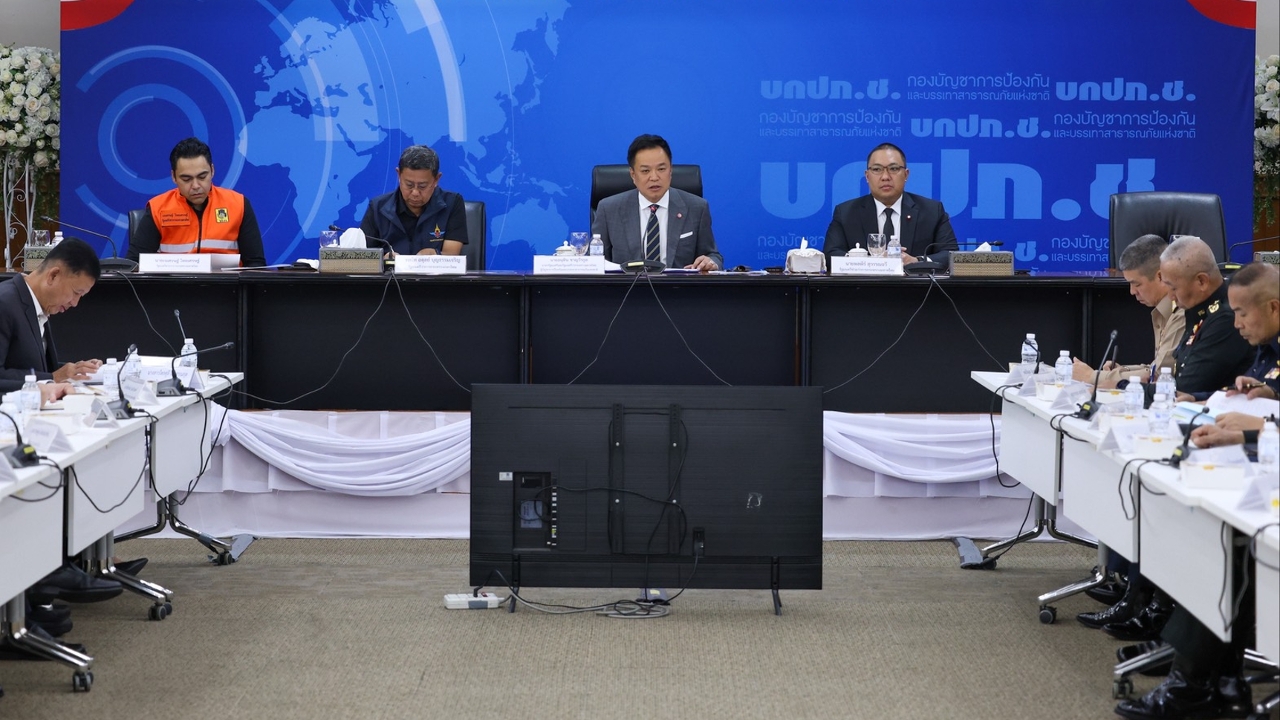
The government spokesperson declared that Anutin is prepared to reassign inactive civil servants involved in flood management to the Prime Minister's Office. He also requested the Bangkok Governor to extend work-from-home measures and instructed provincial governors nationwide to inspect the quality of donated food. Additionally, drainage pipes and dragon-shaped pumps are being mobilized to accelerate water drainage.
At 10:50 a.m. on 30 Sep 2026 at the Government House, Ekapop Pienpiset, spokesperson for the Prime Minister's Office, briefed on the flood situation, stating that rainfall across the country has decreased except for southern Thailand's lower region where rain continues but without water issues. Rainfall is expected to pause until 4–6 Oct. The north and northeast are transitioning seasons, possibly affecting the central region and Bangkok, but not with prolonged rainfall. According to Geo-Informatics and Space Technology Development Agency (GISTDA), flood-affected areas total 1.71 million rai nationwide.
Ekapop said flood-affected areas are receiving comprehensive support from the Department of Disaster Prevention and Mitigation, provinces, and various foundations. In Bangkok, water levels in canals have declined, with remaining flooding mainly on the east side. Following the Prime Minister's site visit with Bangkok authorities, water pumping has increased using small pumps and dragon-shaped pipes. Today, water at Khlong Chan flats has decreased by 30 centimeters.
He added that today marks the first working day after a National Disaster Prevention and Mitigation Command Center meeting to monitor flood response. Prime Minister and Interior Minister Anutin Charnvirakul consulted with the Bangkok Governor, urging extension of work-from-home measures to facilitate efficient water drainage. He emphasized improving transportation support by increasing public transit and arranging additional trips to help flood-affected residents commute to work.
Ekapop noted that on 29 Sep, on the west side, dams in Kanchanaburi—Sri Nakarin and Vajiralongkorn—resumed normal water releases after a three-day pause, continuing from 30 Sep to 4 Oct. This will raise water levels by 80 centimeters along the banks of the Mae Klong River, so residents there should consider evacuation or moving to shelters by coordinating with provincial authorities. Kanchanaburi, Ratchaburi, and Samut Songkhram provinces have issued warnings. On the east side, Prachinburi Province's Mueang district is at peak water levels, which will merge with Nakhon Nayok Province, where Khun Dan Prakan Chon Dam's water has decreased and is no longer overflowing. Attention is also needed in Chachoengsao Province, especially along the Bang Pakong River, where residents should closely monitor conditions over the next 1–2 days.
The Prime Minister's Office spokesperson reported that the Ministry of Public Health has provided care for over 52,000 vulnerable individuals. Hospitals affected include Chaophraya Abhaibhubejhr, Klaeng, and Ban Khai Hospitals in Rayong Province, which continue partial services. Red-category patients at Chaophraya Abhaibhubejhr Hospital are being transferred to nearby facilities. Nationwide fatalities total 40. The Prime Minister has ordered vigilant monitoring and warnings, closely tracking water levels in Ratchaburi, Samut Songkhram, Kanchanaburi, and Chachoengsao provinces. The Department of Disaster Prevention and Mitigation is preparing equipment to accelerate drainage and mobilizing portable toilets from local authorities in unaffected areas to flood zones.
He further stated that the welfare of shelters and mental health care for residents are priorities. Provincial governors are reminded to ensure donated food and beverages meet quality standards and to submit daily situation reports to the Ministry of Interior's Permanent Secretary. The Prime Minister's Office spokesperson confirmed that data is verified for accuracy and consistency.
The spokesperson also discussed the Chainat-Pasak-Gulf of Thailand drainage project approved by the Cabinet on 29 Sep to manage water in Phra Nakhon Si Ayutthaya, Ang Thong, Sing Buri, Chainat, Lop Buri, and Saraburi provinces, preventing them from becoming recurrent flood basins. At the Cabinet meeting, the Prime Minister instructed administrative and operational officials to cooperate fully; non-cooperation may result in reassignment to the Prime Minister's Office. The expectation is for unified, efficient action to restore normal life promptly.
Ekapop explained that various civil service agencies—including the Royal Irrigation Department, Department of Disaster Prevention and Mitigation, Office of the National Water Resources, Hydro-Informatics Institute, and provincial authorities—are active in the field. The Prime Minister stressed at the Cabinet meeting that if ministry-level directives are not followed or do not align with leadership, he will exercise authority to recall non-compliant personnel to serve at the Prime Minister's Office.
When asked why today's briefing could not specify when floodwaters in Bangkok would recede—contrasting the 29 Sep estimate of 2–3 days for water reduction and normal traffic—Ekapop said overall water levels are expected to drop by over 90% in the coming 2–3 days. Some 300–400 small pumps have been deployed into communities to expedite drainage toward the Gulf of Thailand, reducing internal flooding. However, exact timing for full drainage is uncertain but efforts will be as swift as possible.
Asked if the expected rainfall on 4–6 Oct and incoming upstream water would hinder Bangkok's drainage, Ekapop emphasized that rainfall has already left Bangkok and existing water is draining. The Bangkok Governor reports improved drainage efficiency; canals that were full are now lowering, allowing water flow. Concerns about backflow from the Chao Phraya River are addressed: current water management in northern provinces shows only slight increases from the Ping and Nan Rivers, and the Sakae Krang River's flow into Chao Phraya is stable. Dam discharge from Chao Phraya Dam in Chainat is at 2,200 cubic meters per second, adjustable up to 2,500. Flow reaches Ayutthaya's Bang Ban and Bang Sai districts.
Ekapop stated that flooding in Bangkok due to river backflow would require a flow of 3,000 cubic meters per second, but current levels at Bang Ban and Bang Sai are 2,100, leaving 900 cubic meters per second capacity. The 4–6 Oct rainfall is seasonal transition rain, not prolonged heavy rain, so it is unlikely to increase Chao Phraya River water volumes significantly.
He added that government offices currently flooded, such as the Sports Authority of Thailand and military areas, are not yet being pumped out. Priority remains draining water from residential areas first, with government premises addressed last. Regarding the Mae Klong River's 80% water increase from dam releases in Kanchanaburi, residents along riverbanks should monitor local conditions and elevate belongings.
Deputy spokesperson Lalida Pertwiwatana reported that Bangkok is accelerating water level reduction around Lat Krabang area by pushing water with boats and pumping into Pravet Buri Rom Canal, aiming for rapid drainage. She advised residents to avoid routes with severe flooding, including Suwinthawong Road (between Min Buri and Hatha Rat intersections), Lat Krabang near Lotus Lat Krabang, Nawamin Road, Bang Kapi intersection, Lat Phrao 113 intersection, Happy Land intersection, Bang Kapi intersection, Happy Land 1 Road, and Sri Burapha Road.
Lalida added that 15 districts with high flood impact affecting 748 communities include Khlong Sam Wa, Khan Na Yao, Chatuchak, Bang Khen, Bang Kapi, Bueng Kum, Prawet, Min Buri, Lat Krabang, Wang Thonglang, Suan Luang, Saphan Sung, Sai Mai, Nong Chok, and Lak Si. Bangkok has dispatched mobile medical units providing physical and mental health care to all communities and is reallocating personnel from less affected districts to support heavily impacted areas.