

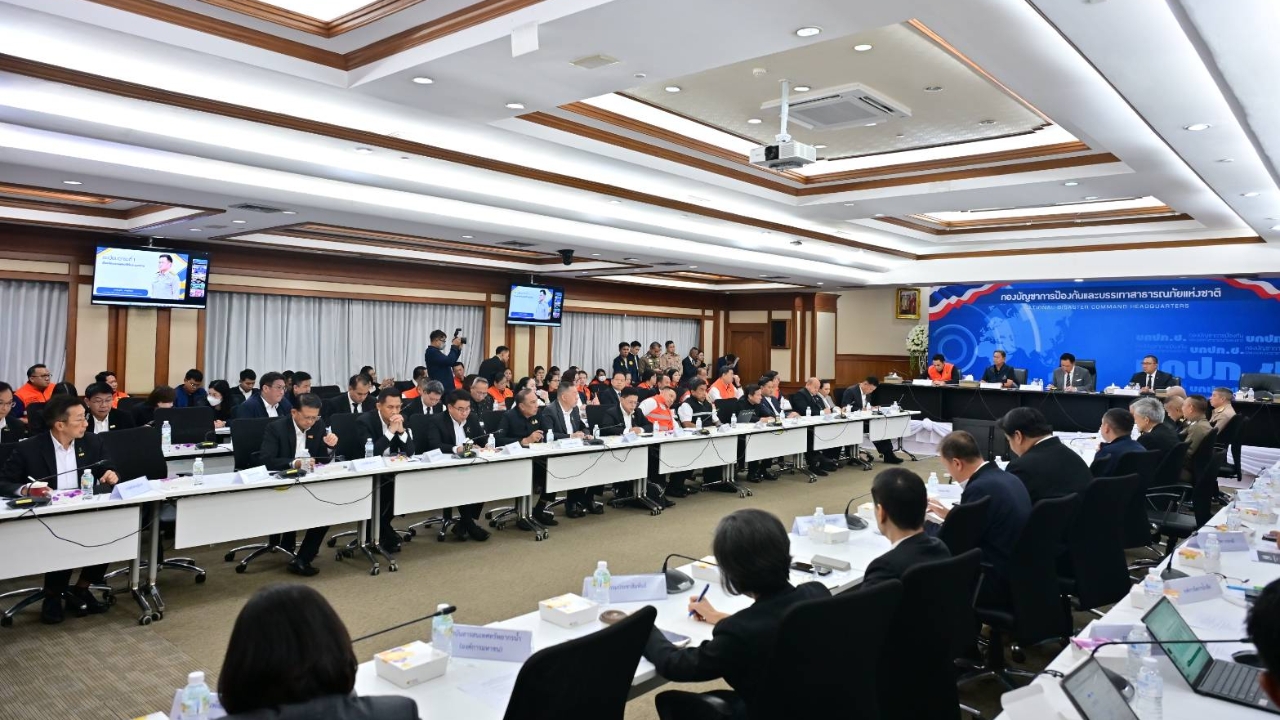
"Je-set" rehearsed with governors nationwide to advance the "Government Project to Purchase Disaster Insurance for the People," covering 30 million households, with coverage starting 1 October 2026.
On 30 September 2026, Je-set Thaiset, Deputy Minister of the Ministry of Interior, chaired a briefing on the Government Project to Purchase Disaster Insurance for the People via video conference to governors of 76 provinces. Executives from the Ministry of Interior, Department of Disaster Prevention and Mitigation (DDPM), Office of Insurance Commission (OIC), and the Thai General Insurance Association (TGIA) also attended.
Je-set stated that the government aims to enhance proactive risk management to international standards, reducing central budget burdens for disaster relief and enabling rapid aid to citizens after disasters. Insurance coverage will begin at 00:00 on 1 October 2026. However, coverage excludes areas already declared disaster zones, which will continue under the previous DDPM assistance criteria.
Teerapat Kachamat, Director-General of DDPM, and Chuchat Pramulpol, Secretary-General of the OIC, explained the project covers housing structures for 30 million households nationwide against three disaster types: floods, windstorms, and earthquakes, once assistance zones are declared. For floods, citizens receive an immediate compensation of 10,000 baht and actual damage compensation up to 90,000 baht. For windstorms and earthquakes, an initial payment of 5,000 baht is made.
Kanlaya Jukhom, Deputy Executive Director of TGIA, explained the claim process: citizens should prepare photos of damage, proof of ownership, and a PromptPay account. Claims can be submitted via four channels: the website www.thainetcat.org, Line @THNCat, Call Center 02-012-5555 (with 300 lines), and local reporting points. Relevant agencies will promptly produce public relations manuals for citizen awareness.

Water drainage operations in Chachoengsao: orders to “Warn early – Assist promptly – Restore quickly.”
Later, Je-set visited Chachoengsao Province to monitor the situation and hold discussions on response strategies. He instructed provincial authorities to closely track the situation, especially transportation routes at risk, and to issue advance warnings to citizens via Cell Broadcast and local communication channels, enabling timely travel planning and avoidance of risky routes.
Regarding water management, Je-set reviewed operations in the Bang Pakong River Basin, where the Nakhon Nayok and Prachinburi rivers converge before flowing into the Bang Pakong River and out to the Gulf of Thailand. Efforts are underway to install additional water pumps at the basin's outlet to enhance water discharge efficiency to the sea, with maximum planned capacity of 26 million cubic meters.
The area requiring special monitoring is the western side of Chachoengsao Province, adjacent to Bangkok, due to potential impacts from water accumulation and discharge. Continuous monitoring of water levels and transportation routes is necessary, with preemptive measures prepared. Je-set emphasized the principle that “field personnel know best.” If additional assistance or resources are needed, immediate notification is required so central agencies can support accordingly, especially regarding water supply and potable water systems. Any problems or additional needs must be reported promptly to ensure uninterrupted assistance, following the approach: “Warn early – Assist promptly – Restore quickly.”