

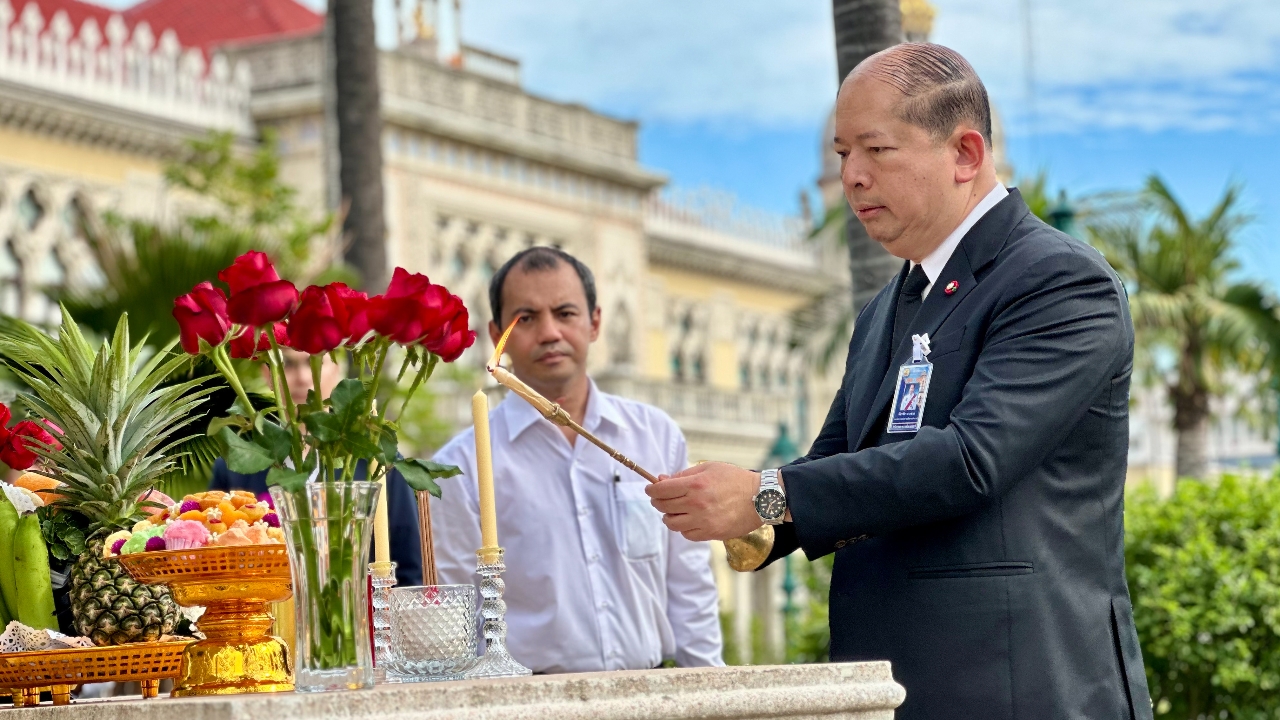
Chatichai paid respects at the Government House sacred shrine on his first day as Permanent Secretary to the Prime Minister’s Office. He revealed that the office will support flood relief through the compensation fund and will expedite the amnesty process, entrusting "Sergeant Pu Duang" to continue work at the National Security Council.
On 1 October 2026 at 08:00 hours. Mr. Chatichai Bangchuad, Permanent Secretary to the Prime Minister’s Office, visited the guardian spirit and ancestral shrines at Government House before starting his first day in office. Chatichai said he would continue the work laid by his predecessor, having formally taken over the position on 30 September 2026.
Chatichai further stated that in terms of assisting citizens affected by floods and other disasters, the Prime Minister’s Office has a fund to help the public, with criteria for compensation payments. It also handles complaints from citizens. He has been familiar with this role from his time as Secretary-General of the National Security Council (NSC), coordinating closely with the Prime Minister’s Office when individuals or organizations brought complaints, often sending NSC representatives to meetings.
Regarding the current flooding, the Department of Disaster Prevention and Mitigation (DDPM) will be the main coordinating agency. Chatichai said he would discuss with PMO executives preparations for relief from various relevant funds, acknowledging that the PMO will play a key role in driving this effort.

Chatichai also revealed that on 30 September, he handed over his duties to General Chaiyapruk Duangpraphet, the new NSC Secretary-General. He entrusted several matters to be continued, as NSC work covers multiple aspects of national and international security, working alongside the Ministry of Foreign Affairs on security and international cooperation. Importantly, human security is a sensitive area requiring balance between human rights and national security. He has briefed General Chaiyapruk, who has relevant experience and is expected to continue this work effectively.
Additionally, as a committee member and secretary of the Committee for Building a Peaceful Society under the 2026 Act on Building a Peaceful Society, Chatichai reported progress: the committee has met once, appointed subcommittees for case screening and public relations, and is moving to receive and review cases according to announced criteria.

When asked if any petitions have been submitted regarding obstacles to filing amnesty requests, Chatichai said the mechanism will assess any limitations. The case screening subcommittee, chaired by the Permanent Secretary of the Ministry of Justice, and the public relations subcommittee, chaired by Chatichai, will handle explanation and dissemination of guidelines to foster understanding among individuals and organizations submitting requests.
Regarding the schedule for the second meeting, Chatichai said it should be soon because there is a 180-day legal timeframe to complete the process. Although extensions are possible, acting quickly benefits those affected in recent times.
On whether this marks the start of fostering unity and reconciliation, Chatichai said he believes so, noting the law’s intention is to build reconciliation positively and constructively. However, submissions must be carefully screened to ensure fairness and proper adherence to criteria for all parties involved.
