

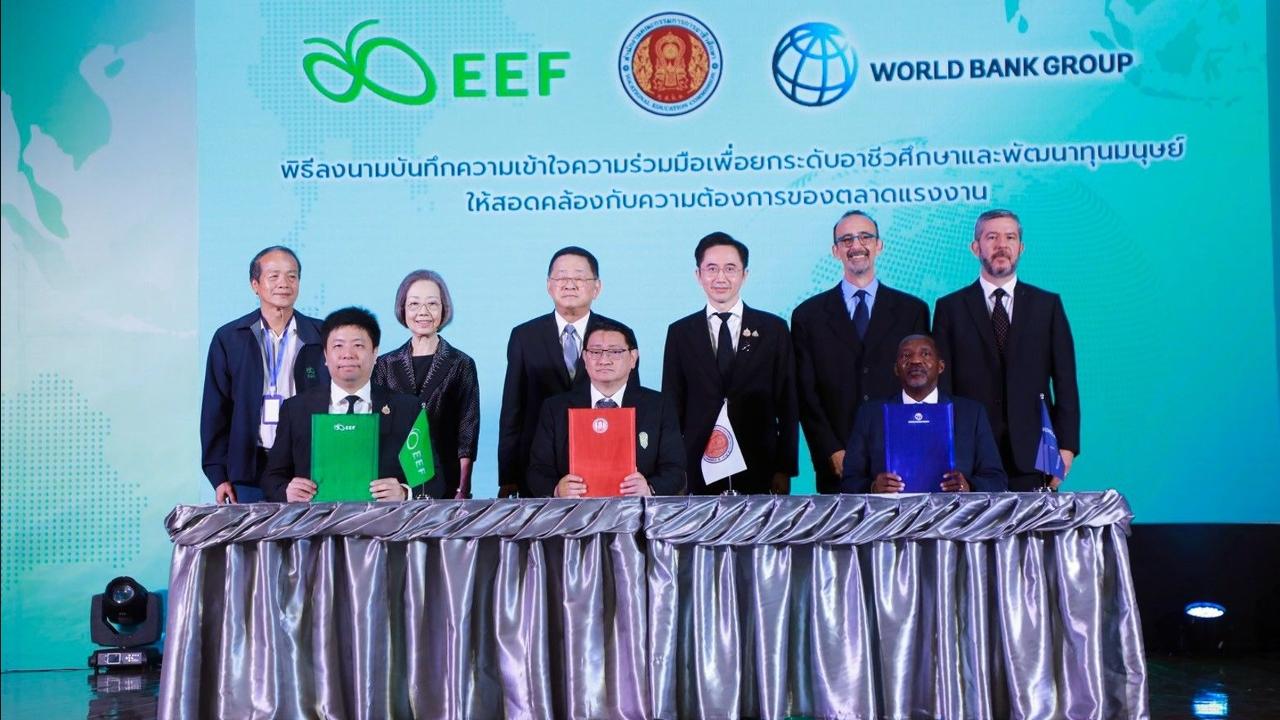
The Equitable Education Fund (EEF) partners with the Office of Vocational Education Commission (OVEC) and the World Bank to enhance vocational education, connecting Thai skills to the labor market and using data to drive workforce development policies. Minister Prasert highlights vocational education as a primary future option.
On 1 Oct 2026 GMT+7, the Equitable Education Fund (EEF) and the World Bank held a High-level Policy Forum titled “Unlocking Thailand’s Future: Transforming Education and Training to Drive Productivity, Innovation, and Growth.” The event provided a platform to exchange knowledge and perspectives on skill challenges, explore policy directions, and discuss the roles of public and private sectors in developing future labor. The goal is for Thailand to become a high-income country, address educational inequality, and consider diverse voices across age groups on skill development, employment, and income generation aligned with the evolving economic and social context. Policy approaches requiring multi-sector cooperation were also presented.
A key collaboration emerging from this event is among the Equitable Education Fund (EEF), the Office of Vocational Education Commission (OVEC), and the World Bank to elevate Thailand’s vocational education system. The aim is to develop a workforce aligned with changes in the working world and labor market demands. The three parties signed a five-year Memorandum of Understanding (MOU) to advance vocational education and training management, focusing on developing foundational skills for learners and teachers alongside linking skill development to labor market needs. This partnership emphasizes using data, knowledge, and empirical evidence as a foundation for policy and practice development to ensure practical and scalable vocational education improvements.
The event featured Professor Dr. Yossanan Wongsawat, Deputy Prime Minister and Minister of Higher Education, Science, Research and Innovation, and Mr. Prasert Jantrawutthong, Minister of Education. Also present were Khunying Kasama Worawan Na Ayudhya, Deputy Chair of the EEF Executive Committee; Professor Dr. Sompong Jitradab, EEF Executive Committee member; Dr. Kraiyas Patrawat, EEF Manager; Ms. Thanthida Wongprasong, Director of Innovation Development for Learning Opportunities; Dr. Stephen N. Ndegwa, World Bank Country Director for Thailand and Myanmar; Dr. Luis Benveniste, World Bank Regional Director for Education, Skills, Health, and Social Policy; Mr. Alejandro Alcala-Garres, World Bank Operations Manager for Thailand and Myanmar; and representatives from education, labor, business sectors, and related partners.

Dr. Kraiyas stated that the core of this collaboration is human capital development, urgently building and enhancing the future workforce by strengthening foundational life skills. These include reading comprehension to understand information and learn new things, technology and digital tool use to access information and job opportunities, and socio-emotional skills such as self-awareness, emotional regulation, communication, and teamwork. Studies by the EEF and the World Bank identify these as essential skills across all ages, professions, and contexts for learning, work, and social life, offering a worthwhile return on investment. In addition to foundational skills, promoting future skills like STEM and AI is crucial to drive economic strength and support Thailand’s progression to a high-income country. Over eight years, the EEF has collaborated with the World Bank to advance the human development agenda through high-quality policy research and addressing intergenerational poverty and the middle-income trap by combining global knowledge with investment in child and youth human capital.
Dr. Kraiyas added that an example of applying global knowledge is the ongoing collaboration among the EEF, the World Bank, and the Office of Vocational Education Commission (OVEC) to prepare youth for life and work by producing a workforce that meets employer needs. This involves promoting Social and Emotional Learning (SEL) for students in vocational institutions. So far, 225 master trainers and lead teachers from 25 vocational schools nationwide have been trained, alongside developing an SEL teaching strategy curriculum incorporated into OVEC’s teacher development program via e-training.
Meanwhile, the Doing Business in TVET (DOBIT) project will continue to study the gap between labor market demands and skills and the capacity of the vocational education system. It works with schools and enterprises in target industries such as advanced manufacturing, digital services, creative industries, agriculture, health, and tourism. The project aims to develop cooperation models between vocational education and the private sector and support schools in becoming skill development centers effectively linked with industries.

Dr. Stephen N. Ndegwa said, “Thailand’s transition to a high-income country depends on ensuring people have the necessary skills to access better, more productive jobs amid economic changes. Upgrading vocational education and closely linking skill development with industry will help reduce skill gaps, increase productivity, and enable Thai workers and businesses to adapt to new technologies and emerging industries. This collaboration will bring together data, empirical evidence, and experiences from educators and employers to develop a skills system that supports inclusive growth for Thailand’s next phase.”
This partnership aims to connect “human development” with “economic development” through an education system that meets the skills needed for the modern workforce. It uses data and evidence as the basis for policy design and fosters cooperation among educational institutions, businesses, and government agencies to increase opportunities for learners and workers to develop skills and successfully enter an evolving labor market.

Mr. Prasert Jantrawutthong, Minister of Education, witnessed the MOU signing ceremony and delivered policy remarks, stating that vocational education is not a secondary choice but a primary pathway for Thailand’s future. It provides young people with jobs, income, and professional qualifications and is vital for building a skilled workforce aligned with economic needs to enhance the country’s competitiveness. He emphasized that the rapidly changing world of work means skills learned today may become obsolete tomorrow, so learners must have strong foundational skills such as reading comprehension, problem-solving, digital tool use, collaboration, and lifelong learning readiness.
The Minister continued that the five-year cooperation framework outlined in the MOU will be driven by three main missions: strengthening learners’ skills, enhancing and empowering teachers, and creating equitable educational opportunities to ensure students from low-income families and remote areas have equal chances to learn and succeed.
“In this partnership, each agency contributes its strengths: OVEC connects the network of vocational colleges nationwide, the EEF supports access for the most vulnerable target groups, and the World Bank brings international knowledge and experience to reinforce these efforts. Together, they aim to create a model for Thailand’s development based on empirical data and aligned with reality, moving from policy to practice, from classrooms to career paths, and expanding equitable educational opportunities for all,” said the Minister. .
