

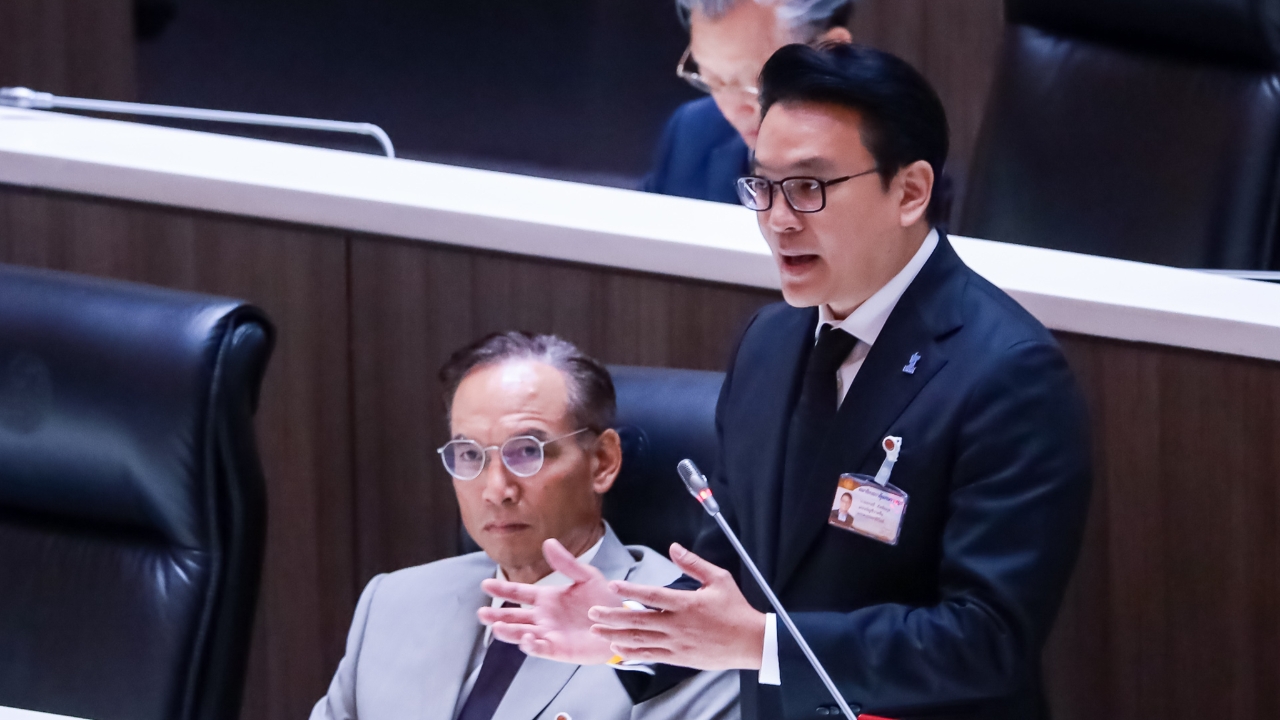
Sakolthee points to baggage backlogs and flight delays, stating that Thai Airways' ground services management has failed in crisis handling and customer service, leaving passengers stranded and damaging the country's reputation. He urges the Ministry of Transport to proactively compensate affected passengers and to reconsider the 25-year long-term ground services concession contract.
On 1 Oct 2026 GMT+7, at the Parliament building during a session of the House of Representatives, a live oral question session was held. Sakolthee Pattiyakul, party-list Member of Parliament from the Democrat Party, submitted a live question to Phiphat Ratchakitprakarn, Minister of Transport, regarding the crisis in ground services of Thai Airways Public Company Limited at Suvarnabhumi Airport. The issues include flight delays, accumulating passenger baggage backlogs, and the announcement to suspend cargo services, all causing severe damage to Thailand's tourism image and national reputation.
Sakolthee said that although Thai Airways is no longer a state enterprise, it remains the national airline closely tied to the country's reputation. Since 26 September, there has been chaos at Suvarnabhumi Airport, including baggage delays of 6-8 hours without passenger notification, instances where flights departed without passengers' baggage, an accumulation of over 10,000 delayed bags, and cancellations of approximately 40-50 flights—constituting a complete failure.
"No one else can be blamed; Thai Airways must take responsibility. The CEO may excel in financial restructuring to profitability, but in crisis management and service, he has failed utterly. He seemed heartless, abandoning ground staff who had to face passenger complaints to the point of tears, while management failed to timely oversee and address the problems on site," he stated.
Sakolthee recounted the timeline, noting that the Meteorological Department and the Civil Aviation Authority of Thailand (CAAT) issued advance warnings about heavy rain. Other airlines managed well, but Thai Airways sent ground staff home. When baggage backlog occurred, they could not swiftly recall staff to manage operations. Additionally, he revealed that Thai Airways prioritized service to contracted partner airlines out of fear of fines, effectively abandoning their own passengers. He posed three key questions to the Ministry of Transport and the government:
1. The causes of the problem and delay in resolution: Why did the Ministry of Transport, which has board representatives, and the Ministry of Finance, the major shareholder, allow the crisis to persist for five days before the Minister of Transport visited the site?
2. Proactive passenger compensation measures: How will the government and Thai Airways compensate Thai and foreign passengers for damages? He urged them not to cite force majeure due to natural disasters to avoid responsibility and to cover costs including ticket changes and wasted hotel expenses from missed connections. He also called for Thai Airways to proactively use its passenger database to directly contact affected customers with compensation offers rather than waiting for claims.
3. Review of the long-term ground services concession contract: He urged the government to reconsider the approval of the over 70 billion baht third-party ground services concession contract passed by the Cabinet on 9 September, which is planned for a 25-year duration. He viewed this period as too long for a service contract and called for shorter terms with transparent KPI details disclosed to Parliament and the public to prevent future monopolies and inefficiencies.
Siriwong Angsakulkiat, Deputy Minister of Transport, delegated by the Minister of Transport, acknowledged seeing ground staff bear pressure from passengers. He affirmed that the Ministry did not neglect the issue and held continuous discussions, though these did not receive media coverage. Officials were sent to assist on 27 September. He agreed delays were due to servicing other airlines first. The Ministry is increasing staff support. Past contracts, obtained 35 years ago, do not include penalties, and 15 years remain on the existing concession, so imposing fines now might violate the contract. However, the new third-party contract will include penalty clauses for delays. Regarding passenger compensation, payments are set at 270,000 baht per case for delays or cancellations, 6.5 million baht for deaths, and 65,467 baht for lost baggage. Thai Airways has confirmed it will take responsibility beyond legal requirements.