

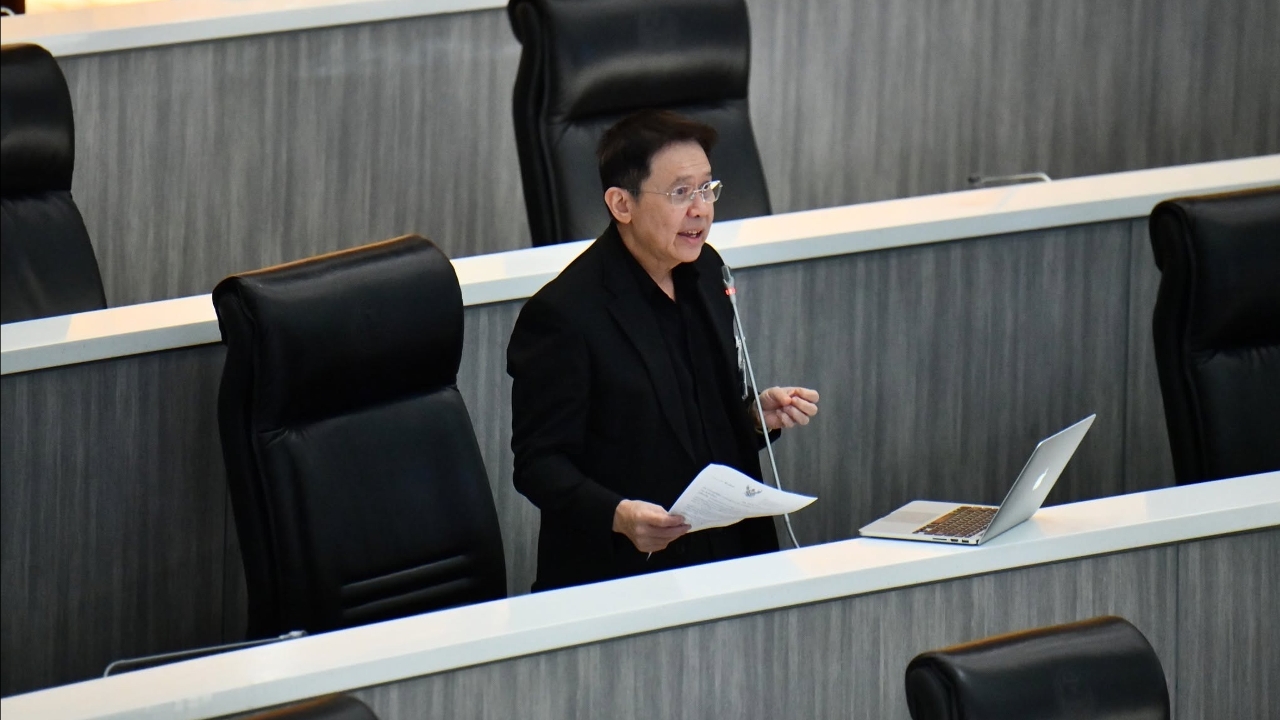
Senator Suntorn echoed the voices of flood victims, urging the government to upgrade the early warning system and criticizing state agencies for lacking a 'Sense of Emergency' after issuing flood warnings at 1 a.m. when people were unaware and drowning.
On 1 Oct 2026 GMT+7, during a Senate meeting to consider a motion to establish a special committee for studying sustainable water management, Senator Suntorn Pruksapipat spoke up. Reflecting his experience as a flood victim, he raised policy questions about the efficiency of water management and early warning systems, noting government agencies’ lack of urgency during crises.
Senator Suntorn pointed out that flooding is an engineering and drainage management issue. Citing data from the Royal Irrigation Department showing the average water level in the Chao Phraya River at about 1.2 meters—over one meter below flood embankment levels (2.2–2.9 meters)—he noted severe urban and community flooding, indicating water could not drain properly into the main river. This suggested blockages or that the large drainage tunnels were not operating at full capacity.
“They claim the giant tunnel operates at 50–60%, but what is the actual percentage? The government funds it fully, yet results fall short. I propose installing CCTV inside the giant tunnel so the public and agencies can monitor in real time whether water is flowing,” Senator Suntorn said. Senator Suntorn stated:
Warning at 1 a.m. while citizens drowned unaware.
Senator Suntorn criticized the administration’s warning mechanisms as lacking proactive situational awareness. He said mobile phone alerts sent at 1 a.m. do not effectively reduce damage because people are asleep; by morning, property and vehicles are already flooded. He argued that if weather forecasts could predict floods earlier, proactive field measures—such as loudspeaker vehicles or megaphones in communities—should be used to wake residents and alert them to evacuate and move valuables promptly.
Ending the era of spoiled meal boxes at shelters.
Towards the end, Senator Suntorn called on administrators and policymakers to manage disasters based on two key principles: (1) Common Sense, meaning listening to and respecting on-site experts’ decisions without interference in areas beyond their expertise,
and (2) Sense of Emergency, meaning awareness of citizens’ distress and prioritizing effective aid distribution to prevent system failure, such as having thousands of spoiled meal boxes left undelivered to victims.
“All authorities, especially top leaders, must be the first to have a Sense of Emergency, genuinely caring about the people's suffering, not allowing repeated damage while citizens wake up to unpreparedness,” Senator Suntorn said. Senator Suntorn Pruksapipat concluded.