

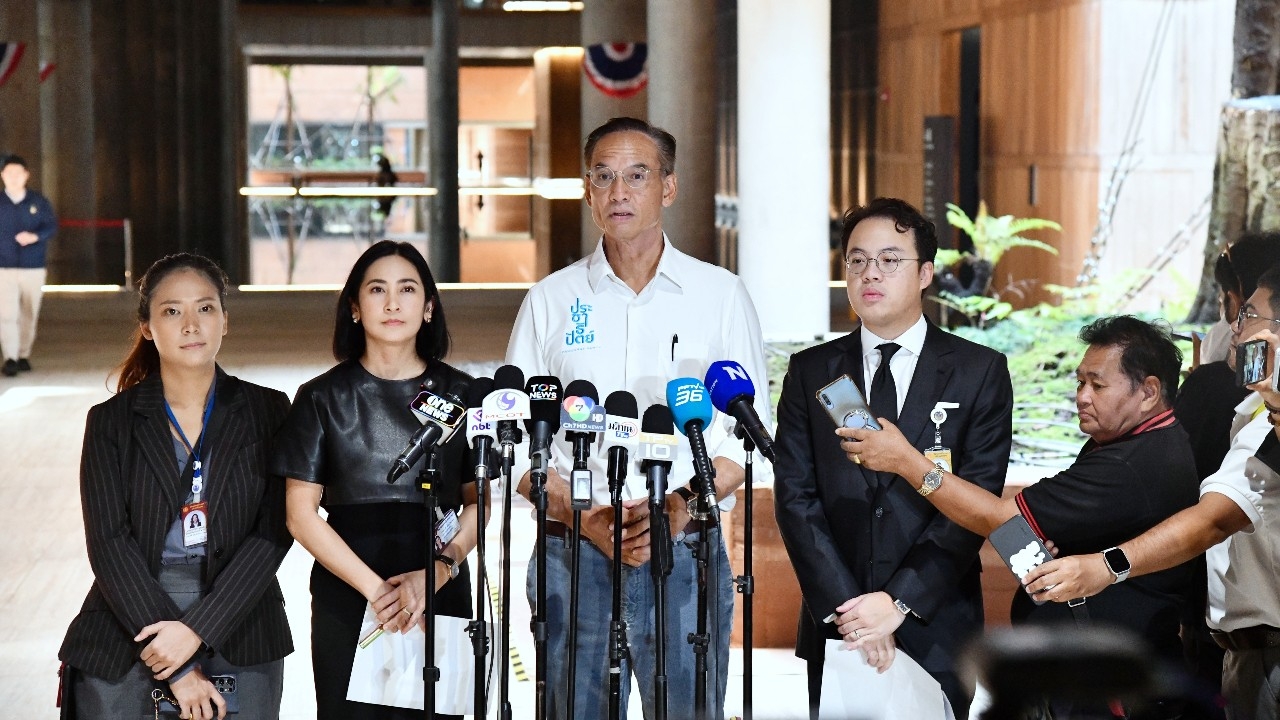
The Democrat Party's economic team urges the government to promptly issue measures to support the "urban poor and small SMEs," advocating for interest-free loans for 3 to 6 months ranging from 20,000 to 200,000 baht per person to prevent slipping into the vicious cycle of informal debt.
At 10:00 a.m. on 2 October 2026 at the Parliament, Korn Chatikavanij, Naree Liewpiroj, party-list MPs and deputy leaders of the Democrat Party, along with Teerarat Sirichantaropas, the party's energy economics team, held a press conference calling on the government of Anutin Charnvirakul to urgently implement relief and grassroots economic recovery measures. Although flood levels in many areas have begun to recede, citizens and small traders face a crisis of lacking working capital to resume their livelihoods.
Mr. Korn stated that over the past week, Democrat Party members assisting flood victims found widespread damage affecting shops, restaurants, and vehicles such as cars and motorcycles, which are key livelihood tools. Particularly, daily wage earners lost nearly a full week of income, depleting their savings and reserves. Restarting businesses requires funds for cleaning, repairs, purchasing equipment, and restocking. Without access to formal credit, people risk falling into the informal debt cycle, as happened in the 2011 flood crisis.
Mr. Korn illustrated the difference between formal and informal borrowing using a 200,000-baht loan over two years. A proposed Soft Loan from the Government Savings Bank would have 3–6 months interest-free, then a 7% annual interest rate, resulting in about 11,000 baht total interest and 210,000 baht total repayment. In contrast, informal loans charging 5% monthly interest would require paying 10,000 baht monthly interest alone, totaling 240,000 baht interest over two years—exceeding the principal, which remains unpaid. The Democrat Party thus proposes the government direct the Government Savings Bank to immediately release loans from 20,000 to 200,000 baht to flood victims, leveraging the bank’s existing database of small traders for rapid processing.
Ms. Naree said that according to the Thai Restaurant Association, the average daily income of small restaurants is about 5,000 baht. A 5–7 day halt is extremely difficult. She proposed the government simplify relief procedures by 1) using existing data and location information from programs like 'Thai Chuey Thai Plus' and 'Khon La Khrueng' to directly link to the Government Savings Bank for immediate loan approval without restarting the process, and 2) expanding relief scope to cover livelihood tools such as vehicles and equipment, not only building structures.
Meanwhile, Mr. Teerarat called on the government to fulfill its campaign promise regarding the disaster fund, which pledged to use AI to verify data and promptly pay 100,000 baht relief. He urged the government to 'talk and act' so that aid reaches those in hardship effectively.
When asked about relief for migrant workers and tenants in flooded areas of Bangkok and its vicinity—since compensation is usually paid to property owners rather than actual tenants—Mr. Korn said the government must shift its approach from property-based relief to person-based relief. Although tenants or residents of flats do not hold property ownership or house registrations, their lives and livelihoods are genuinely affected by floods, so ownership proof should not be a barrier to assistance.