

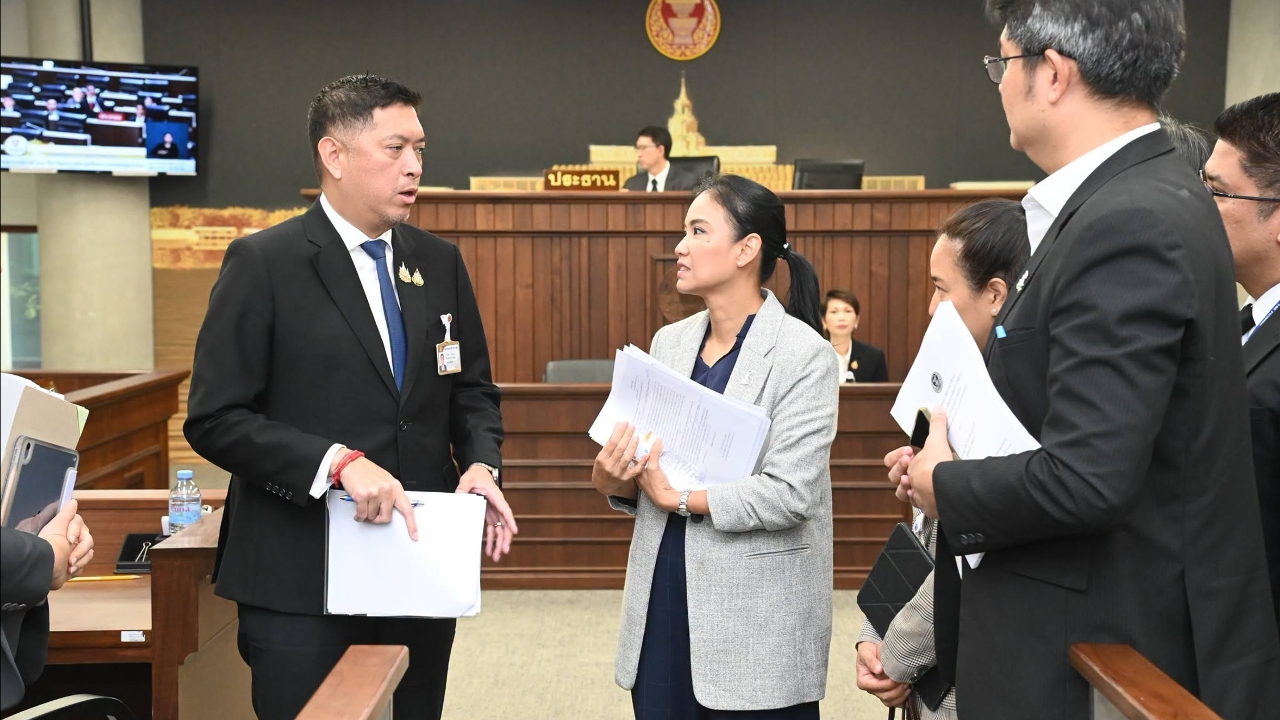
Radklao pushes the Ministry of Social Development to overhaul support systems for single-parent families, unlocking the crisis of lost opportunities and focusing on reducing inequality.
On 2 Oct 2026, during the House of Representatives session held on 1 Oct 2026, under the agenda reviewing a separate question on "Measures to promote welfare and improve the quality of life for single-parent families," Radklao Intawong Suwankhiri, a party-list MP of the Democrat Party, raised questions to the Minister of Social Development and Human Security to highlight problems and policy suggestions to aid vulnerable groups like single-parent families nationwide.
Radklao stated that statistics show a large number of Thai women, nearly 80–90% of vulnerable groups, are single mothers bearing the sole responsibility of raising children and earning income alone. Moreover, following Thailand's equal marriage law, the definition of single-parent families now extends beyond women to include single fathers and LGBTQ+ groups, many of whom face severe financial shortages.
Radklao therefore posed three key questions to the government regarding finances, time, and policy.
1. Regarding finances and housing: Does the government plan to establish a dedicated fund or enhance welfare to assist all single-parent families across genders with expenses and housing?
2. Regarding time and work: Does the government have policies to collaborate with the private sector to implement flexible working hours or create a work environment that understands the burdens of single-parent families?
3. Regarding policy measures, divided into three subcategories: 1. Welfare—how does the government plan to integrate currently scattered welfare services across agencies to improve accessibility? 2. Economy and self-development—how will the government support skill enhancement (Reskill/Upskill) and health care for single parents constrained by time? 3. Child support law—will the government provide legal assistance to caregivers when former spouses breach child support agreements, to avoid additional legal burdens?
In her second round of questioning, Radklao emphasized that although the Ministry of Social Development operates job creation centers, the real limitation for single-parent families is time, as they cannot leave children unattended, making it practically impossible to work.
Radklao proposed three solutions and observations:
1. Loss of Opportunity: From discussions with the Japanese embassy, the decline in newborns is not only due to financial issues but also lost life opportunities. Having accessible, quality childcare centers is a key unlock to enable parents to work while raising children.
2. Extend childcare center hours: Most state childcare centers operate during government office hours (around 4 p.m.), which does not align with workers' actual end times (5–6 p.m.), risking job loss or penalties for parents who must leave work early to pick up children.
3. Promote model childcare centers: She urged parliament to serve as a model organization by establishing childcare centers for officials' and MPs' children and requested the Ministry of Social Development to expand this model nationwide.
Radklao also proposed urgent policy measures, requesting universal newborn child allowance payments (for children under six) and consideration of directing aid payments directly to children, citing a heartbreaking case from fieldwork.
"I encountered a grandmother pushing a trash cart selling goods with a two-year-old child suffering from severe wounds, blackened nails, oozing blood and pus, and flies all over. When trying to help, structural rights issues arose because the child's mother had left to start a new family and abandoned the child. The grandmother used the child to beg, and when attempting to transfer the child's medical rights to treat wounds, it was impossible since the law requires the biological mother to apply, who could not be located," Radklao said.
She concluded by urging the Social Development Minister to urgently resolve complex laws and procedures so that bureaucratic obstacles do not hinder protecting the welfare and lives of neglected children in society.
The Social Development Minister immediately requested details of the child's case from Radklao to dispatch a multidisciplinary team for urgent welfare protection. The minister confirmed that the ministry is accelerating projects to link vulnerable group databases internally and negotiating cross-ministry data integration to ensure precise and targeted allocation of resources and social welfare payments by the government.