

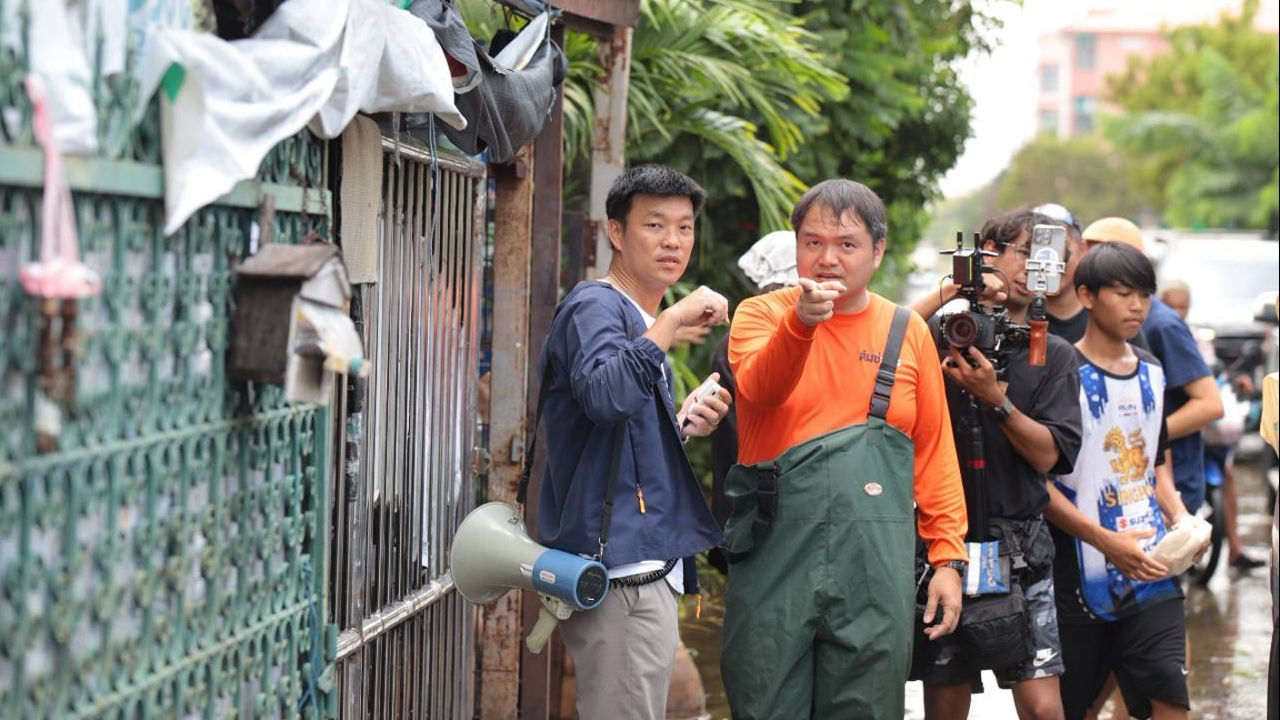
Nattapong surveyed the flood situation in Rangsit and Pathum Thani, urging the government to stop letting agencies work independently and to accelerate drainage efforts to full capacity. He questioned why water pumps are operating at only 60% capacity and how much longer residents must wait.
On 2 October 2026, Nattapong Ruangpanyawut, leader of the Prachachon Party, joined party MPs to monitor the flood situation in Rangsit, Pathum Thani. Several communities have faced continuous flooding for days. He brought rice, dried food, and essential medical supplies to distribute to affected residents.
A site survey revealed many alleys still flooded from mid-calf to knee level, preventing motorcycles from passing and putting small cars at risk. Some residents rely on pickup trucks and local assistance to enter and leave communities. The main issue is that water levels within communities are barely decreasing because water in the main canals remains high. Villages pump water into canals, but slow canal drainage causes water to back up, perpetuating the flooding problem.
During the visit, Nattapong told reporters that before coming to Pathum Thani, he had monitored flooding in eastern Bangkok and observed similar issues, especially in deep alleys where water levels inside are nearly equal to canal levels. When canal levels do not drop, community flooding cannot recede.
At a parliamentary disaster management commission meeting on 1 October, agencies responsible for water management reported that drainage capacity from inner urban areas to outer zones is operating at only about 60%, hindering rapid water removal from Bangkok and Pathum Thani. Another issue concerns managing floodgates at area boundaries, constrained by existing agreements between agencies and neighboring areas to prevent flooding one area by draining another. In crisis situations, a central authority must coordinate and integrate the entire system, enabling simultaneous pumping from inner areas and drainage at outer points.
Nattapong added that distributing food, drinking water, and medicine remains necessary as long as water levels are high enough to disrupt daily life. However, immediate relief alone is insufficient. What people most need now are clear answers from the government about how much water can be drained and when levels will recede.
"While water still floods residents' doorsteps, the pumps draining water to the Gulf of Thailand, Chao Phraya, Bang Pakong, or Nakhon Nayok rivers are only operating at 60%. This does not justify the situation. The government must explain why and how it will restore the system to full capacity," Nattapong said.
Regarding the Prime Minister's absence from parliament to explain the flood situation—citing delegation to responsible ministers—Nattapong said that although each agency and minister has their duties, the Prime Minister, as head of government and a parliament member, remains accountable to parliament.
The current crisis is not just about how many pumps each agency has, but whether the government can command and coordinate the entire drainage system to operate at full capacity swiftly. Every day the water does not recede is another day residents must live with flooding at their doorstep without knowing when it will end.

