

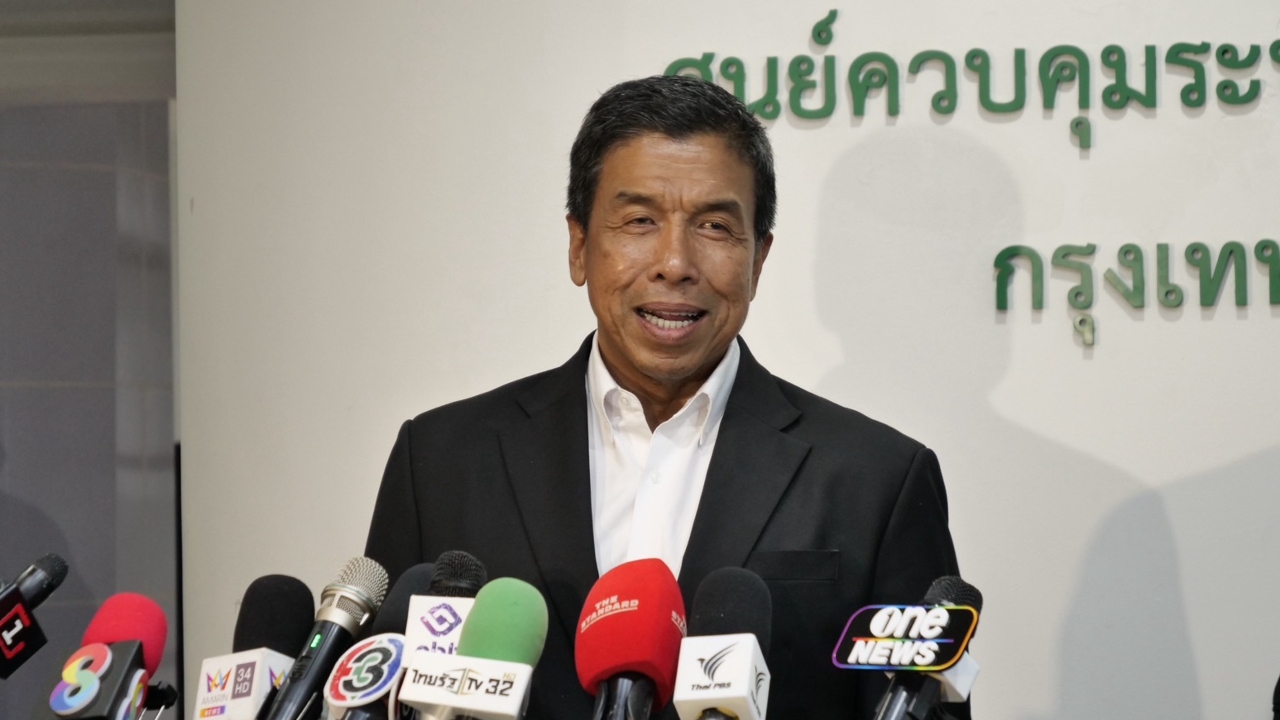
Chadchart affirmed he is not upset by the drama over who first coordinated the Naga pipe water pumping at Khlong Chan Flats, stressing he has no ego and is ready to cooperate with all parties for the benefit of the people. Meanwhile, Bangkok's Deputy Governor noted that the city's water situation is beginning to improve, as water is being pumped out of Khlong Prawet, and explained that the use of detention basins must consider the entire water system.
On 2 October 2026, Chadchart Sittipunt, Governor of Bangkok, spoke about coordinating to bring the “Naga pipe” from Nakhon Pathom province to help pump water in the Khlong Chan Flats area, which has since seen water levels recede.People are returningto live their normal lives
He said he contacted via MP Beer, who had previously helped during the State Audit Office building collapse, and since MP Beer is from the Bhumjaithai Party and familiar with the Naga pipe team, he asked them to support Bangkok. He emphasized that there was no ego involved and he welcomed help from all sectors.
He added he does not care who called first or later, because the most important thing now is to bring equipment and tools to relieve the people's suffering as quickly as possible, together with the Bangkok administration.
Chadchart also insisted there is no conflict or dispute over credit. He urged anyone still facing flooding problems to report to the Bangkok hotline 1555 so authorities can send teams to assist.
Wisanu Subsompon, Deputy Governor of Bangkok, revealed that the water situation in Bangkok is expected to improve, with close monitoring of water levels in Khlong Prawet Burirom being key. The city is speeding up pumping water from the Romklao housing estate into the drainage system. Once water levels in Khlong Prawet Burirom are lowered, they will push and pump water out continuously to reduce levels quickly.
Regarding questions about using detention basins or water retention areas, Wisanu said Bangkok is managing water by diverting water from Khlong Prawet Burirom into Bueng Nong Bon, a large retention area that can hold about 5 million cubic meters. However, operating detention basins requires considering the system's three parts: water inflow, storage area, and outflow. Even with large storage, if inflow or outflow is insufficient, the basin cannot be used to full capacity.
Wisanu explained that Bueng Nong Bon currently has drainage systems and tunnels that can pump water from the basin to the Pak Om pumping station, so the outflow system is fairly ready. But the inflow system needs improvement because water from main and smaller canals currently flows into Bueng Nong Bon slowly.
Therefore, Bangkok has a project to extend Bueng Nong Bon's drainage tunnel to directly connect and receive water from Khlong Prawet Burirom, a main canal. This will increase Bueng Nong Bon's water management efficiency and capacity. In the short term, Bangkok is also using pumps to help drain water from canals and surrounding areas to lower water levels as quickly as possible alongside developing drainage tunnels.

The Deputy Governor also said that the use of detention basins must be considered according to the type of water problem. Floodwater and rainwater problems differ, so system design must consider from which direction water will come, how much, and whether there is sufficient storage and drainage.
Regarding previous studies on developing large detention basins, Bangkok has reviewed their suitability in line with current drainage system contexts. If there is a large storage area but limited inflow and outflow capacity, the area cannot be used efficiently. Therefore, developing drainage systems and improving main canals connected to storage areas is another important approach to proceed alongside.
Wisanu said Bangkok does not view solving water problems as relying solely on large detention basins but should develop storage areas appropriate to the landscape and risk points, especially by improving existing water storage such as basins or community water retention areas. Enhancing inflow and outflow systems there can be cost-effective and directly address rainfall problems.
Examples include developing small detention basins near Lak Si roundabout in Bang Khen district, improving Bueng Si Kan's efficiency, and cooperating with private sectors in areas with existing basins or water storage to upgrade drainage systems for better water intake and discharge. This approach distributes water storage across risk points since heavy rain cannot be predicted in specific locations. Detention basins do not have to be large but should be considered based on the drainage system context in each area, including water volume, storage points, inflow, and outflow to ensure efficiency and investment value.
Regarding concerns that Bangkok's pumps are not operating at full capacity, Wisanu said this must be assessed case by case because pumping stations and pumps are spread across many areas. In some places, pumps are not faulty but water levels have not yet reached the point requiring full pump operation.