

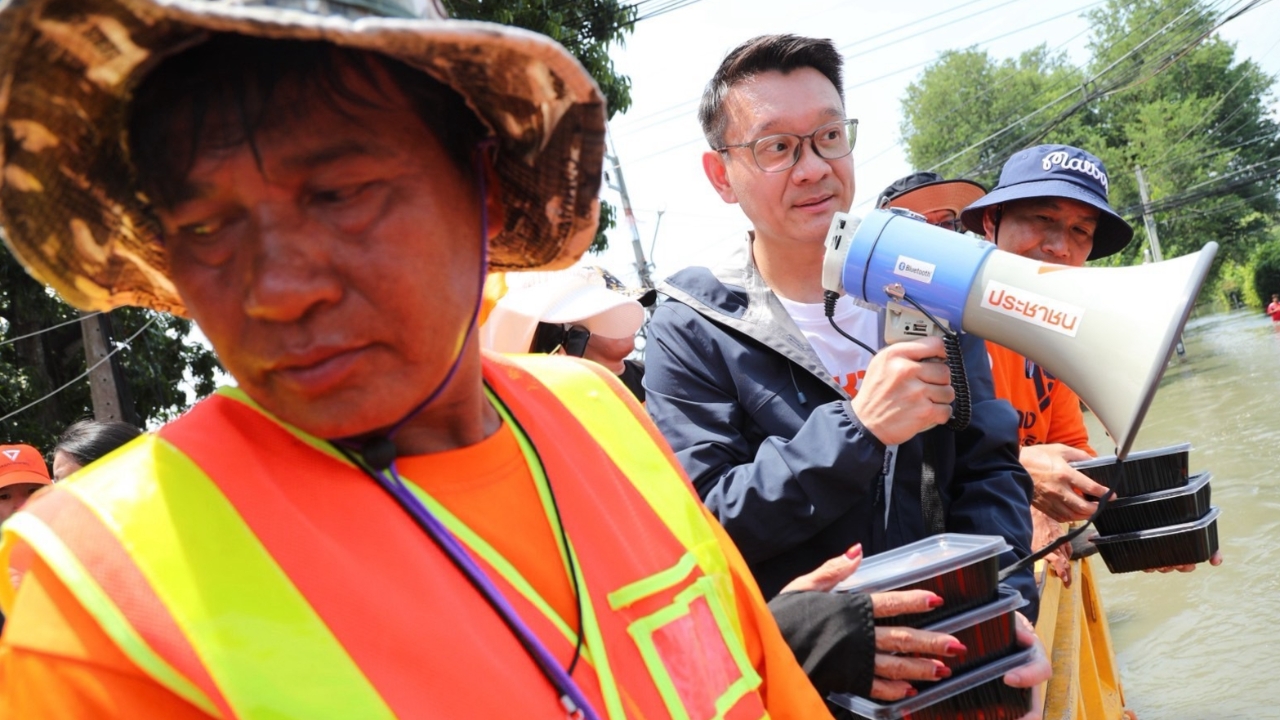
Veerayut, Deputy Leader of the Prachachon Party, confronted flooding in Chachoengsao by distributing relief bags, highlighting that the area has been forgotten with many communities lacking aid for over a week. He urged the government to declare disaster zones comprehensively and expedite water drainage system management.
On 3 Oct 2026 GMT+7, Veerayut Kanchuchat, Deputy Leader of the Prachachon Party, along with the Chachoengsao provincial party team, monitored the flood situation and assisted affected residents by delivering food, relief bags, medicine, and essential items, as many parts of the province have experienced flooding for more than a week.
Veerayut assessed the situation in Bang Khla District, where several communities remain heavily flooded, with water levels above waist height in some areas. Four-wheel drive pickup trucks could not access these zones, requiring high-clearance six-wheel trucks and boats to transport people and supplies, making aid delivery very difficult. Hundreds of households have been cut off from normal transportation routes.


The team also found that damage extended beyond homes to severely affect residents’ livelihoods, including widespread harm to shrimp farms, barramundi fish, and poultry, due to prolonged waterlogging lasting several days.
While damage in Bang Khla District is widespread, Veerayut noted that disaster declarations cover only some subdistricts and villages, not the entire district. This creates critical gaps in management, complicating agency coordination, resource mobilization, and delivering aid to residents.

He urged the Chachoengsao governor to promptly declare disaster zones covering all truly affected areas across the district to enable full-scale management and aid efforts, rather than leaving agencies to work haphazardly and residents waiting helplessly amid floods.
Subsequently, Veerayut and the Prachachon Party team traveled to Khlong Luang Phaeng Subdistrict in Mueang Chachoengsao District, on the border between Chachoengsao Province and Lat Krabang District, Bangkok, to deliver essential supplies to over 1,000 households across three housing estates.


Surveys found that the innermost parts of these villages lie about two kilometers from the main accessible road, with the entire route flooded. Homes and roads are surrounded by water, some vehicles submerged, forcing residents to use small boats for travel and transport. Veerayut and his team waded through about two kilometers of floodwater to deliver food, drinking water, and necessities to those still living inside.
During this time, locals informed the team that many families have been living amid floodwaters for over a week without receiving aid. Some residents work at Suvarnabhumi Airport but have been unable to commute normally due to the flooding.


Veerayut pointed out that the problem is not only lack of aid but also absence of a central authority managing water drainage. Although each village has pumps and tries to drain water independently, levels do not decrease because no government agency oversees overall management or sets clear agreements for water drainage between areas.
This situation has forced the private sector and communities to handle the crisis individually, each trying to protect and drain their own area first. However, water displaced from one area affects another, so without a government authority managing the entire system, water levels are unlikely to recede and conflicts between communities may arise.
Veerayut concluded that the government must urgently take responsibility by declaring disaster zones aligned with actual damage, delivering aid to isolated communities, and acting as the main agency to coordinate water drainage management. It is unacceptable to leave residents struggling with prolonged flooding or force communities to solve water problems alone without clear government direction.
