

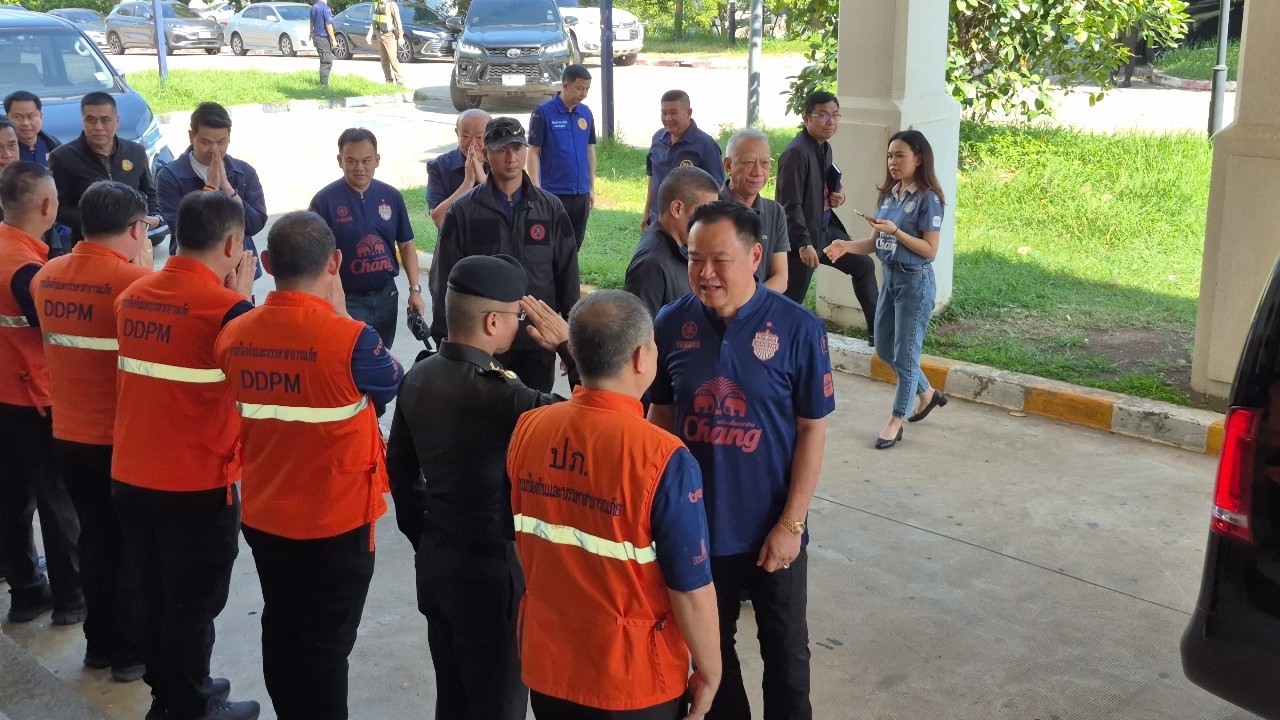
Anutin held a conference from Buriram to monitor the flooding, reporting that while many areas show improving conditions, they remain under high alert. He emphasized the importance of aid and management, and stressed scheduling staff shifts to avoid fatigue.
4 Oct 2026 GMT+7 Prime Minister and Minister of Interior Anutin Charnvirakul conducted a video conference from the Phanom Rung meeting room, 4th floor of Buriram Provincial Hall, to monitor flood situations and aid efforts with the National Disaster Prevention and Mitigation Command. Attending were Deputy Prime Minister and Minister of Transport Pipat Ratchakitprakarn, Minister of Industry Varawut Silpa-archa, Minister of Digital Economy and Society Chaiyachon Chidchob, Minister of Energy Eknat Promphan, Minister of Public Health Patanawadee Prompattana, the Permanent Secretary of Public Health, and the Deputy Permanent Secretary of Interior.
Prime Minister Anutin said, “I thank everyone for attending this meeting together. Today marks the fifth day of our daily meetings. Reports indicate that many areas are improving, but we remain at a high state of vigilance. We must update the situation, check readiness for aid and rehabilitation, and monitor potential new flood waves, especially in southern Thailand.”


“Yesterday (3 Oct 2026), I visited Chai Nat and Nakhon Sawan provinces to observe evacuation centers and support for affected people. Continuous efforts include preparing shelters in all necessary areas, especially caring for the elderly, bedridden patients, vulnerable groups, children, and those with limited self-care. I ask all provincial governors, as incident commanders locally, to prepare food, drinking water, health services, medicine, medical care, electricity, and clean water, as well as plan for safe returns home once floodwaters recede.”
The Prime Minister added, “From what I saw at the shelters, bringing people there during floods is more difficult than if planned in advance. Since we meet daily and receive weather forecasts from the Meteorological Department, if any area is at risk, governors should decide and order early evacuation of vulnerable groups to shelters before the event. Once floods occur, efforts focus on water pumping, drainage, and supplying medicines and food. Moving bedridden patients and the elderly during floods adds to the workload.”
“Please manage aid, communication, and donations carefully to ensure a positive experience for both donors and recipients. Resource use must be calculated to avoid excess causing spoilage or poor management, and essential items must reach all areas without concentrating in just one place. Governors should assess disaster relief centers from past border situations with Cambodia: provinces with good readiness and ample supplies should act as distribution centers to support less-prepared provinces.”


“Today’s discussion will accelerate preparedness, especially for the south, where the Meteorological Department forecasts heavy rain from 4-10 October. The eastern side will see some rain, the western side will be covered throughout. Accumulated rain may cause flash floods, mudslides, and landslides. We will await daily updates from the Meteorological Department to plan, manage the situation, and prepare emergency responses accordingly.”
The Prime Minister also urged southern provincial governors to review emergency plans by district, clearly identifying risk areas and vulnerable groups. They must prepare shelters, water pumps, boats, generators, food, medicine, and medical teams before the rains. If early evacuation is needed, responsible persons must accompany evacuees to safe locations. He instructed the military secretariat to coordinate with the 4th Army Region commander and local administration to integrate rescue operations into a unified task force. During the Hat Yai flood, all agencies worked as a team for effective relief without separation.
For other affected areas along major river basins, the Prime Minister requested continuous command centers with staff shifts to prevent fatigue. He emphasized timely, clear, and accurate public alerts, with the Department of Disaster Prevention and Mitigation serving as the central information source, coordinating obstacles and monitoring aid from provincial governors down to local administrative organizations closely connected to communities.

The Prime Minister added that the government spokesperson’s office has established a nationwide public communication center. Thus, communication must summarize ongoing events and inform citizens on how to act during the situation, what to expect, and how to prepare accordingly.
He also asked the Minister of Public Health to prepare hospitals, nursing teams, and medical supplies, including mobile medical units at shelters. Community hospitals or local facilities capable of accommodating bedridden patients in risk areas should consider admitting them to ensure proper care from medical staff. Additionally, medical personnel shifts should avoid fatigue that could impair diagnoses or health checks, as post-flood conditions will involve waste, stagnant water, and unpleasant odors.
Regarding areas with standing floodwaters, the Prime Minister noted a high likelihood of water, sewage, and waste decomposition, deteriorating water quality for consumption. Therefore, utmost priority must be given to planning drainage out of affected areas. He requested the Director-General of the Department of Disaster Prevention and Mitigation to hold meetings to review situations in each troubled and risky area, ensuring public awareness.
However, the latest data from the Department of Disaster Prevention and Mitigation before today’s meeting showed ongoing flood situations in 26 provinces including Bangkok, affecting more than 3.24 million people. Buriram remains among the provinces impacted by flooding.

