

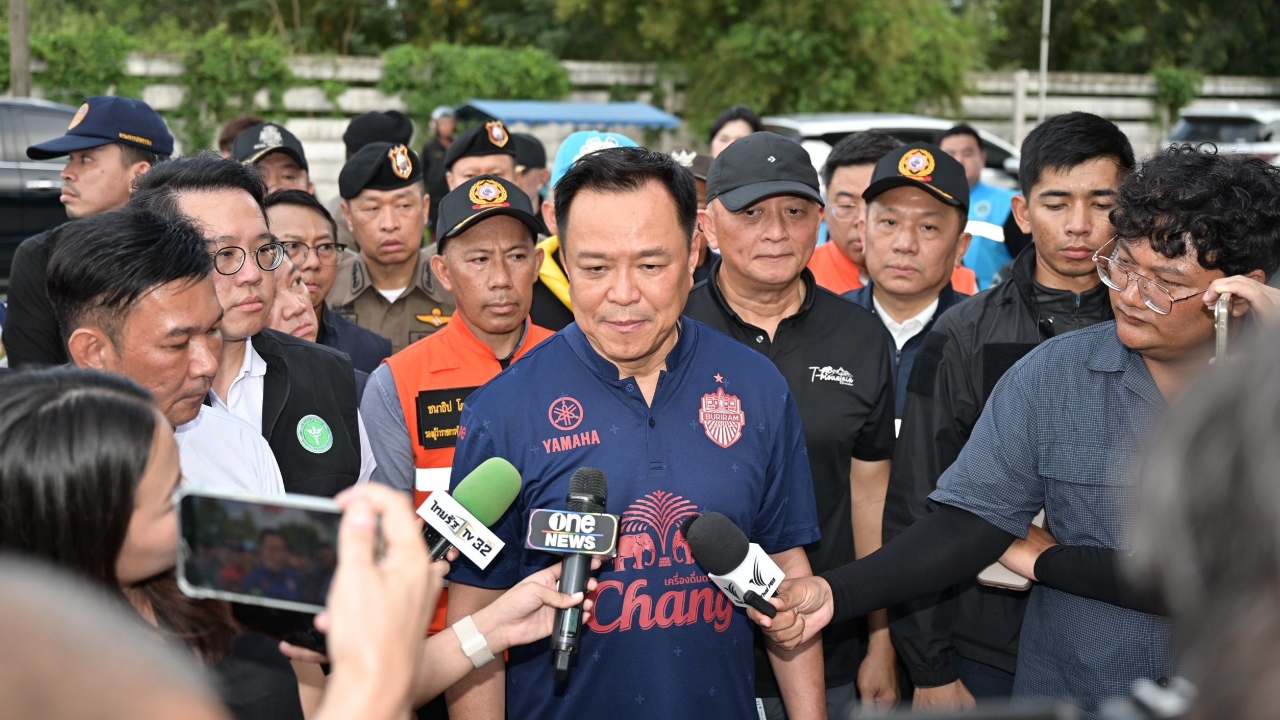
Prime Minister Anutin Charnvirakul pointed out that Prachinburi is experiencing its heaviest flooding at this time. He praised the mobilization of resources to establish field hospitals, shelters, and large kitchens. He explained that water drainage is slow because the area is surrounded by water. When a cook invited him to fry omelets, he promptly replied, "It's okay, or I'll get criticized again." The prime minister also complimented the omelet’s appealing color, indicating care in preparation, and emphasized the importance of having food and supplies ready.
4 Oct 2026 GMT+7 Prime Minister and Minister of Interior Anutin Charnvirakul visited Prachinburi province, first inspecting and listening to issues at the field hospital at Chakrapong Camp Hospital, which accommodates patients evacuated from Chaophraya Abhaibhubejhr Hospital and Ban Sang Hospital. He visited patients there and encouraged medical teams caring for the public.
Medical teams reported expanding ICU units at Kabinburi Hospital with 8 beds and Sri Maha Phot Hospital with 6 beds. They currently require support including 4 ventilators, 8 ventilator circuit sets, 40 oxygen machines, 30 portable suction machines, and 20 infusion pumps.


Next, the prime minister visited evacuees at the Prachinburi New Transport Office shelter, offering encouragement to patients, elderly residents, and volunteer citizens. He entered the kitchen and took up a spatula to serve omelets. At that moment, a cook asked him, “Prime Minister, would you like to fry some?” He replied, “It’s okay, or I’ll get criticized again.” He also praised the omelets’ appealing color, saying it showed care in frying, and urged ensuring that food and supplies are fully prepared.
Additionally, the cook told the prime minister that all food prepared would be distributed to those in need. They cook meals around 5:00 p.m. and again beginning at 3:00 a.m. The prime minister exclaimed, “Oh!” then respectfully clasped his hands and wished prosperity to the cook.


At one point, the prime minister assured flood victims that there is funding to repair damaged homes and urged them to trust the government and not worry. Residents expressed hopes that the prime minister would give special attention to Prachinburi after the floodwaters recede. Anutin responded affirmatively, assuring ongoing care.
After the visit, the prime minister stated that Prachinburi is currently the most severely flooded area, to the extent that Chaophraya Abhaibhubejhr Hospital, the provincial hospital, had to close and transfer all patients to other facilities. The establishment of evacuation centers was well supported by Prachinburi Provincial Administrative Organization (PAO) chairman, who managed operations effectively. The shelters are as prepared as possible, and food provision has benefited from cooperation among the PAO and all volunteer groups, enabling large kitchens to supply multiple shelters. He expressed gratitude to the PAO chairman and Prachinburi teams.
He continued, saying that visiting the area revealed not only severe flooding but also the need for external support, especially expanding the emergency budget framework to fully support victims. He praised the province for satisfactory preparedness and rapid, efficient resource mobilization when the disaster struck.
“It’s never like being at home, but we try to provide equipment and supplies to make them as comfortable as possible.”


Regarding reports of equipment shortages at field hospitals, Anutin said that in such emergencies, it’s not so much a shortage as a matter of improving completeness over time for patient convenience. Medical supplies are available. The Ministry of Public Health had prepared for such situations since the COVID-19 pandemic. Treatment of patients has not lacked anything significant; the focus is on making conditions more comfortable.
Asked about relocating patients from hospitals in other flooded districts, Anutin emphasized that all areas must be prepared. The PAO chairman arranged transfers, prioritizing vulnerable groups. The province has assembly halls and government offices for sheltering, choosing locations with good ventilation. Some places like temples or schools were not designed for large-scale sheltering, so suitable spaces must be arranged carefully.
When asked why Prachinburi’s water drainage is slower than other provinces and when drainage would begin, Anutin explained, that water must be drained immediately once possible, but drainage must ensure water does not return. Currently, the area is surrounded by water, preventing drainage from inside out. Therefore, evacuation plans are necessary. He assured that when drainage is feasible, the province is ready to accelerate it, and all equipment is prepared.
Currently, the hardest-hit provinces are Prachinburi, with severe flooding in Mueang district, as well as neighboring provinces Nonthaburi and Nakhon Pathom, although the flooding there is localized. Governors have received support to aid their residents in all aspects.


Regarding compensation, the prime minister stated it follows previous practice because flooding has lasted over seven days, meeting criteria for 9,000 baht per household assistance. The government is now surveying, registering, and transferring funds to affected citizens. If further incidents occur after 1 Oct 2026, additional compensation will come from disaster insurance policies covering 30 million households, supplementing the 9,000 baht legal aid.
If insured, initial compensation is 10,000 baht, plus 40,000 baht for home repairs under the law, with insurance coverage up to 100,000 baht. In cases of death, compensation is 2 million baht per person. The government hopes these funds will not be needed but has allocated the budget to purchase insurance for citizens. The insurance covers three main disasters: floods, storms, and earthquakes, and is prepared for fiscal year 2027.
When asked about the death of village headman Thongpim Muangphrom of Moo 4, Koo Lampan subdistrict, Si Maha Phot district, Prachinburi, who died from electric shock while rescuing a drowning child, Anutin said the government will fully support the family. Regulations mandate care for officials who sacrifice their lives performing duties, and there are various funds available to assist them.

