

The Royal Irrigation Department has established a crisis water management center to accelerate drainage and open waterways in preparation for southern rainfall, providing continuous warnings and situation updates to the public so they can prepare and respond promptly.
Suriyas Juangroongruangkit, Minister of Agriculture and Cooperatives, has instructed the Royal Irrigation Department to closely monitor the water situation, speed up drainage in areas still flooded, and mobilize machinery and tools to assist the public immediately to reduce impact and alleviate hardship as much as possible.
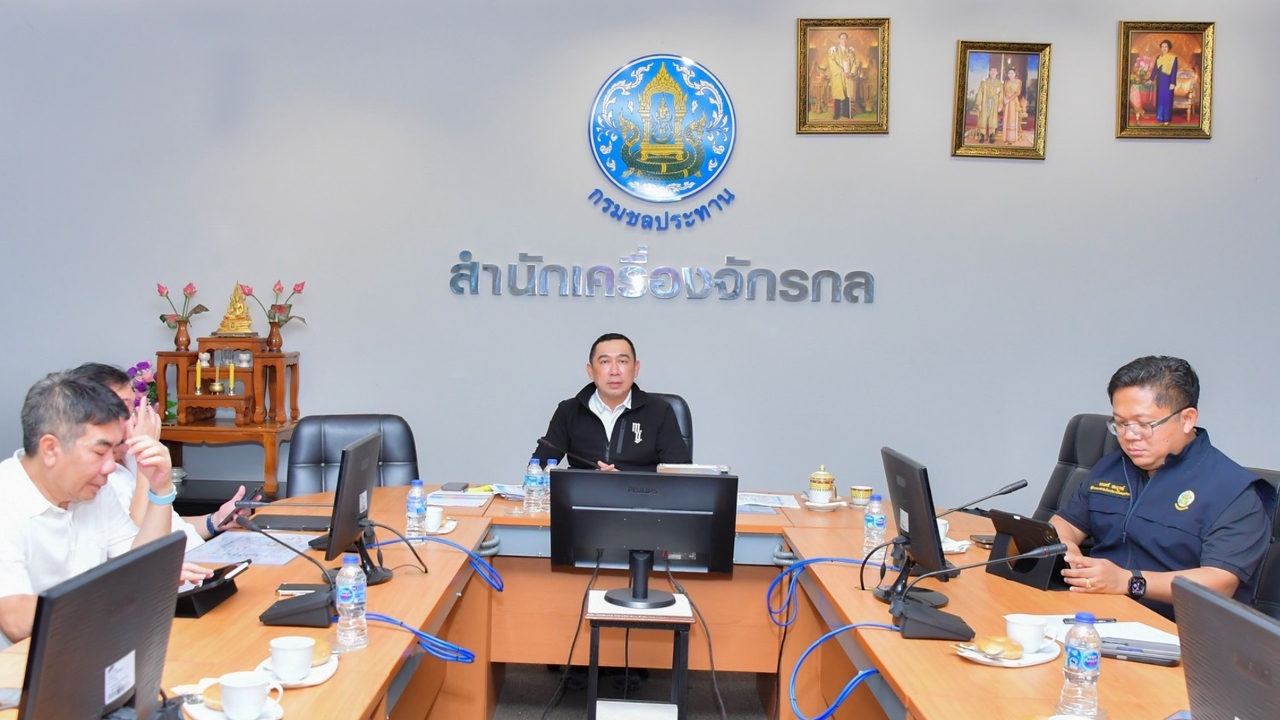
At 18:00 on 4 Oct 2026, Witthaya Kaewmee, Director-General of the Royal Irrigation Department, chaired a meeting of the working group on flood crisis management and monitoring of the Chao Phraya basin water situation. The meeting aimed to review the situation and plan water management for the next phase. Tanand Sutthipisan and Worapot Petchnarach, Deputy Directors-General, along with other executives and relevant staff, attended the meeting at the Machinery Bureau conference room, Royal Irrigation Department, Pak Kret, Nonthaburi, and via video conference to irrigation projects in the region.
Regarding the overall current situation in the Chao Phraya basin, as of 19:00 on 4 Oct 2026, station C.2 in Nakhon Sawan recorded a water flow of 2,078 cubic meters per second with a decreasing trend, while the Chao Phraya Dam maintains discharge at 2,500 cubic meters per second downstream. Water is being distributed into irrigation systems on both east and west sides to reduce the volume flowing to lower areas. Continuous monitoring remains in place downstream of the dam. Although inflows from some upper areas are decreasing, the volume arriving at the dam remains high, with accumulated water upstream. Therefore, discharge is managed in accordance with the situation to control water levels above the dam and reduce risks to upstream areas. Increases in discharge are implemented stepwise to moderate water level rises and minimize impacts on residents.
In the Pasak basin, the Pasak Jolasid Dam in Lopburi discharges water at 450 cubic meters per second. Continuous assessments of reservoir inflow, rainfall trends, and downstream conditions are conducted to adjust discharge appropriately and prepare receiving areas for additional inflows, minimizing impact on downstream communities. Meanwhile, the Rama VI Dam has a flow of approximately 662 cubic meters per second. Water management is coordinated from Pasak Jolasid Dam through Rama VI Dam to the Raphiphat Canal to ensure system-wide balance, considering rainfall and the receiving capacity of downstream areas.
For areas still flooded, the Royal Irrigation Department continues to mobilize water pumps, water pushers, machinery, and personnel to expedite drainage from communities and low-lying areas. Simultaneously, water hyacinths, aquatic weeds, and obstructions in canals, sluice gates, and pumping stations are being removed to clear waterways, facilitating smoother water flow and improving drainage efficiency as quickly as possible.
Attention must also be paid to upcoming rainfall forecasts. Data predicts continuous rain in many parts of the country during 4–7 and 9–13 October 2026, especially heavy and accumulated rainfall in the southern region. Northern, northeastern, eastern, and some central areas will have scattered rain. Close monitoring is necessary for areas at risk of flash floods, flash floods, and low-lying zones.
Regarding the south, the Prime Minister has expressed particular concern due to ongoing and increasing rainfall. He has instructed advance preparedness, especially for areas from Prachuap Khiri Khan down to Narathiwat, urging close monitoring of rainfall and water levels, appropriate management of reservoirs and irrigation systems, inspection of watercourses, sluice gates, and irrigation structures, and readiness of water pumps, machinery, and personnel in vulnerable areas to provide immediate assistance if heavy rain or flooding occurs.
Director-General Witthaya has established the “2026 Crisis Water Management Coordination Center” to serve as the central command for coordinating and expediting systematic crisis water management. The center closely monitors and assesses the situation to enable timely directives and adjustments to water management plans. It also disseminates public information, warnings, and situation reports continuously, allowing at-risk areas to prepare and respond promptly. All regions have been instructed to continue full-scale assistance to the public, while areas still flooded are urged to accelerate drainage and clear waterways to facilitate water flow.
The Royal Irrigation Department continues 24-hour water situation monitoring, managing water resources, and mobilizing machinery, equipment, and personnel to assist the public fully. Concurrently, preparations are underway for new rainfall, particularly in the southern region, to alleviate hardship and minimize impacts on the population as much as possible.