

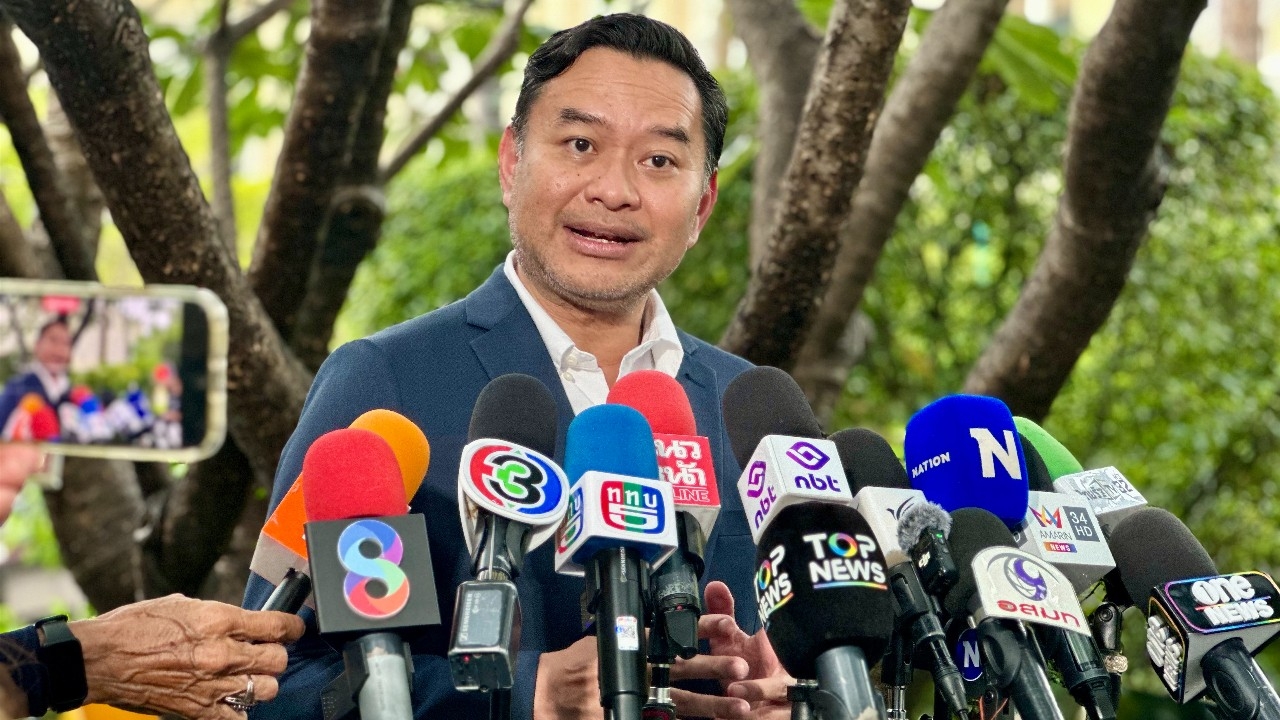
The government spokesperson has openly taken the lead in investigating the 'S' family, revealing information from the health sector that the Health Promotion Foundation (ThaiHealth) has used its budget to favor associates and networks, reserving funds to earn interest and invest in securities.
At 13:35 on 5 Oct 2026 at the Government House, Mr. Ekaphop Pienpiset, spokesperson for the Prime Minister's Office, spoke about probing ThaiHealth's budget use. He said that no one had dared to investigate ThaiHealth before. He has been examining this issue since before entering politics and gathered considerable information since 2019 from insiders and outsiders in the health sector. Monitoring ThaiHealth's operations over 25 years, he noted that despite budget expenditures, every three-year health assessments from 2024-2025 show 40% of Thais are overweight, 10% have diabetes, another 20% have undiagnosed diabetes, one-third have hypertension, smoking rates have not dropped, e-cigarette use has risen, alcohol consumption has increased, and traffic accidents remain unchanged. This raises questions about the effectiveness of ThaiHealth's 77 billion baht budget over 25 years.
Mr. Ekaphop said that currently, the Public Financial Discipline Act requires all state revenues to enter the official budget system. There were claims that the 4 billion baht allocated to ThaiHealth, which supports the Sports Fund, Elderly Fund, and ThaiPBS, would be reduced, benefiting alcohol companies and funds. He denied this, noting that earlier the Excise Department Director-General clarified that after amending the Act, ministerial regulations will ensure that the original or greater amounts will still be collected for the state.
Asked whether his role as Prime Minister's Office spokesperson and his criticism might be driven by hidden agendas related to ThaiPBS, Mr. Ekaphop said this is a government policy announced to Parliament that all budget revenues must be accounted for transparently. The budget management policies for 2027, recently passed by Parliament, and the 2028 budget to be prepared, require transparency, auditability, and traceability. His actions are on behalf of the government, while legislative proposals are Parliament's responsibility.
Asked whether inefficiency checks have revealed corruption or concealment, Mr. Ekaphop said investigations show ThaiHealth reportedly set aside about 2 billion baht, spending the interest gradually. Some projects have approval but delayed payments, allowing interest earnings from accounts.
“We found several hundred million baht invested in securities companies, which may be legally problematic. Previously, ThaiPBS invested in CPF shares and was judged to have violated regulations. Thus, ThaiHealth's actions require further scrutiny. Today, the Senate also raised questions on this matter,” Mr. Ekaphop said.
Asked whether ThaiHealth, as a strong organization with doctors and NGOs, can withstand these disclosures, Mr. Ekaphop said he presents studied information and is not fighting anyone but working for the public. Those in the medical and health fields know ThaiHealth's annual 4 billion baht budget rarely reaches public health benefits. Over 20 years, public benefits and health improvements from ThaiHealth have been minimal, limited to campaigns like reducing poverty, stress, alcohol abstinence during Buddhist Lent, and New Year's chanting, which is insufficient given the 77 billion baht spent. The Health Minister has also discussed with ThaiHealth ways to enhance health promotion for the public.
“If the 4 billion baht goes into the budget system without allocations favoring close networks, there are suspicions that past distributions favored related networks over broad dispersion. Government agencies have requested significant funds, but closer organizations or NGOs received large shares while smaller units got only hundreds of thousands or tens of thousands baht, which collectively seems substantial,” Mr. Ekaphop said.
Asked whether the Prime Minister has commented on these views, Mr. Ekaphop said this concerns financial discipline procedures, and the government wants every budget baht to benefit the public.
“The Prime Minister said our actions are not for ourselves but for the people, and that we are not afraid of influence. I often say this, and those in health say there is a 'mafia' in the Ministry of Public Health hiding behind white coats. If not doctors managing doctors, no one dares act. I am taking the lead. I do not work alone; some in the health sector are seeing this direction and providing information, raising their voices for the public. Let’s work together without distorting facts and ensure taxpayers' money truly reaches public health. Our work covers not only ThaiHealth but also the National Health Security Office and all 'S' groups to reform so that people truly benefit health-wise,” Mr. Ekaphop said.
Asked whether, with a network of doctors and health personnel, he will continue the investigations, Mr. Ekaphop said this was his plan before campaigning: to lead a major reform of the country’s public health system. Reform is not only for the 'S' family but for all public health-related matters, which must be overhauled. Some state sectors, including some doctors and health personnel, do not fully understand or have not studied this from the start. He is trying to provide information to foster more discussion.