

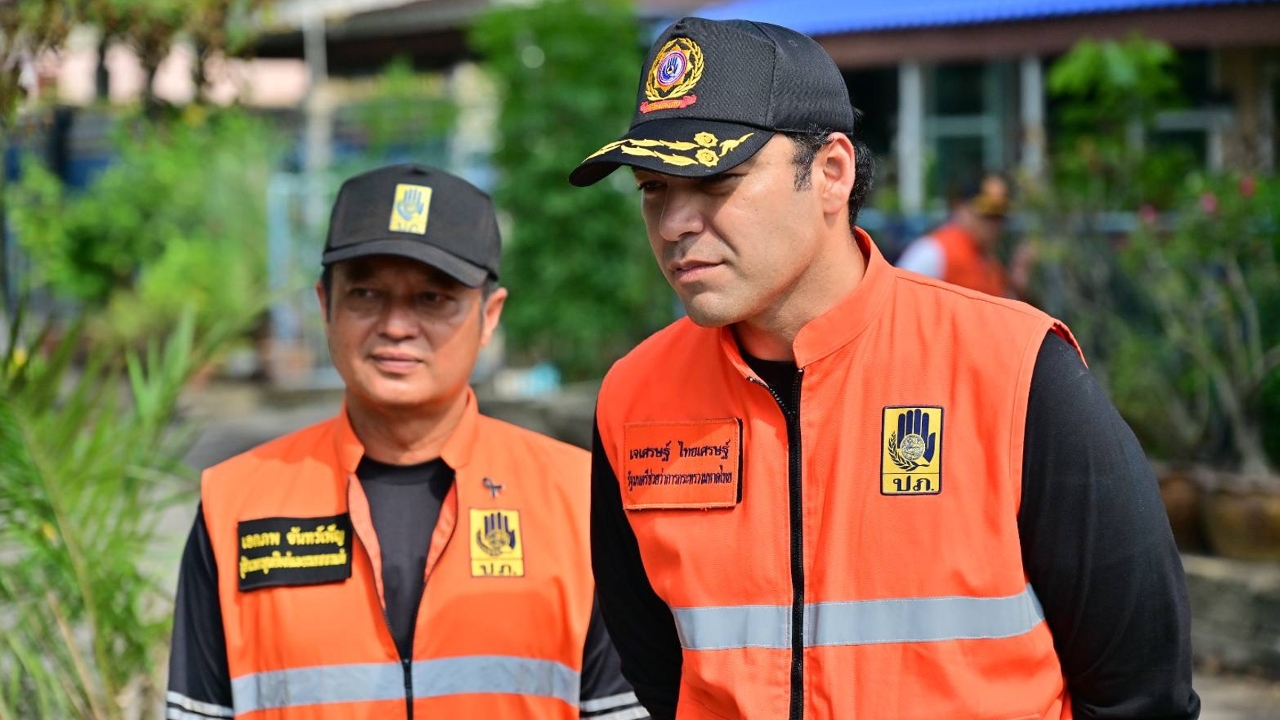
“Je Setth” teams up with “Supamas” to expedite sewage treatment and add microorganisms to assist Rangsit residents, alongside public information dissemination.
At 16:00 on 5 Oct 2026 GMT+7, Mr. Je Setth Thaisetth, Deputy Minister of Interior (M.T.3), coordinated efforts with Ms. Patcharin Samsiripong, Secretary to the Minister attached to the Prime Minister's Office, acting on behalf of Minister Supamas Isarapakdi. They visited Rangsit, Pathum Thani Province, to integrate cooperation in aiding and rehabilitating citizens affected by flooding, while also communicating relief and area management information widely to the public.
Today's mission focused on managing water still pooled in Rangsit, specifically at Chang Thong Village beside Udom Wittaya School within the Saha Kon Mankong Mitr Samphan community. Microorganisms were introduced into stagnant water to decompose organic matter and reduce water contamination and foul odors, thereby improving environmental conditions and lessening impacts on residents while water remains. Coordination was made with Rangsit Mayor Police Captain Trilup Thupkrajang, who received the microorganisms for local application.
This operation represents integrated cooperation between the Ministry of Interior and the Prime Minister's Office. Ms. Patcharin Samsiripong oversaw coordination related to public relations and government communication to ensure information about relief efforts and area management reaches the public quickly and comprehensively.
Ms. Patcharin Samsiripong stated that Minister Supamas Isarapakdi emphasized close monitoring of the situation, particularly in areas still experiencing flooding. She called for integrated cooperation from all sectors—including government agencies, private sector, and civil society—to accelerate aid and minimize impacts on affected communities as much as possible.
“Minister Supamas stressed that assistance must be continuous and on-the-ground. Today’s effort connects cooperation from various parties, including water quality management, environmental impact reduction, and accurate information communication to the public, enabling all stakeholders to participate in timely problem-solving,” Ms. Patcharin said.

Mr. Je Setth said that caring for citizens after flooding does not end when water levels recede, but must continue through recovery phases. Areas with residual stagnant water can affect the environment and residents’ quality of life, requiring cooperation from all sectors to address these issues collectively.
“We must continuously support the people from the disaster’s onset through recovery. Today, we connect cooperation from all parties—including area management, reducing impacts from remaining water, and accurate, comprehensive communication to the public,” he said.
This integration focuses on connecting efforts in three areas: “assistance – recovery – communication” to ensure continuous care for residents in Rangsit, reducing impacts on people and the environment until the situation returns to normal.