

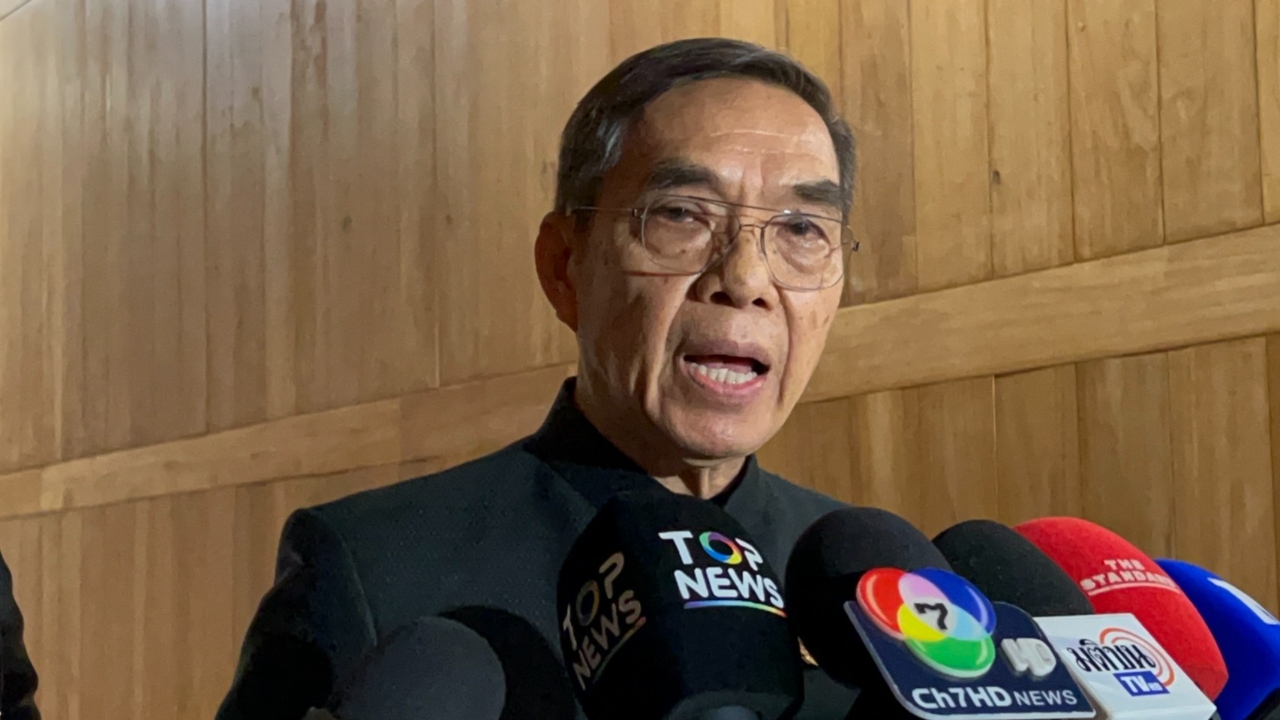
Senator Kob strongly criticized after filing a minority-vote complaint against the Election Commission, admonishing former judges as adults not to lead public opinion, viewing the EC's decision as not yet final, and accusing opposition MPs of immaturity while condemning iLaw for causing turmoil and confusion in society.
At 09:00 on 6 Oct 2026 GMT+7. Pol. Col. Kob Ajanakit, Member of the Senate (Senator). Speaking at the parliament about submitting a complaint to the National Anti-Corruption Commission (NACC) to investigate the Election Commission (EC), he said he wants the NACC to examine the facts according to law, not to pre-judge anyone accused as guilty, and requested that the rights of the accused, witnesses, and related persons be protected under the presumption of innocence principle.
Pol. Col. Kob added that once the matter reaches the NACC, it is their duty to act. He cannot specify who or how the complaint was filed, nor confirm if it involved the two minority-vote EC members, as the EC is an independent organization subject to NACC’s oversight. How the NACC will investigate will be evident in the submitted complaint.
Therefore, all actions must be within the law. The EC chairman and members must respect the law, as the constitution establishes the EC as an independent body, which must perform duties impartially and without bias. He questioned whether interviews given show bias and emphasized there must be no conflict with the constitution. While it is their right to speak to the media, they must not violate others’ freedoms. The minority must accept the majority’s decision, and the majority must respect the minority. This legal principle governs voting.
"The constitution states that any vote should be decided by majority. If you understand the term 'majority,' your work will be easier, and you won't mislead society with falsehoods. Today, so-called experts are no longer neutral. What is the Royal Institute for? It exists to educate and clarify for the public, not to direct who is right or wrong. Accusations have even gone as far as calling it a silent coup. How can you say that? That phrase is painful because it contradicts democratic governance principles. You have worked under the royal authority as judges, but now you seem to forget the ethics required of legal professionals. I want to remind those who influence opinion—you are all adults and have held positions in independent organizations, some even helped draft ethical standards. Why didn’t you fix things when you had the chance? What were you doing? Now you blame others; goodness or badness depends on one’s actions, regardless of status."
Regarding whether ethics complaints will be filed against MPs who disclosed information about senator election fraud, Pol. Col. Kob said he believes MPs know they are also bound by ethics. However, some MPs lack maturity, applying foreign laws to Thailand, which doesn’t work. Accusing that this matter is confidential during consideration is false because one can know if it is under review. The EC has not yet issued a formal ruling, only a resolution, yet some claim the review is complete, which is incorrect. People must be reasonable and ethical, including the media.
Pol. Col. Kob further said that senators have never disputed or argued in two years; they accept scrutiny and do not accuse others. MPs also never criticized senators publicly. If criticism exists, it should be within parliament, not outside causing public confusion. Currently, people suffer from livelihood issues, floods, and fires. Has anyone paid attention? Only private groups have prepared aid for citizens, but when they turn away, some steal aid and claim it as their own. Should this be allowed?
"Young people should observe what their elders do, not recklessly use avatars to insult and damage reputations without contributing anything beneficial to the country, only stirring up trouble on social media."
He added that he has wanted to speak for a long time. Working in the legislature, they have been accused alone but respect the law, so they did not respond. Now that the matter is under review, some claim it is finished and ask 4-5 questions. What right do they have? As MPs, do they have the right to investigate senators? The body responsible for investigating senators is an independent organization.
"Parliament consists of 500 MPs and 200 senators, totaling 700. People avoid saying 500 alone because Thai custom views 500 negatively. Everyone has one vote equally. Do not interfere or intervene. Currently, committee members interfere with state agencies, summoning officials by order, using this power excessively. Some matters are personal, not for public benefit, yet are pushed as social media issues. Citizens have suffered for years with no help from anyone, only talk without action. I can say that chronic governance instability stems from a lack of leadership."
Pol. Col. Kob also revealed that allegations against senators originate improperly. He criticized from day one the Department of Special Investigation (DSI) for stepping in without authority to investigate, except if invited by the EC. Without invitation, they have no legal power. The constitution grants the EC authority to adjudicate election and political party cases, while the DSI's law is subordinate and covers only special cases it can handle automatically or via its special case committee.
"Turning the senator selection matter into a special case may violate the law. The EC’s attempt to involve DSI—comprising three DSI members, four EC members, and chaired by a Senate academic—is questionable regarding impartiality and bias. Please investigate all parties, not only senators, as our selection complies with constitutional Article 107."
He also reaffirmed that senator selection follows the law, and senators’ self-introductions are lawful. In contrast, MPs must disclose election expenses, but senators only pay a 2,500-baht application fee. Could this be money laundering? Does it exceed 300 million baht? If so, it falls under DSI's jurisdiction as a special case. Using EC law as a special case law and linking special cases as evidence in senator investigations—is this proper?
When asked if he would pursue other channels, such as collecting signatures to submit to the Senate president for the Constitutional Court, Pol. Col. Kob said he prefers not to comment legally as it’s not his role, but anyone affected has equal rights, and any approach must have legal public law backing. Without law, there is no authority. Since EC law grants authority to verify rights, it is up to the EC, whose rulings are final.
Regarding whether iLaw’s ongoing public disclosure of witness evidence should lead to legal action, Pol. Col. Kob questioned the appropriateness of such actions, noting that iLaw’s purpose is to educate the public on law, not to mislead or manipulate understanding.
"Who is iLaw? Who are the EC, senators, and MPs? The EC, senators, and MPs have legal authority to perform their duties. Does iLaw have such authority? Can it freely accuse others? iLaw members and their families are lawyers but use the law to create social chaos, violating Criminal Code Section 116."
When asked if legal action would be taken against this, Pol. Col. Kob replied it is the right of those affected to decide.