

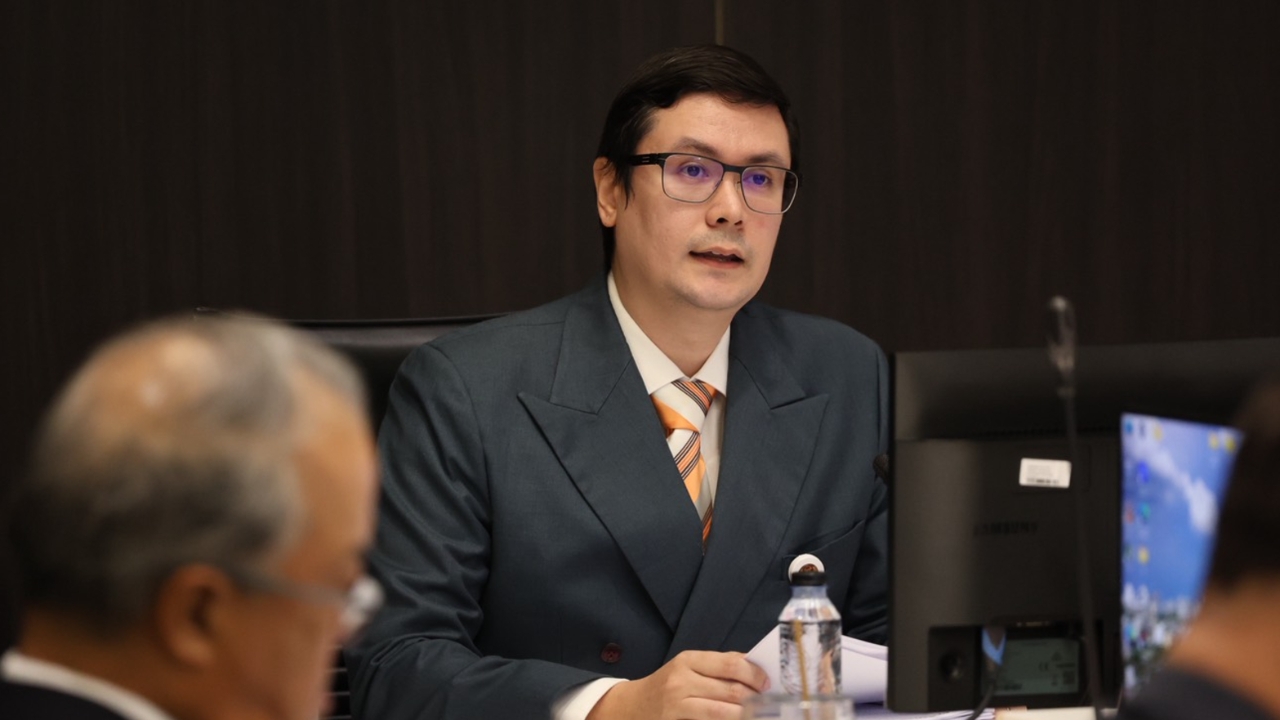
'Rome' criticized the government for hastily endorsing and whitewashing 'Idea's husband,' awaiting his appearance before the parliamentary committee. He emphasized society's right to question the matter and declared there is no need to disclose evidence prematurely. He affirmed he is not worried about being reported to the police and is ready to present all forms of evidence.
At 09:20 on 7 Oct 2026 GMT+7, Mr. Rangsiman Rome, a party-list Member of Parliament (MP) from the People’s Party and chairman of the Parliamentary Committee on Law, Justice, and Human Rights, gave an interview at the parliament regarding the invitation of Ms. Suchada Sang Tanthasap, also known as 'Idea', MP for Chaiyaphum province from the Bhumjaithai Party, to explain to the committee. He said he had not yet been informed whether Ms. Suchada would appear but expected, according to reports, that she might not come. However, regardless of her attendance, preparations have been made to question her if she appears late.
Regarding the committee’s next steps, he said the invitation to Ms. Suchada ultimately offers her and her husband (Mr. Taiyang Sang) an opportunity to clarify. Any facts presented will become official documents for further action.
Mr. Rangsiman added that there have been many public demands and findings, including discrepancies between declared assets and those filed with the National Anti-Corruption Commission (NACC), as well as suspicious links to grey capital. He believes this will benefit Ms. Suchada. Should she not appear today, the committee will continue pursuing the matter, as their policy is to follow through on all important issues. He cited the ongoing investigation into a 40-million-baht bribery case involving Mr. Chaichanok Chidchob, Minister of Digital Economy and Society, who has been unclear about the details. The committee continues to monitor that case.
Similarly, the case of Ms. Suchada is an extension requiring full truth-seeking. He stressed that public suspicion is extending to the government, which should investigate this case. However, on 6 October, the government seemed to simply endorse Ms. Suchada’s husband regarding online gambling websites. Many such websites operate in Thailand, raising questions about their legality, whether Thai nationals use them, and if there is an effort to target Thai customers.

'The government prides itself on shutting down millions of gambling websites, yet this morning my team accessed these sites without issue. Why are they still accessible? What is going on? This reveals a failure in state administration. Before hastily declaring someone innocent or unblemished, thorough investigation is essential. Rushing to speak may intimidate civil servants from examining this issue for fear of conflicting with ministers and facing retaliation or transfers.'
Asked if Ms. Suchada’s absence is to pressure him to reveal evidence first, Mr. Rangsiman said discussing evidence is appropriate. According to anti-money laundering law, mere suspicion suffices. In this case, suspicion is strong, and the Anti-Money Laundering Office (AMLO) can trace suspicious financial flows. Public questions about Ms. Suchada’s asset declarations—possibly inaccurate and suggesting unexplained wealth—are significant.
In principle, if a person holds such assets and appears unusually wealthy, the burden of proof may fall on Ms. Suchada, as a politician, to clarify. As committee chairman, he must verify evidence thoroughly. He confirmed many facts have been submitted to the committee, some previously known and others newly obtained.
When asked if withholding information means it won’t be used in a no-confidence debate, Mr. Rangsiman said it is premature to discuss that. Ms. Suchada is not a minister, so the committee uses all available channels to investigate fully. Whether evidence is used in a no-confidence debate is a separate matter he does not want to conflate.

Regarding why evidence is not yet disclosed, Mr. Rangsiman said much of what the public uncovered is indeed evidence requiring Ms. Suchada’s explanation. He does not deny having some of this information. Some remains undisclosed, awaiting state agency action. He proposed hypotheses about the wrongdoing’s extent, including:
1. Whether Ms. Suchada’s husband is at fault,
2. If he is at fault, whether Ms. Suchada knew or should have known, which could involve charges,
3. Her past role as secretary to Mr. Chaichanok and her involvement,
4. Whether Mr. Chaichanok can claim ignorance, which seems unlikely.
Thus, the issue is less about individuals and more about power structures and lawful versus unlawful use of authority. The scope may involve several scenarios.
When asked when it would be appropriate to disclose evidence, Mr. Rangsiman said if Ms. Suchada comes before the committee, questions will be asked. There is no need to reveal evidence beforehand, as she is a public figure and much has already surfaced. He questioned if she truly refuses to clarify. Explaining the origin of funds used for loans is necessary; failure to do so suggests unexplained wealth, with several legal offenses possible. He believes Ms. Suchada cannot claim ignorance given the numerous issues. Her silence and refusal to appear before the committee are notable.
"I call on the government to investigate Ms. Suchada thoroughly and not rush to endorse or whitewash her. Otherwise, it will cause serious suspicion. Anyone involved should be thoroughly examined. It is good for politicians to undergo proactive scrutiny. However, if the government hastily defends, it may amount to abuse of power or dereliction of duty," he said.
Mr. Rangsiman added that the committee has invited the NACC to verify asset declarations, as Ms. Suchada submitted them to that agency. The committee aims for proactive work; if government agencies fail, further action must follow. He noted that the committee has the least investigative power among all agencies, though the state could conduct better checks, reflecting systemic weaknesses in the country's oversight.

Regarding Ms. Suchada filing a complaint against him, raising concerns of a legal battle, Mr. Rangsiman said he does not wish for that. He is not thinking along those lines but, as involved, will prove evidence and is not worried. Many wonder if the power of attorney was granted by her husband; he has not seen evidence. Regardless, he is ready to fulfill his role in all forms, including answering police queries without issue.
Responding to Mr. Tom Krueasophon’s comment that his digging into this issue is unhelpful and stirs social resentment, Mr. Rangsiman said he is unsure about Mr. Tom’s remarks on Ms. Suchada. He respects Mr. Tom’s right to express opinions as a commentator in a democracy but stressed the importance of accuracy. For example, Mr. Tom claimed to have sent information about the People’s Party for investigation, but actually sent data about a different ruling party from the previous parliament. Mr. Rangsiman confirmed that Mr. Tom had provided useful information.
If accused of not investigating his own party, that is unfounded and false. He said such claims are baseless attempts to dismiss the matter as social jealousy. Mr. Tom, given his age, should understand that Ms. Suchada is a public figure subject to public scrutiny. In the US, where Mr. Tom once lived, politicians are regularly questioned. Therefore, society has the right to ask questions. The fact that citizens have uncovered so much information, yet state agencies claim she acted properly, means society deserves credit for helping government work more effectively.