

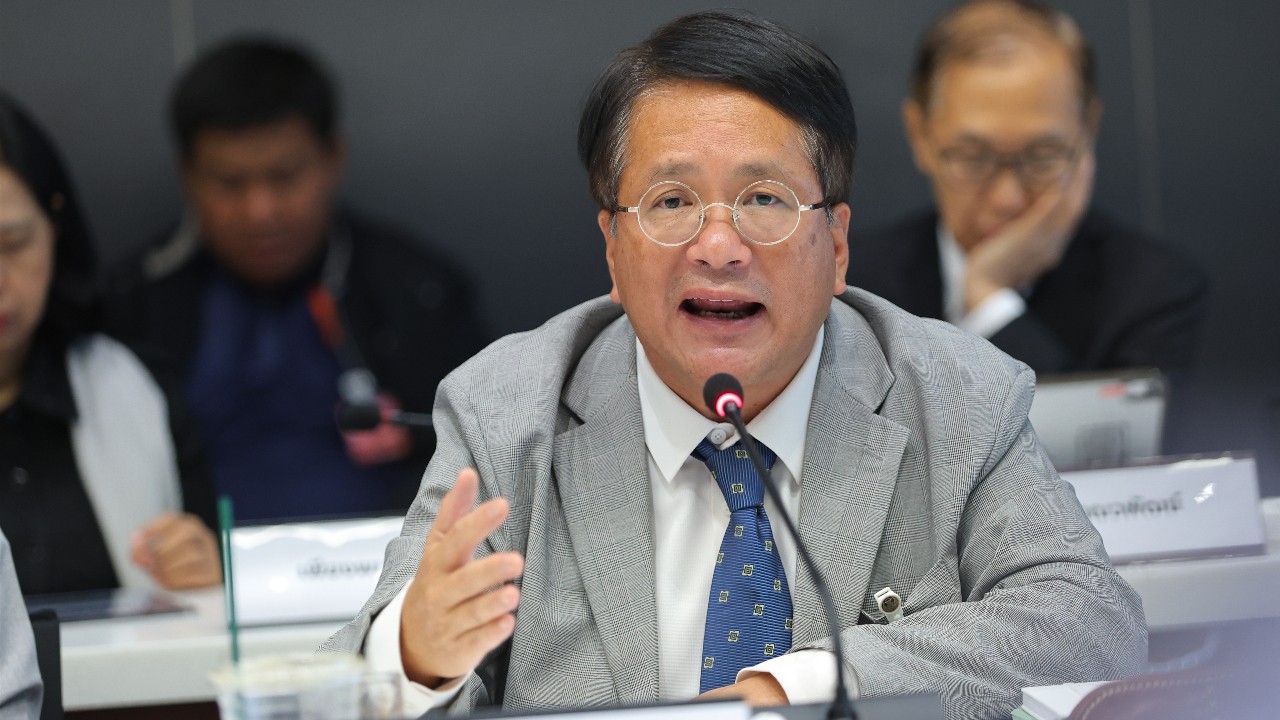
“Decharat” urges the government to revise the criteria for agricultural flood relief, criticizing the compensation as low and delayed, and proposes urgent injections of central budget funds for recovery efforts.
On 7 October 2026 at the Parliament Building, the People’s Party held a press conference on the 15th Shadow Cabinet meeting. Mr. Decharat Sukkamnerd, head of the Shadow Cabinet’s Quality of Life team, revealed that the 2026 flood crisis severely affected farmers in 47 provinces, with over 154,000 farmers suffering. Agricultural land damage totaled more than 1.74 million rai, including nearly 1.4 million rai of rice paddies, 247,000 rai of field crops and vegetables, and over 100,000 rai of fruit trees or perennial plants. Additionally, livestock losses reached as high as 12.5 million animals, with more than 50,000 rai of aquatic farming areas damaged.
Mr. Warayut Thongsuk, former MP for Chanthaburi from the People’s Party, pointed out shortcomings in government management. He stated that the flood was not an unforeseeable natural disaster but resulted from inefficient state agencies. For example, in Kaeng Hang Maeo district of Chanthaburi province, which had never before experienced severe flooding, the Royal Irrigation Department focused mainly on water storage for drought prevention without planning or incorporating risk forecasts for increased water volumes. This led to concerns about the failure of water management in the area.
This aligns with testimony from Mr. Wongsathon Sorna, a durian farmer in Tha Mai district, Chanthaburi, who reported his losses. Of his 800 durian trees, fewer than 200 are expected to survive, representing a total loss of five years’ investment. He also said there was no clear early warning, causing him and many farmers to misjudge the situation and be unable to mitigate losses effectively, despite efforts to prepare by relocating agricultural equipment and fertilizers in advance.
Mr. Decharat continued that many areas are now entering the recovery and relief phase. He analyzed five major problems in the current government relief process:
1. Delays: The aid payment process can take 5-6 months due to a shortage of field survey staff and sequential approval steps from district, provincial, to national levels.
2. Low compensation rates that do not reflect reality: Government compensation amounts are insufficient for reinvestment. For example, rice paddy compensation is only 2,240 baht per rai, while total loss of fruit trees or durian orchards receives 6,800 baht per rai, and growth stagnation compensation is 3,400 baht per rai.
3. Unrealistically low compensation ceilings: Relief criteria for livestock and fisheries cap aid at very low limits, such as no more than 5 cattle or buffalo, 10 pigs, 1,000 laying hens, and 5 rai of aquatic farming. Farmers with larger holdings do not receive full assistance.
4. Lack of recovery support: The government has no measures to assist perennial plants experiencing growth delays and does not regulate rising prices of production inputs that may be exploited.
5. Debt relief alone is insufficient: Simply deferring debt payments does not solve the problem because most farmers lack new capital to restart production, especially for replanting crops or repairing damaged facilities.
Mr. Decharat proposed urgent measures to relevant agencies, urging the government to improve relief criteria—both compensation rates and ceilings—to reflect actual damages, considering use of central budget funds. The Ministry of Agriculture and Cooperatives should send expert teams and budgets promptly to rehabilitate surviving fruit trees to preserve orchards. If this fails, the government must provide assistance equivalent to full loss cases. He suggested using technology such as satellites and drones to assess damages and empowering local officials to expedite compensation payments within 45 days. He also called for revising farmer registration requirements to allow those without updated registrations, undocumented land, or land tenants to prove agricultural activity and damage with other evidence.
Regarding financial measures, Mr. Decharat recommended the government negotiate with the Bank for Agriculture and Agricultural Cooperatives (BAAC) to implement debt restructuring programs for affected farmers. This should include adequate funding support for restarting production, crop insurance to reduce future risks, grace periods on debt payments during non-productive early stages, and appropriate repayment structures, alongside exploring ways to increase supplementary income in the initial phase.