

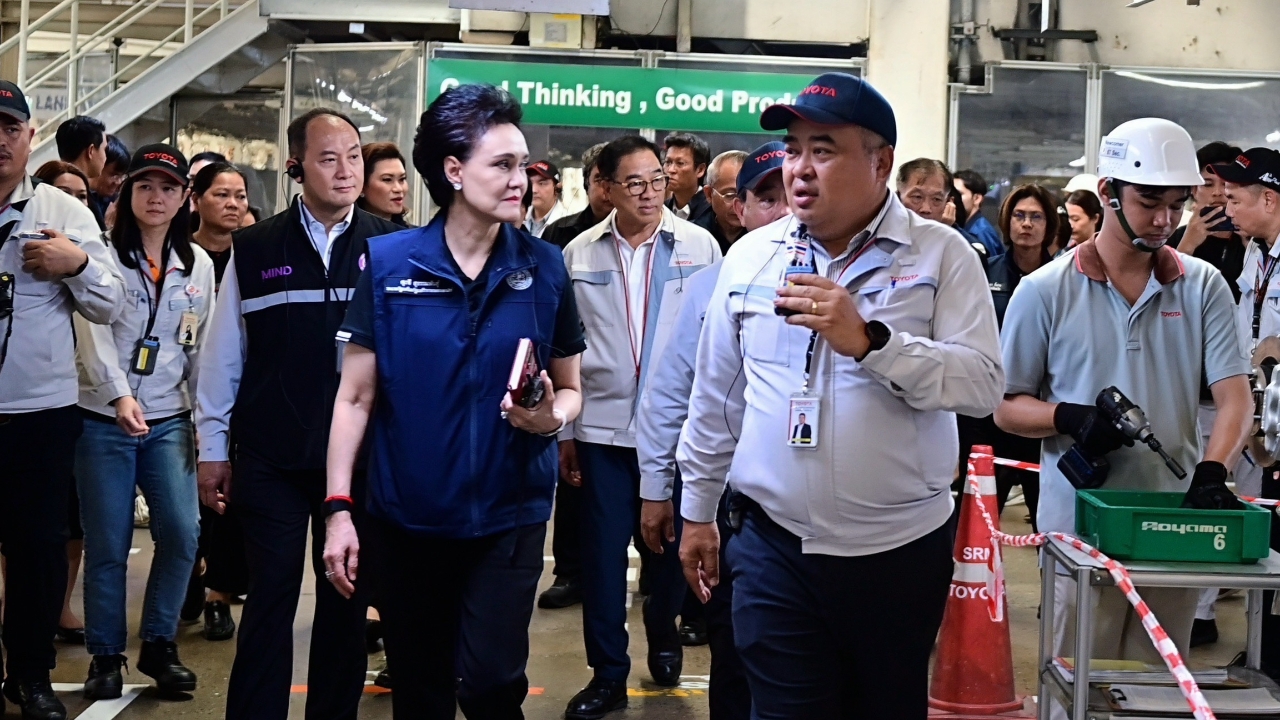
Suphajee inspected Toyota factories, listened to issues, and helped coordinate solutions. Toyota announced a temporary suspension of production lines at three plants, reducing output by 30,000 units after floods affected suppliers. The company hopes the government will improve flood warning systems to be more effective.
At 14:00 on 7 Oct 2026 GMT+7, Ms. Suphajee Suthumpun, Deputy Prime Minister and Minister of Commerce, revealed after visiting the Toyota automobile manufacturing plant in Samrong to build confidence in the industry and hear approaches for coping with flood impacts that the three main Toyota factories were not directly damaged, but were affected through the supply chain. Suppliers in Amata Industrial Estate were unable to deliver key parts because their factories were flooded.
Ms. Suphajee said that regarding the economy, the Ministry of Commerce and Ministry of Industry have interconnected roles from upstream to downstream. The Ministry of Commerce handles goods, distribution, trade, and exports, while the Ministry of Industry manages manufacturing, factories, and supply chains. This visit was to monitor another aspect of the flood situation to ensure no shortage of goods, production continuity, and minimal trade and export impact.
"Currently, all parties have divided responsibilities. The front line cares for affected people and local situations, while we act as the support line to keep the system running smoothly. Goods must not run short, factories must keep producing, and transportation and exports must not be disrupted, because all are interconnected in one system."

Previously, the Ministry of Commerce established a Single Command and War Room to monitor goods and distribution nationwide and visited distribution centers to follow up on implementation after orders. This visit expanded monitoring to the "upstream" production sector, especially the automotive industry, a key export sector with a large supply chain linking many parts manufacturers and operators.
In Toyota’s case, the three factories were not directly flooded, but production was affected because some parts suppliers in the supply chain were flooded and unable to deliver parts normally. The Ministry of Industry was instructed to monitor the entire system to identify affected factories or suppliers, potential bottlenecks in raw materials or parts, and areas where the government can assist or remove obstacles to help production resume quickly.
"Today we focus on Toyota because the automotive industry includes not only vehicle assembly plants but also interconnected parts manufacturers and suppliers. If one point stops, the impact can spread through the whole system. We need to identify problems quickly and help coordinate solutions."

Short-term plans include relevant agencies visiting Amata Industrial Estate to inspect supplier issues preventing parts delivery and coordinating with industrial estates and key production bases elsewhere to collect impact data and consider tailored assistance. Monitoring will cover not only automotive but also food and related industries to track the whole supply chain from factories, transportation, warehouses, and distribution to domestic and foreign markets.
Long-term plans involve considering operators’ proposals at the policy level, including tax incentives to reduce costs for transporting labor and raw materials, supporting continuous production. These measures are still under consideration and are not yet in effect.
There is also an idea for businesses to use the temporary production halt period to develop employee skills, preparing for accelerated production when parts supply normalizes. This approach could serve as a model for other industrial plants to adapt during disruptions.

Ms. Suphajee added that another concurrent task is maintaining confidence in Thailand’s capabilities. Besides resolving affected areas promptly, examples of industrial zones, warehouses, and operators managing the situation well will be collected to demonstrate to partners, investors, and foreign businesses that Thailand’s production and logistics systems remain ready and manageable under these conditions.
Long-term proposals will be considered at the policy level, including requests for government tax exemptions on imported machinery, equipment, and parts necessary for repairing flood-affected factories, and additional tax deductions for repair and restoration costs of machinery and plants to resume normal production quickly. These proposals will be discussed with relevant agencies and are still under consideration.
"Being the support line doesn’t mean waiting for problems to occur before acting. We must view the entire system to identify risks, where help is needed, and where things still run well. We must keep it moving to minimize impacts on the economy, production, and exports."

Mr. Somkid Praditkamjachai, Senior Executive Vice President of Toyota Motor Thailand Co., Ltd., said that Toyota has temporarily suspended production lines at its Samrong, Gateway, and Ban Pho plants because about 14 suppliers in Amata Industrial Estate were flooded with water levels 50-70 centimeters high, preventing production and delivery of key parts like mats and airbags. As a result, they had to urgently import some parts from Japan and Vietnam temporarily.
The production halt has caused accumulated vehicle production losses estimated at 30,000 units, affecting domestic sales and export proportions. Initially, the Samrong and Gateway plants will stop production until 10 Oct, while Ban Pho is expected to suspend operations until 18 Oct. The company plans a two-phase recovery: accelerating supplier factory reopening and urgently increasing production capacity to deliver vehicles to customers.

Additionally, Toyota urges the government to swiftly improve flood warning systems to be more accurate, faster, and efficient. The delayed warnings caused factories and suppliers to be unprepared, leading to severe machinery damage from flooding. Toyota also calls for concrete government tax and low-interest loan support measures to help suppliers recover and prevent future crises.
The government is seriously considering Toyota’s requests, including import tax exemptions for new machinery and replacement parts from abroad, and allowing repair and machinery upgrade expenses to be deducted from taxes at double the value. Government representatives promised to discuss these with the Ministry of Finance and Revenue Department promptly to reduce costs and speed up recovery of the automotive sector’s production capacity.
