

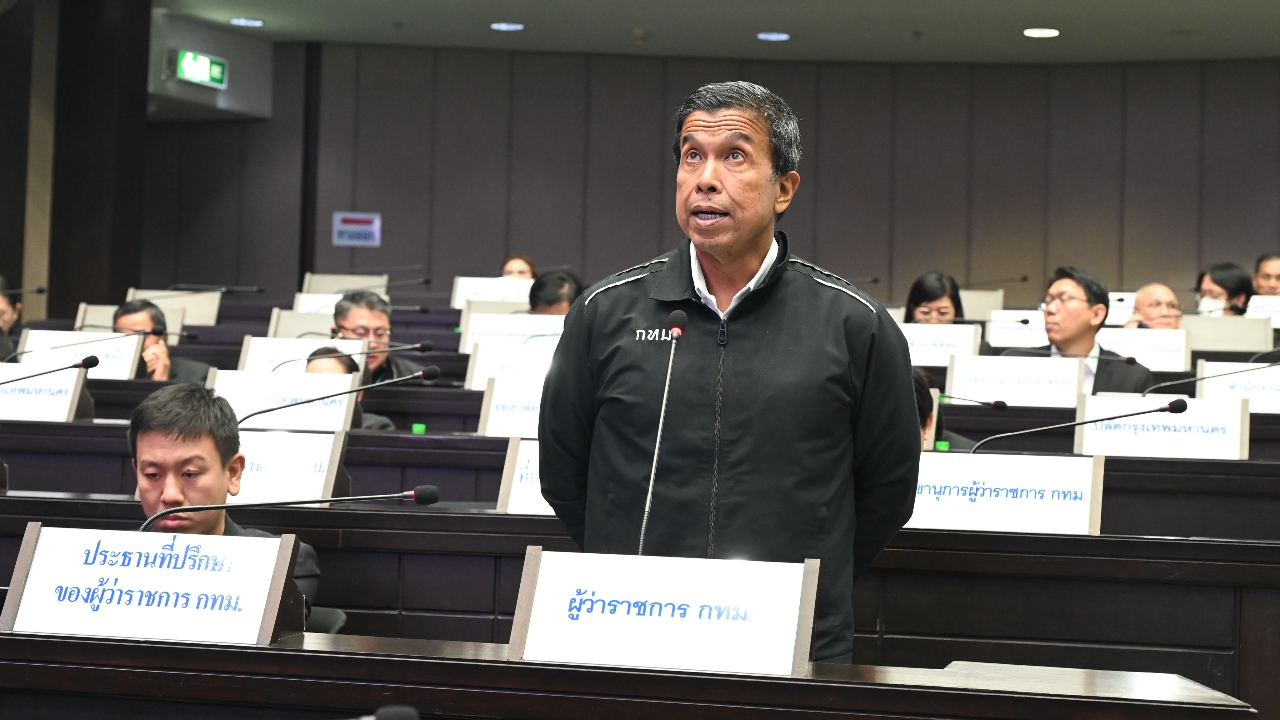
Bangkok councillors queued to debate an urgent motion pressing the city to resolve issues of flooding, stagnant water, waste, and victim relief. Governor Chadchart explained that the situation remains fragile, with continuous inflow from neighboring provinces, requiring more time to drain the water.
On 7 Oct 2026, during the Bangkok Metropolitan Council's fourth regular session (first meeting) at the council chamber in the Airawat Pattana Building, Bangkok City Hall, Din Daeng, Mr. Narissorn Saengkaew, Second Deputy Chairman of the council, chaired the meeting. At one point, Mr. Surachit Pongsingwittaya, council member for Lat Krabang, along with other councillors, verbally proposed a motion urging Bangkok to expedite solutions for flooding and manage stagnant water areas back to normal quickly.
Mr. Surachit stated that the stagnant floodwater situation in Lat Krabang continuously affects and causes distress to residents, with water accumulating for several days. He urged Bangkok to take prompt corrective action and highlighted five key issues needing urgent attention:
1. Stagnant water and foul odors: Currently, stagnant water in many areas is beginning to smell and decay. Residents demand EM solution to treat wastewater and reduce health and environmental impacts.
2. Accumulated waste: Although Bangkok has collected waste from main roads, significant amounts remain piled up in alleys and communities. Waste collection and disposal should be expedited to cover all areas.
3. Victim relief: Compensation payments remain delayed, especially for homes without land deeds. Some cases require certification from local councillors despite district offices already having household and property data. Bangkok should consider reducing steps and speeding up verification so compensation reaches victims faster.
4. Transportation in flooded areas: Travel and transport systems remain inadequate. Small vehicles cannot access some locations, forcing residents to wade through water, risking accidents. Fatalities have already been reported due to this situation.
5. Survival kits and essential supplies: Residents in affected areas still lack survival kits and necessary consumables. Bangkok should promptly allocate and distribute aid sufficiently and comprehensively.

Later, Mr. Somchai Wesaratchatrakul, council member for Sai Mai, said relief measures still lack clear details for residents, especially for homes without land deeds, where residents must submit documents and have local councillor or community leader certification. Some homes lie along canals without deeds or are outside communities. He urged Bangkok to set clear criteria and procedures and to publicize them so officials and residents understand when documents or certifications are required for compensation.

Deputy Governor Tawida Kamolwet explained that per Cabinet resolutions, compensation applications via the "Government Channel" app require house registration number verification to prevent duplicate claims. Compensation amounts depend on the type and duration of impact.
For Bangkok's actions, further evidence verification is needed since some victims do not reside according to house registration data, requiring officials to inspect and assess damage. A land deed is only one proof of residence rights; if absent, district offices can consider other documents with possible certification per criteria. Bangkok has assigned officials from unaffected districts to assist in affected areas and instructed them to expedite document collection and verification.

Council member Wirat Meenchainan of Min Buri said Bangkok should prepare plans for water volume flowing from northern areas through Khlong Hok Wa Sai Lang in Pathum Thani. Districts likely most affected include Nong Chok, Khlong Sam Wa, Sai Mai, and Don Mueang.
For areas with stagnant, foul water, treatment with EM solution before pumping into canals should be considered to prevent downstream impacts, especially in northern Bangkok. He proposed that the administration consider allowing communities to use funds from the Strong Community Project to purchase water pumps to mitigate local effects. He also suggested that district directors lead local command centers to coordinate agencies and volunteers efficiently and expedite removal of waterway blockages.
. Governor Chadchart Sitthiphan explained that currently, over 350 million cubic meters of water are accumulated in Bangkok's eastern areas, affecting Bangkok and nearby provinces such as Pathum Thani, Chachoengsao, and Samut Prakan.
Regarding drainage, main canals like Saen Saeb and Lat Phrao canals are gradually improving water flow. However, Pravet Burirom Canal still handles large volumes slowly, as it is a key catchment for surrounding provinces. Bangkok coordinates closely with the Royal Irrigation Department to manage floodgates and pumps, accelerating discharge into the Bang Pakong and Chao Phraya rivers at full capacity.

At the onset, coordination faced challenges, especially at Romklao Housing Estate and Khlong Chan community in Lat Krabang, low-lying areas shaped like basins over 40 years old. Romklao Housing Estate, a large community with over 30,000 residents, initially saw multiple agencies and volunteers assisting simultaneously, while district directors had to oversee many areas.
. Currently, Bangkok has established an incident command center and divided zones for systematic area management, improving organization and efficiency in administration and aid delivery. He emphasized the situation remains fragile with large water volumes, particularly around outskirts where water continues flowing in from neighboring provinces, requiring more time for drainage.
Council member Yokpornchai Isarasereepong of Khlong Sam Wa proposed that Bangkok consider additional relief measures for those affected long-term, especially if impact exceeds 14 days or lasts up to a month, since property damage and psychological effects differ. Compensation criteria should reflect duration of impact.
Council member Piyawan Choraka of Suan Luang district asked whether Bangkok has measures for repeated storms and floods, and whether the "Government Channel" app and Bangkok's systems can resolve duplicate registration issues, as some residents share buildings or apartments. She also suggested reducing registration steps to enable officials to verify data and provide assistance faster.
The governor reiterated that there is no clear forecast of a new storm, but Bangkok remains cautious and prepares contingency plans in advance. The deputy governor added that application systems are managed by Bangkok officials who evaluate cases individually and request additional information as needed. Officials have been trained by the Department of Disaster Prevention and Mitigation to provide accurate information and respond to victims' inquiries.
Council member Mathuros Bent of Saphan Sung added that Bangkok should implement a systematic water drainage management plan including drainage pipes, flood barriers, gates, and water level sensors. The city should also urgently address encroachment on waterways, especially large housing projects that might obstruct water flow and discharge wastewater into canals.
Then, council member Pongsakorn Rattanrueangwatthana of Bang Kapi stressed that after floodwaters recede, Bangkok must swiftly resolve accumulated waste and victim relief issues. He thanked officials, residents, and volunteers from all sectors who assisted during this crisis.

Council member Kantapong Dichaiya of Taling Chan reported that the shelter at King Mongkut's Institute of Technology Ladkrabang houses over 700 evacuees but lacks sufficient support from Bangkok, forcing helpers to provide 24-hour care for 5–7 days. There are patients and health issues in the shelter, with delays in supplying regular medicines due to complex documentation procedures.
Dr. Kriangkrai Tangjitmanisakda, Director of Bangkok's Medical Department, explained that since 02:00 on 25 Sept 2026, Bangkok has upgraded its medical operation plan for flood victims, opened the Erawan hotline 1669, and alerted all city hospitals from 05:00. Care divides into two main groups: general evacuees, managed primarily by district offices, and bedridden or special care patients, who receive treatment in city hospitals.
However, Nakharin Hospital was affected by flooding near Soi 15, making access impossible. King Mongkut's Institute of Technology Ladkrabang offered meeting rooms as shelter centers, cooperating with King Mongkut's Hospital to accommodate and care for both groups in the same location.
Support also comes from Ministry of Public Health agencies including the Department of Medical Services, Department of Disease Control, and Department of Mental Health, plus medical teams from Nakharin and Sirindhorn hospitals. Initial coordination challenges occurred, with about 70 vulnerable individuals among 700–800 evacuees. Currently, Bangkok medical teams fully manage and provide care.
Council member Nopwit Wongaree of Lak Si added that online applications are a good approach but some document requests remain redundant, as district offices may already have the information. He urged Bangkok to reduce duplicate document requests. After water recedes, accumulated waste and road surface damage remain problems needing prompt repair.
Deputy Governor Sannot Wangsangbun briefly stated that Bangkok is improving systems to eliminate unnecessary document requests.

Council member Sutthichai Veerakulsunthorn of Chom Thong said Bangkok should seriously address waterway encroachments and consider purchasing water pumps and sludge suction vehicles for districts, rather than storing them only centrally. Council member Adisorn Rerklasani of Don Mueang supported this, recommending budget allocation for districts to acquire pumps for rapid local problem-solving.
After the debate, the Bangkok Metropolitan Council approved the motion and forwarded it to city administrators for consideration and implementation of related actions.