

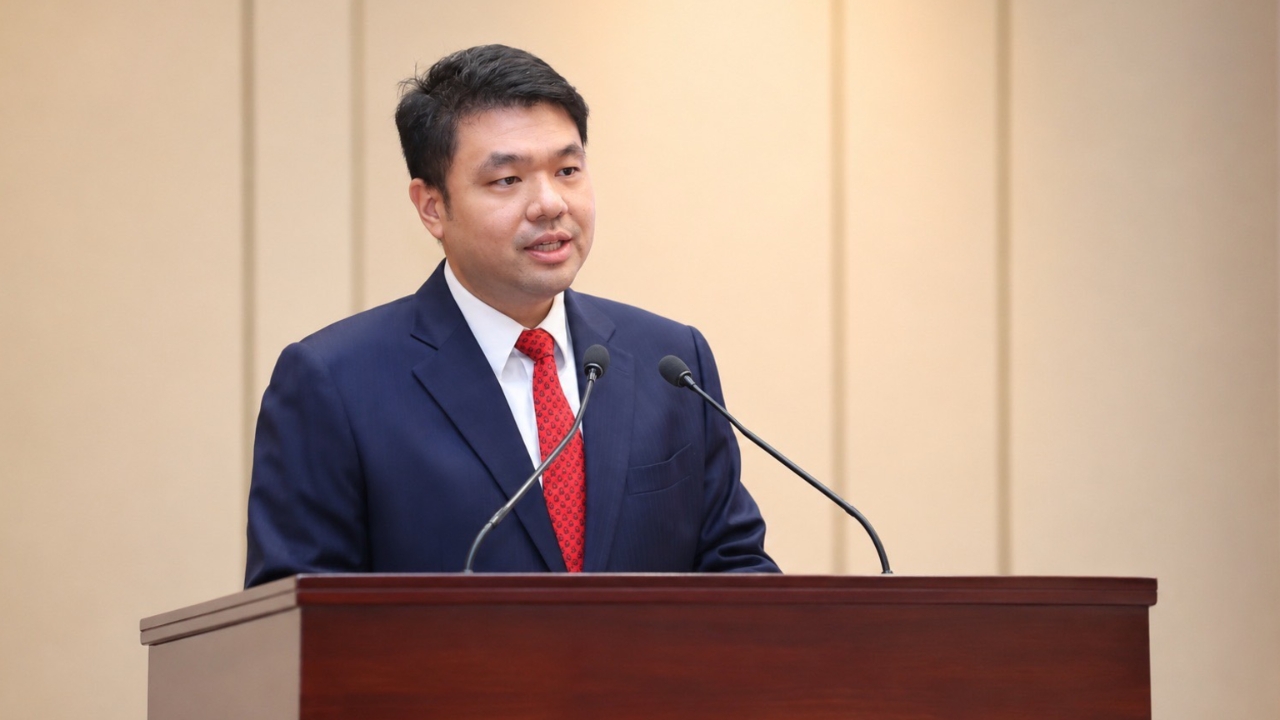
Pachara Naripthaphan advises the government to seize the opportunity of the 2026 IMF-World Bank meeting to position Thailand strategically, seeing it as a chance to engage with those who set the global economic direction, and points out four benefits Thailand should receive.
9 Oct 2026 GMT+7 Pachara Naripthaphan, member of the Securities and Exchange Commission (SEC) Board, commented on the 2026 annual meeting of the International Monetary Fund (IMF) and World Bank Group, which Thailand will host in Bangkok from 12 to 18 October. This is the first time in 35 years since 1991. He said Thailand should not view this merely as successfully hosting a major event but as an opportunity to converse with those shaping the global economic landscape at the same time.
Pachara said the government’s plan to present itself as a “Trusted Connector” in its role as a Middle Power is a correct approach aligned with Thailand’s true strengths. “Thailand is not an economic superpower competing to set global rules like the U.S. or China, but it has a rare strength: being trusted by all sides— the U.S., China, Japan, the Middle East, and ASEAN countries themselves. Positioning itself as a connector best suits our status as a Middle Power.”
He also noted that this concept aligns with the government’s main theme for the Thailand pavilion, “New Horizon: 7 Decades of Building Resilience and Empowering People,” covering four key areas: government digital infrastructure, Middle Power diplomacy, climate change resilience, and an aging society.
However, Pachara warned that the term “Trusted” must be proven through actions, not just slogans. “To claim fully that we are a Trusted Connector, Thailand must answer persistent investor questions first—such as issues with foreign nominee shareholders, transparency in supply chains, and clarity in AI and data center regulatory frameworks. If internal structural gaps remain, then the word ‘Trusted’ will be just a nice-sounding term without real weight when investors do their homework later.”
Pachara suggested Thailand should use this platform for more than just hosting duties, citing at least four practical benefits that should arise.
The first is to use this forum to discuss Thailand’s economy directly with standard-setting authorities. The IMF plays a key role in assessing members’ macroeconomics, including growth, inflation, fiscal policy, and public debt. This year is especially important because the government plans to borrow 1.26 trillion baht in fiscal 2026, and the Finance Ministry expects public debt to approach 70% of GDP in fiscal 2027. This meeting offers a chance to explain how Thailand will manage growth alongside fiscal discipline.
The second is to use this platform to observe global capital flow directions. The agenda covers FDI, AI, supply chains, financial stability, and digital public finance, providing insight into where investments will go over the next 3-5 years, which industries are emerging, and which countries are competing with Thailand for investments.
The third is to build state-to-state networks through parallel bilateral meetings, which provide space to discuss trade, investment, and country-specific issues.
The fourth is the opportunity to set issues Thailand wants the world to hear. This year includes the Thailand Special Seminar titled “Bangkok 1991-2026: Thailand's Path to Resilient, Inclusive Growth,” the Finance Minister’s talk “Building Resilience in a Fragmented World,” and the launch of the Bangkok Blueprint for Fraud-Resilient Financial Services, a cooperation framework to combat financial crime, highlighting the government’s special efforts on this front.
Pachara added that another key point to understand for leveraging this forum to build Thailand’s investment image is investors’ perception of risk.
“Every investment inherently involves risk; the real question investors ask is not whether there is risk, but whether the risk they bear is justified by the returns. Being a meaningful Trusted Connector means providing the best risk-adjusted returns compared to competitor countries in the region, not just claiming to be trustworthy superficially.”
Pachara explained this ties directly to the business environment, which converts abstract risk into measurable numbers investors can calculate—such as policy clarity and continuity, transparency of regulatory processes, and speed of legal procedures in disputes. Efforts are underway to improve Thailand’s Ease of Doing Business ranking as part of the OECD accession process, but the current progress and assessment authorities remain unclear.
“At this point, institutional investors attending this event do not decide based solely on speeches at the meeting; they follow up with their own research. If what they find does not match the presented image, the credibility built can collapse faster than it was created. Therefore, the real work of being a Trusted Connector lies not in the seven days of the meeting but in making Thailand’s business environment predictable in risk and genuinely rewarding in the long term.”