

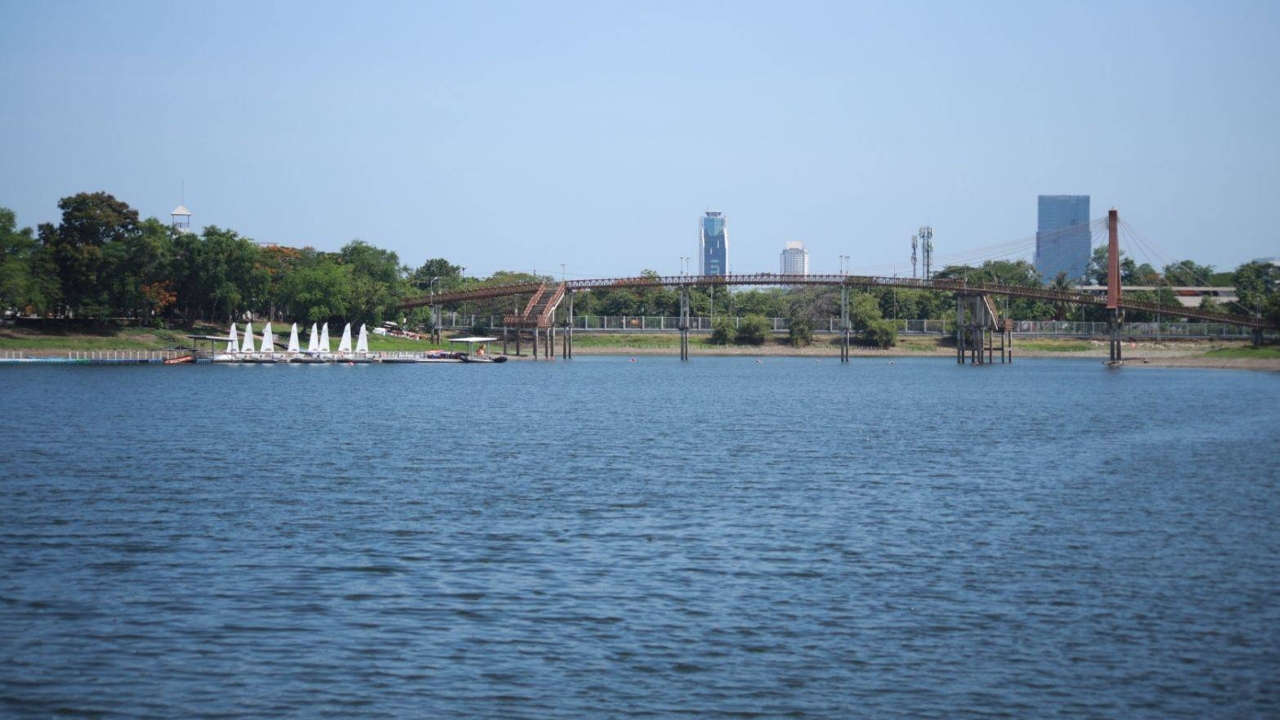
Samasarn presents the budget for building three monkey cheek reservoirs, challenging the Bangkok Metropolitan Administration (BMA) to prioritize the public benefit rather than choosing projects just because they are "cheaper".
On 9 Oct 2026 GMT+7, Mr. Samasarn Rajapolsit, former Deputy Governor of Bangkok (BMA), posted on Facebook regarding the flood control measures by the current BMA administration under Governor Chadchart Sittipunt. He criticized the revised city plan that removed the eastern Bangkok monkey cheek reservoirs from consideration, citing high land costs and questioning what Bangkok could build. He noted that the monkey cheek reservoirs, especially Bueng Khu Bon and Bueng Bang Chan, were canceled in favor of improving the already existing Bueng Nong Bon reservoir with comprehensive system upgrades—canals for water transport, tunnels to bring water in, and drainage systems—mainly due to rising land prices and project costs.
He invited the public to examine the figures and asked whether abandoning the Bueng Khu Bon and Bueng Bang Chan reservoirs in favor of Bueng Nong Bon is truly more cost-effective.
1. What is the current land price?
The BMA clarified the current land prices as follows.
(1) Bueng Khu Bon: 130 rai priced at 16.8 million baht per rai (42,000 baht per square wah), totaling 2.184 billion baht.
(2) Bueng Bang Chan: 39 rai priced at 37.6 million baht per rai (94,000 baht per square wah), totaling 1.466 billion baht. Combined land cost for both sites is 3.65 billion baht.
2. Where does the 11 billion baht come from?
The BMA explained that the investment for the Bueng Khu Bon and Bueng Bang Chan monkey cheeks includes not only land costs but also excavation and construction: 324 million baht for Bueng Khu Bon's pond and water control buildings, 172 million baht for Bueng Bang Chan's pond and buildings, 450 million baht for pumping and drainage stations, and 6.404 billion baht for main canal upgrades. Adding the 3.65 billion baht land cost results in a total investment of 11 billion baht.
3. How much would it cost to use Bueng Nong Bon instead? The BMA revealed that using the existing Bueng Nong Bon reservoir with necessary system upgrades would require about 6.5 billion baht, including 6.404 billion baht for main canal improvements and 96 million baht for water control buildings. Compared to the 11 billion baht for the Khu Bon-Bang Chan project, the Nong Bon option costs 4.5 billion baht less. Although the investment difference is clear, flood prevention investments should not be judged by cost alone.
4. Which option provides greater benefit? The crucial question is not just "which project is cheaper?" but "which project offers greater benefits or returns to the public?" Here, returns do not mean financial profit or loss but benefits from reducing flood-affected areas and damages relative to investment, including long-term operational and maintenance costs. Examples of damages if no monkey cheek reservoirs exist include damage to homes and property, business disruptions, traffic jams, inability to work or attend school, difficulty accessing medical care especially for pregnant women near delivery, and impacts on physical and mental health. Many of these damages are hard to quantify financially but still impose costs. Has the BMA incorporated these damages in its cost-benefit analysis of the monkey cheek projects?
5. How much additional water retention capacity does eastern Bangkok still need? Mr. Samasarn noted that the BMA previously studied flood protection east of the Chao Phraya River within the royal flood barrier area, covering about 650 square kilometers. The study found that during heavy rain within three hours, about 13 million cubic meters of excess water would accumulate, necessitating additional monkey cheek reservoirs. As of January 2023, the BMA reported 7.66 million cubic meters of existing monkey cheek capacity in the east, while demand is about 13 million cubic meters, leaving a deficit of 5.34 million cubic meters. The question is whether the east still requires at least this additional capacity. If so, does canceling Khu Bon and Bang Chan, which together provide about 1 million cubic meters, cause Bangkok to lose an opportunity to increase floodwater storage?
6. He proposes building all three: Khu Bon, Bang Chan, and Nong Bon. This is significant because the 6.404 billion baht for main canal upgrades is part of both projects. Both the Khu Bon-Bang Chan and Nong Bon projects require this canal upgrade. Therefore, the BMA should consider constructing Khu Bon-Bang Chan and upgrading Nong Bon simultaneously to maximize the benefits of the main canal improvements for both monkey cheek sites.
"If both sites are developed, how much additional funding is required?"
Mr. Samasarn stated that the Khu Bon-Bang Chan project costs 11 billion baht, including 6.404 billion baht for the canal upgrade. The Nong Bon alternative costs 6.5 billion baht, also including the 6.404 billion baht canal upgrade. So, if the BMA is already undertaking the Nong Bon project and wants to add Khu Bon-Bang Chan, the canal upgrade cost should not be counted twice. The incremental cost for Khu Bon-Bang Chan is therefore 4.596 billion baht (11 billion minus 6.404 billion). Adding this to the Nong Bon budget of 6.5 billion baht results in a total of 11.096 billion baht. Within the 4.596 billion baht increase, land expropriation accounts for 3.65 billion baht and other components 946 million baht. If the BMA can acquire land at previously assessed prices (324 million baht for Khu Bon and 424 million baht for Bang Chan, totaling 748 million baht), land acquisition costs would decrease by 2.902 billion baht. The additional 4.596 billion baht investment would provide Bangkok with about 1 million cubic meters more floodwater storage and significantly reduce flood damage.
"Therefore, do not cite only 'high land prices' as a reason. I'm not saying land prices are not an issue, but land cost should not be the final deciding factor for infrastructure projects. If 'land is expensive, so no construction' is the rationale, many major infrastructure projects in Bangkok would be difficult to implement because at some stages land acquisition costs exceed construction costs. Regarding Khu Bon-Bang Chan, I leave this question to the BMA: If spending an additional 4.596 billion baht can provide about 1 million cubic meters more floodwater storage, should the decision be based on 'land price' or on 'damage prevented' instead?" Mr. Samasarn concluded by inviting public opinion.