

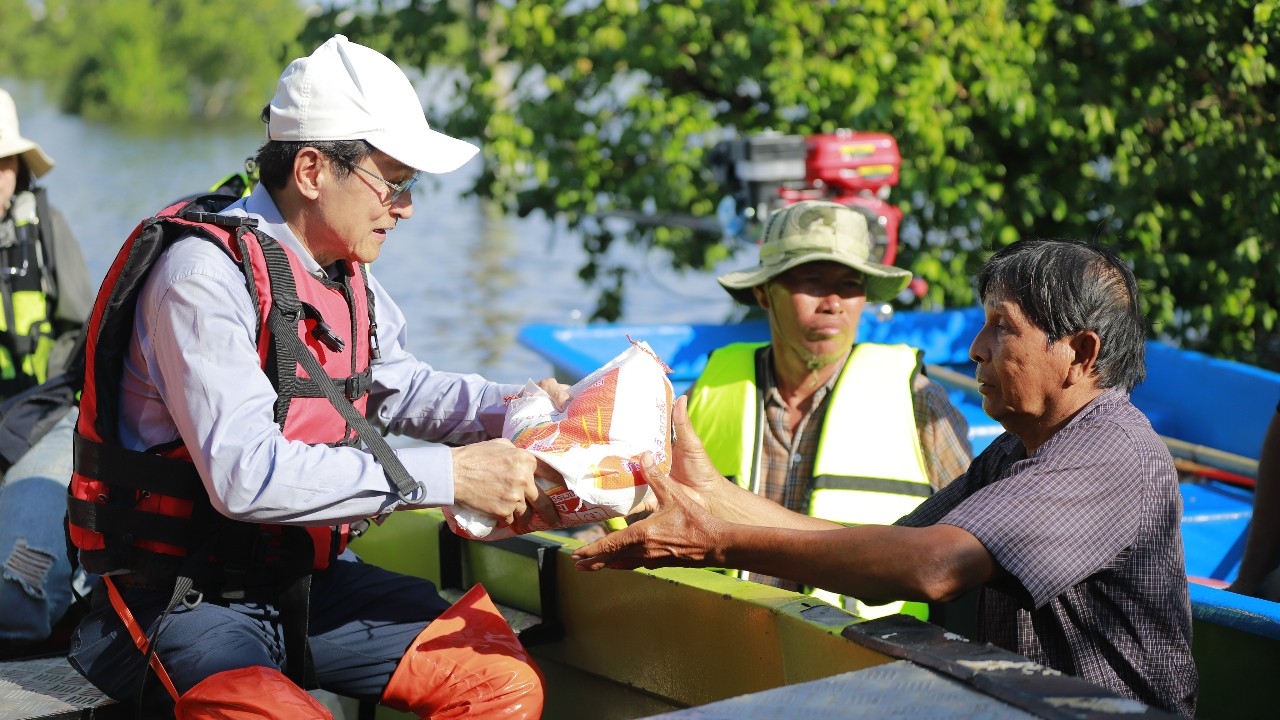
Chaturon boarded a boat to assist flood victims in Hua Sai Subdistrict, Chachoengsao Province. He pointed out that residents may have to live with floodwaters for up to two months but still lack boats, forcing them to use foam rafts that risk capsizing. He urged the government to urgently provide sufficient boats.
On 10 Oct 2026 GMT+7, Chaturon Chaisang, party-list MP for the Pheu Thai Party, visited Hua Sai Subdistrict, Bang Khla District, Chachoengsao Province. He traveled by boat to the far end of the subdistrict bordering Dong Noi Subdistrict, covering about 5 kilometers round trip by water, while receiving information from the Hua Sai Subdistrict Administrative Organization president and his team.
Chaturon stated that Hua Sai covers about 48 square kilometers, with only around 5 square kilometers not flooded; the rest is submerged. The area has approximately 2,500 to 2,600 households. It is a water junction receiving flows from three directions: Khlong Rabom-Siyad, Prachinburi-Nakhon Nayok provinces, and Rangsit. This flood is 30 to 50 centimeters higher than the previous severe flood in 2013.


Chaturon said experts predict that the Bang Pakong River basin will remain flooded for about 38 days if there is no additional rain or inflow. However, from 9 to 13 Oct, heavy to very heavy rain is expected. Local administrative organizations estimate flooding will last at least one to one and a half months. If water inflow increases and drainage is slow, the hardship could extend to one and a half to two months, which is not an exaggeration.
He added that almost all damage is severe. Recently harvested rice fields are completely ruined. Most shrimp ponds, which are numerous, are nearly destroyed. For perennial trees like mango and coconut, if flooding continues for two to three weeks up to one month, they are likely to be almost entirely lost. Relief measures must consider rules and criteria that allow farmers to recover their livelihoods, including managing debts.

Meanwhile, residents are scattered rather than clustered in villages, making care and travel difficult. Problems include shortages of food, essential medicines, treatments for foot rot, common medicines, and transporting patients to hospitals in emergencies.
Chaturon said the local administration is doing its best but still lacks flat-bottomed motorized boats—at least two per village with drivers. Floodwater increases boat prices, so many villagers resort to homemade rafts made from foam sheets reinforced with bamboo or slats, which lack standards and risk capsizing. The challenge is to provide safe, adequate boats for residents.
“Since the first day of rain, I have said that dealing with flooding across Bangkok and over twenty other provinces without boats is impossible. The government must urgently secure enough boats as soon as possible,” Chaturon said.


Chaturon explained that his visit to Hua Sai aims to learn lessons applicable to many other subdistricts, districts, and provinces facing similar issues: to speed up water drainage so people endure flooding for the shortest time possible, and while flooding persists, to minimize hardships and ensure comprehensive care for residents.
He also praised all personnel, including local administrative organizations, military, public health, government officials, and rescue units, as the main forces handling overwhelming tasks. He stressed that the most critical lacking equipment are motorized boats, flat-bottomed boats, and water pumps. Managing over twenty provinces requires large-scale coordination, rapid data collection, effective measures, and bold, precise budget allocation.
