

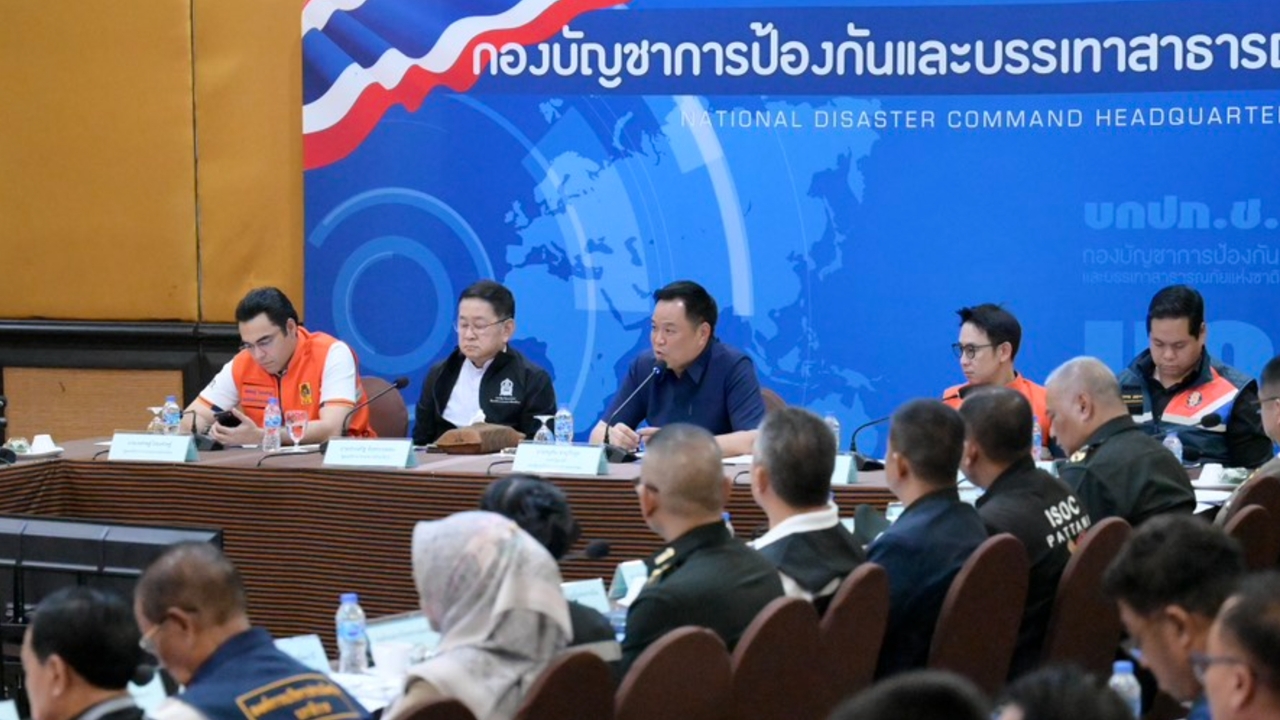
Prime Minister Anutin held a joint meeting with governors from 14 southern provinces in Pattani, issuing seven directives to address flooding from heavy rain. He stressed that no area should be overlooked, underscoring the principle of public safety and urging communication in simple, understandable language to the public.
On 10 October 2026 at 3:00 p.m. Mr. Anutin Charnvirakul, Prime Minister and Minister of Interior, in his capacity as Commander of the National Disaster Prevention and Mitigation Command, chaired a meeting of the National Disaster Prevention and Mitigation Command (NDPCC) to monitor the flood situation and assist affected people in the southern region at the C.S. Pattani Hotel, Mueang District, Pattani Province.
Attending were Mr. Phiphat Ratchakitprakarn, Deputy Prime Minister and Minister of Transport; Mr. Prasert Chanruangthong, Minister of Education; Mr. Jesadaporn Thaiset, Deputy Minister of Interior (Interior 3); Mr. Worasit Liangprasit, Deputy Minister of Interior (Interior 4); Mr. Sanphet Boonyamanee, Deputy Minister of Transport; Ms. Traisuli Traisornkul, Secretary-General to the Prime Minister; Mr. Atsit Sampanrat, Permanent Secretary of the Ministry of Interior; Mr. Narucha Kosasivilai, Director-General of the Department of Provincial Administration; Prof. Dr. Prawit Erawwan, Permanent Secretary of the Ministry of Education; along with related agencies and southern provincial governors, who also participated online.


Prime Minister Anutin said today they were carrying out a mission to welcome the royal visit of His Majesty the King and Her Majesty the Queen in Pattani Province, taking the opportunity to meet with southern provincial governors because according to weather forecasts from the Meteorological Department, many provinces remain at risk of flooding due to heavy rainfall covering nearly all southern provinces, starting from Phetchaburi Province to Malaysia, from now until the end of October 2026. Therefore, a meeting was necessary to rehearse preparedness to cope with potential flood situations.
He emphasized that such flooding should not occur, but if it does, they must be prepared to handle it. There is no sign of rainfall decreasing. Preparedness, especially in caring for the public, is the best action today, including anticipating the situation in advance and preparing evacuation shelters for vulnerable groups such as bedridden patients and the elderly, categorized by medical conditions to various hospitals to ensure their safety.
Mr. Anutin continued that the principle is "No area should be neglected." Communication with the people is extremely important, requiring thorough, easy-to-understand messaging using simple language that can be immediately grasped without unnecessary technical explanations. Clear instructions on when to evacuate, when to return, and what actions to take—step 1, 2, 3, 4, 5—should be provided so the public can prepare to face the situation.
Regarding water management, communication across adjoining areas is necessary so that downstream areas can prepare warnings and care for their populations, reducing the severity of flooding and preventing local conflicts. The focus must be on ensuring people’s safety, providing them shelter with complete basic necessities without deficiency.


. In a crisis, the most critical moment is when water volume arrives; vulnerable groups must be relocated promptly. Additionally, managing the food supply chain—including raw materials, fresh food, meat, vegetables, eggs, cooking oil, gas, and seasonings—is essential. Coordination with food suppliers, transport operators, and disaster machinery operators such as pump and motorboat operators must be arranged in advance.
He reiterated that authorities should use legal powers under disaster prevention and mitigation laws to manage operations, including approving and disbursing emergency government funds with discretion, ensuring proper and transparent usage. This approach can resolve situations without solely relying on central government support, which may be delayed due to travel time for equipment. Proper preparation will allow effective care for the people and keep situations under control.
Shelters must meet standards, including good ventilation and hygienic bathrooms and toilets. This requires cooperation among all sectors, including the military and private organizations, to mobilize resources ready for emergencies. Emergency funds may be used to hire cleaning services to maintain sanitary conditions.
The Ministry of Public Health must prepare to separate patients by type for hospital care and have transfer plans because if hospitals are affected, a referral network is needed. The Ministry of Education must assign provincial officials to deploy personnel and vocational students in technical and home economics fields to support shelters and repair electrical equipment for affected residents.


At the end of the meeting, the Prime Minister issued seven directives to prepare for flood management in the southern region, which are:
1. Monitor and assess the situation, identify risk areas and watch points, review data on previous flood zones, lowlands, key drainage points, transportation routes, and potentially affected areas.
2. Inspect and improve drainage systems such as ditches, canals, floodgates, and remove water blockages. Address vulnerable spots that may obstruct water flow.
3. Prepare personnel and resources, including support plans. Develop and integrate resources across areas, ensuring provinces exchange information and cooperate continuously to avoid overlapping efforts or negative impacts on other areas, enabling efficient cross-area assistance.
4. Plan evacuation and public warnings by reviewing evacuation points, temporary shelters, evacuation routes, care for vulnerable groups, and communication channels to ensure efficient operation.
5. Supervise and report preparedness, obstacles, and support needs to the National Disaster Prevention and Mitigation Command, the Department of Disaster Prevention and Mitigation (DDPM), Ministry of Interior.
6. Publicize emergency reporting channels and government contact points clearly.
7. Establish preparedness centers in each agency according to their duties and responsibilities to integrate operations, coordination, and resource support efficiently.


"Every provincial governor must use social media and internal communication units to disseminate information through all available channels, including provincial platforms and social media such as Facebook, Line, Instagram, X, or others—even personal channels of governors, provincial Red Cross presidents, local officials, and all local government organizations must actively publicize accurate information as officially announced by the government," the Prime Minister said.
He also emphasized that governors should promote the National Disaster Insurance policy, effective from 1 October 2026, which covers floods, storms, and earthquakes for 30 million households nationwide. He instructed that in case of disaster, affected areas must be declared and reported to the DDPM promptly to expedite assessment and insurance claims: initial compensation of 10,000 baht per household, actual home repair costs up to 100,000 baht, and 2 million baht in case of death.
Senior officials attending included Pol. Lt. Gen. Piyawat Chalermsri, Commander of Provincial Police Region 9; representatives from the Internal Security Operations Command Region 4 Front; Mr. Boonchuay Homyamyen, Governor of Narathiwat; Mr. Chotinrin Kerdsom, Governor of Phuket; Mr. Weeraphong Ritrod, Governor of Lopburi; Mr. Kanit Kongsuay, Governor of Satun; Mr. Supamit Chinsri, Governor of Samut Prakan; Mr. Jumphat Wannachatsiri, Governor of Surat Thani; Mr. Chaiporn Niyomkaew, Deputy Governor of Pattani; along with provincial governors, deputy governors, DDPM provincial chiefs, and local administration heads.

