

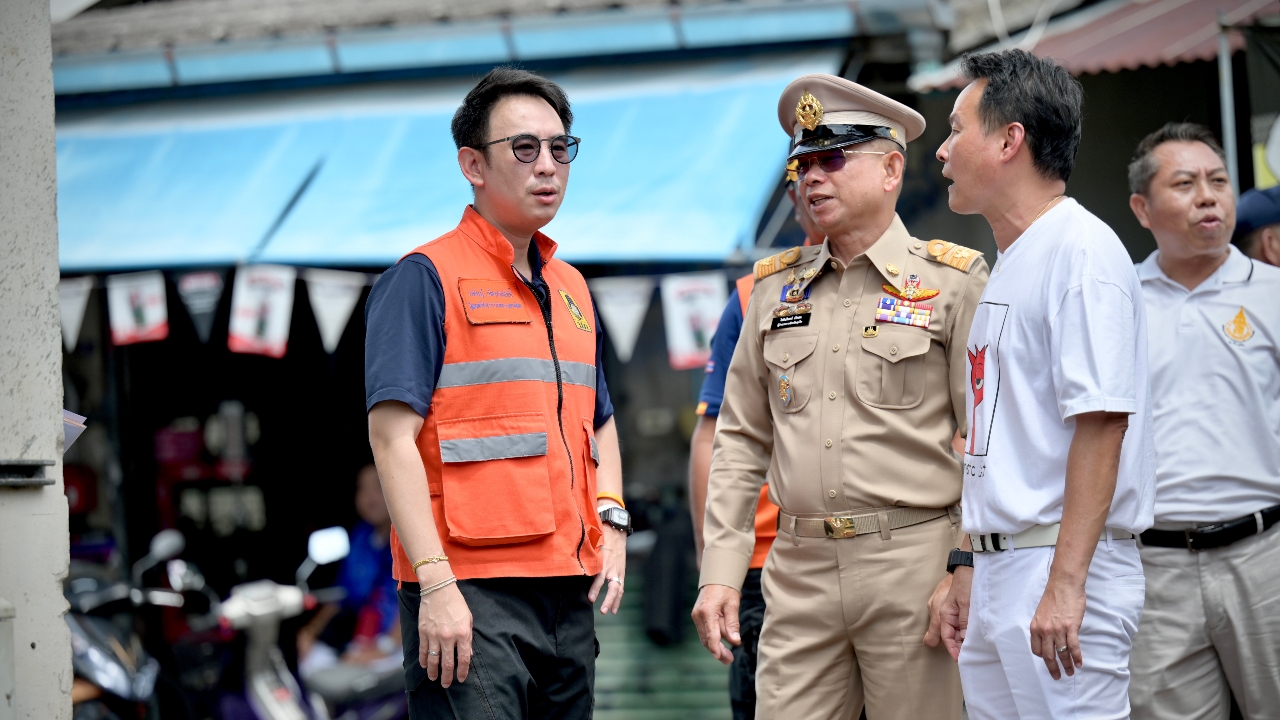
The Prime Minister has assigned the Ministry of Interior Region 4 to monitor Phuket's flood readiness, issuing 10 directives to handle the situation, stressing communication with residents and tourists. Meanwhile, Worasit has ordered the Department of Public Works to study adding flood gates to manage flooding in the economic zone.
At 10:00 a.m. on 12 October 2026, at Mukda Meeting Room, Phuket Provincial Hall, Ms. Ploytale Laksameesangjan, Deputy Spokesperson for the Prime Minister’s Office, revealed that Prime Minister and Minister of Interior Anutin Charnvirakul assigned Deputy Minister of Interior Worasit Liangprasit to chair a meeting to monitor the situation and prepare for flood response in Phuket. Present were Phuket Governor Chotinrin Kerdsom, Deputy Governor Romdon Hayaewa, Deputy Spokesperson Ploytale Laksameesangjan, Director of Disaster Prevention and Mitigation Region 18 Wasan Chaitaveewong, heads of government agencies, district chiefs, state enterprise representatives, local government executives, and officials.

Ms. Ploytale said that this week, southern Thailand is expected to experience thunderstorms with heavy rainfall. Worasit Liangprasit emphasized that Phuket’s Governor, as the provincial disaster prevention director, must implement 10 urgent measures: 1. The most important is to be prepared because while we cannot stop the rain, we must be ready to assist and care for the people. 2. Remove waterway obstacles, especially in flood-prone areas and key economic zones, including dredging canals and ponds, integrating all local governments for maximum effectiveness to ensure optimal water drainage during incidents. 3. Use emergency and local government budgets efficiently and legally, prioritizing public safety, and ensure local leaders understand transparent, worry-free budget approval and spending.
4. Phuket is a province with many Thai and foreign tourists, so emergency communication must reach both residents and tourists, ensuring they understand what to do if floods occur, as public understanding greatly helps reduce damage and distress. 5. Maintain data sets to monitor water conditions—rainfall and soil moisture—from the Meteorological Department, GISTDA, Department of Disaster Prevention, and the Department of Mineral Resources to assess soil water absorption capacity and thresholds for landslides to prevent incidents. 6. Manage water drainage efficiency in line with expected water volumes in flood-prone, sensitive, and main traffic areas.
7. Ensure readiness of disaster machinery such as tractors, loaders, high-lift vehicles, and small boats, maintaining an inventory from the Disaster Prevention Department, military, Ministry of Transport, and local governments, including coordinating private sector machinery for effective management. The Department of Local Administration has created an equipment inventory nationwide to support provinces. 8. Prepare personnel including Territorial Defense Volunteers, Civil Defense Volunteers, and community volunteers; if more support is needed, coordinate centrally for military and volunteer force assistance, as well as private sector foundations ready to help immediately. 9. In case of disaster, identify "who are the first people to assist" and promptly evacuate vulnerable groups, bedridden patients, and the elderly to hospitals and safe areas. 10. Shelter management must be immediately ready to accommodate evacuees with complete basic necessities, hygienic conditions, full bedding sets, meal preparation for every meal with continuous supply coordination, and parking spaces for residents, officials, and volunteers.
At the end, Worasit emphasized, "These measures will be ineffective if the public is unaware," as reducing damage depends on public awareness. Awareness helps reduce confusion, chaos, and disorder among the public. When people understand and can act appropriately during emergencies, government agencies and sectors managing the situation can operate more smoothly, quickly, and effectively.
Phuket Governor Chotinrin stated that the provincial disaster prevention command has adopted the Incident Command System (ICS) to manage potential incidents in a unified manner, establishing a management system including operators, assistants, budget managers, and appointing Deputy Governor Romdon Hayaewa as Phuket’s spokesperson to continuously disseminate information to residents and tourists.
"Currently, Phuket has deployed disaster machinery in key locations ready for immediate operation, with backup power systems in place. Shelters, food supply chains, and marine and island tourism safety are prepared through integrated air operation security. The public is assured that Phuket is ready to handle any situation, ensuring the safety of residents and tourists as prioritized by the Prime Minister, Minister of Interior, and Deputy Minister Worasit Liangprasit," Ms. Ploytale said.
Worasit prepares to handle flooding in Phuket’s economic zone, ordering the Department of Public Works to study adding more flood gates.
At 10:35 a.m., Deputy Minister of Interior Worasit Liangprasit monitored weather forecasts and flood management at Phuket's Intelligent Operation Center (IOC), a real-time monitoring and data integration center, gathering data from relevant agencies and local governments. Present were Phuket Governor Chotinrin Kerdsom, Deputy Governor Romdon Hayaewa, Deputy Spokesperson Ploytale Laksameesangjan, and Phuket City Mayor Supachok Laongpetch.


Worasit and his team then inspected the Bangyai Canal Pumping Station (PS1) on Rattanakosin 200 Year Road and the Takuapa Pumping Station on Takuapa Road, both under Phuket City Municipality’s responsibility. These key stations manage water drainage from various urban areas in Phuket, preventing flooding in communities and economic districts by pumping water out to sea, protecting homes and properties. They also have the capacity to handle high tides combined with heavy rain, preventing seawater backflow into the city.
Worasit said that inspecting these flood gates and pumping stations today demonstrated the local government's capability to manage water and protect Phuket’s inner economic zone. The Phuket City Mayor requested support to add more flood gates within the municipality. As chairman of the Southern Region Flood and Drought Prevention Committee and Deputy Minister overseeing the south, Worasit has ordered the Department of Public Works and Town Planning in Phuket to submit this request to central authorities for support.


Worasit added that overall, Phuket province and municipality have plans and resources to handle potential heavy rainfall floods, including equipment, machinery, and personnel, monitoring risky areas and preparing for evacuation of vulnerable groups such as bedridden patients.
Furthermore, central support from the Department of Local Administration includes compiling and coordinating resources like machinery, high-lift vehicles, portable toilets, and water pumps. When local governments, districts, or provinces need assistance, support is ready immediately, working alongside the Ministries of Transport and Defense. For example, the Navy has water-pushing boats that help speed water drainage to the sea.
After a disaster, local governments serve as the frontline for manual damage surveys, while citizens can also report damage via government apps. Worasit emphasized the need to facilitate citizens as much as possible by simplifying paperwork and deploying teams to assist residents in quickly and easily assessing home damage.
