

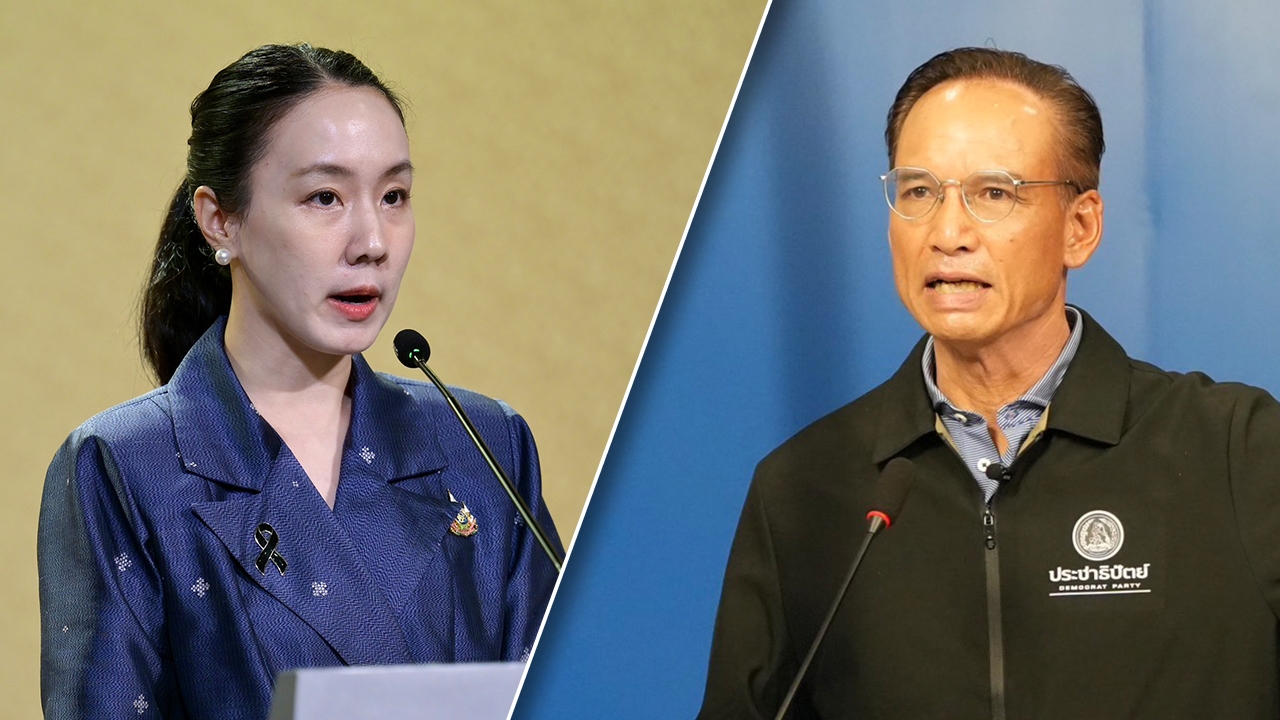
The Deputy Government Spokesperson rebutted Korn’s comments regarding Thailand’s economic future over the next five years, urging not to judge the country’s prospects solely by today’s problems. She cited Fitch’s upgrade of Thailand’s credit outlook and actual investments exceeding 535.8 billion baht.
On 13 October 2026, Ms. Lalida Pertwivatana, Deputy Government Spokesperson, addressed concerns raised by Korn Chatikavanij, a party-list MP and Deputy Leader of the Democrat Party, about Thailand’s economy over the next five years. She said the government acknowledges the urgent economic issues such as low growth, high household debt, and an aging population. However, concluding that Thailand’s future will inevitably decline based on today’s problems is an incomplete assessment that overlooks both economic stability and emerging investment opportunities.
“Mr. Korn asked what Thailand will be like in five years. The government sees this as a good question. But a good question should not predetermine that Thailand must worsen. Warning about risks is necessary, but using those risks alone to define the country’s future without considering emerging opportunities may cause people to overlook Thailand’s potential,” Ms. Lalida said.
The Deputy Government Spokesperson noted that recent facts show Thailand’s economy is not only facing negative signals. On 18 September 2026, Fitch Ratings maintained Thailand’s BBB+ credit rating but upgraded the outlook from Negative to Stable, reflecting improved risk assessment. On 9 October 2026, Reuters reported that although Thailand’s economy faces challenges, it remains resilient and differs from the 1997 economic crisis.
“If we discuss Thailand’s economic risks, we must also consider the other side. Fitch did not upgrade the outlook without reason, and Reuters does not see Thailand returning to a crisis like in 1997. The government does not claim the economy is already good but emphasizes that future assessments must consider all data, not just select information that supports one’s concerns,” Ms. Lalida said.
Ms. Lalida added that regarding investment, data from the Board of Investment (BOI) shows that in the first half of 2026, investment promotion applications totaled over 1.47 trillion baht, a 37% increase, while actual investment in promoted projects reached more than 535.8 billion baht, up 27%. This included over 127 billion baht in real investment in AI and advanced electronics sectors.
“These figures are not just hopeful projections; actual investments exceeding 535.8 billion baht have already occurred. However, the government does not claim that high investment alone will immediately raise incomes. The next step is to convert investment into quality jobs, generate income for Thai workers, and open opportunities for Thai SMEs to join production chains, rather than concentrating benefits in a few groups,” Ms. Lalida said.
The Deputy Government Spokesperson acknowledged that the government does not overlook concerns such as household debt at 85.9% of GDP, an aging society, fiscal constraints, and risks from technological changes. In particular, investments in AI require increased use of domestic raw materials and technology, workforce skill development, and technology transfer to ensure Thailand’s economy truly benefits.
The government admits that Thailand faces difficult challenges. But acknowledging problems is not surrendering to them. If today we only see debt, low growth, and limitations without recognizing new investments and future industry opportunities, we are judging the country’s future solely by past and present problems.
“The government must answer how Thailand will be in five years through results, not just words. The opposition has every right to fully scrutinize, but constructive criticism should help the country see both problems and solutions, not turn concerns into a conclusion that Thailand has no future. What the people want is not competition over who sees the problems as worse, but who can turn problems into solutions, investments into jobs, and economic opportunities into better incomes for Thai people,” Ms. Lalida said.