

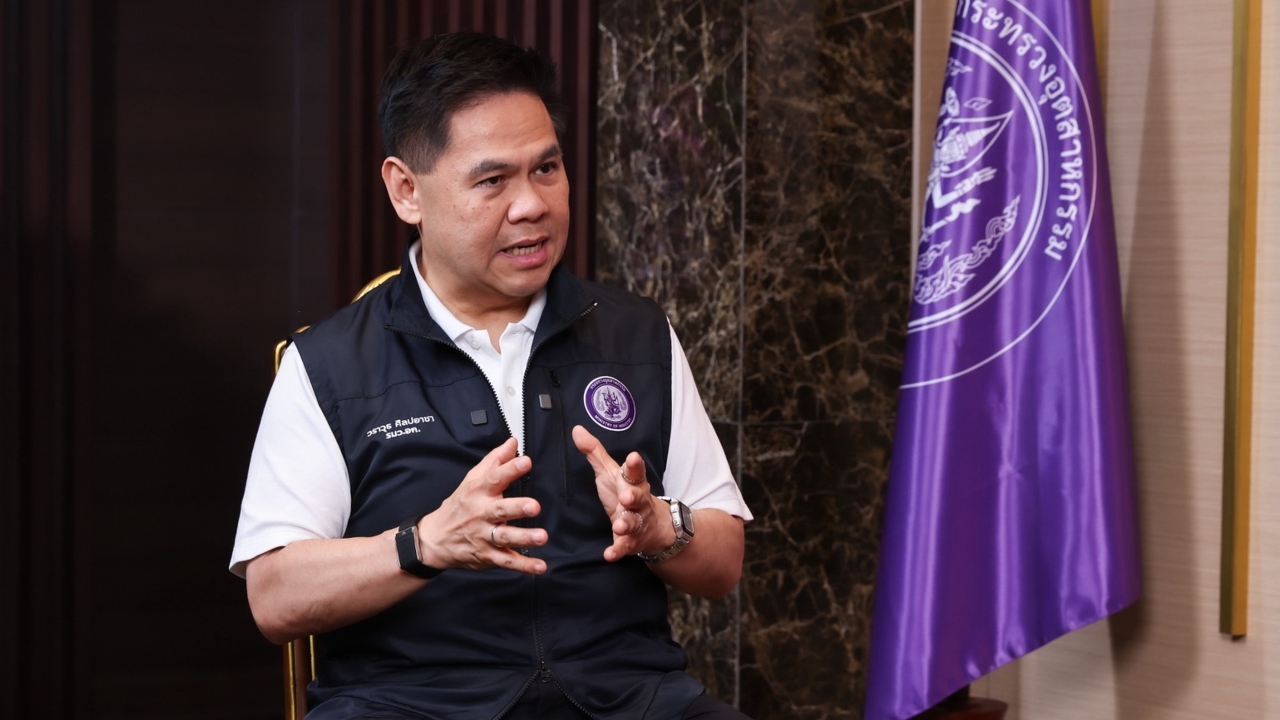
Minister Warawut is taking a firm stand on toxic waste, proposing fines in the tens of millions and asset seizures. He is fast-tracking recycling industrial estates to handle solar panel and EV battery waste, promoting AI to help farmers increase the value of rice and sugarcane, supporting SMEs, and emphasizing that Thailand's automotive industry will not pursue EVs exclusively.
On 17 Oct 2026 at 9:05 a.m., Warawut Silpa-archa, Minister of Industry, revealed on the “Talk with the Cabinet: Anutin” program that the direction of Thailand's industry focuses on economic growth without causing pollution or leaving citizens behind.
A major focus is managing illegal industrial waste, as some laws are 40-50 years old and the existing maximum fine of 200,000 baht is too low, leading some operators to opt to pay fines rather than properly treat their waste.
Currently, the Ministry of Industry is amending the Factory Act and industrial waste laws and is consulting with the Ministry of Natural Resources and Environment, the DSI, and Customs to enhance enforcement by linking to financial trails, seizing business owners' assets, and raising fines to eight figures.
“Today, penalties are cheaper than proper waste treatment. If penalties are too light, offenders won't fear the law. We must make violations unprofitable and enforce proper industrial waste disposal,” Warawut said.

Warawut said another urgent issue is waste from clean technologies like solar panels and EV batteries that will reach end of life soon, especially solar panels used about 10 years with a lifespan of around 15 years, potentially creating large amounts of waste in the next 1-2 years.
The ministry is pushing to establish recycling industrial estates that gather recycling and hazardous waste disposal factories in controlled areas with centralized wastewater treatment and 24-hour monitoring to prevent batteries, solar panels, and electronics from mixing with general waste.
EV batteries that no longer function in vehicles don't all need to be discarded; some can be reconditioned and used as energy storage systems (ESS). Those truly degraded must be properly disposed of due to hazardous substances harmful to health.
On livelihoods, the ministry is advancing the “AI squared” concept, connecting advanced industrial technology with agriculture, which employs nearly 30% of the workforce but contributes about 8% of GDP, to prevent widening gaps between the new economy and grassroots sectors.
AI will be used from upstream—monitoring irrigation, soil quality, and weather—to midstream with automated processing, and downstream with AI-powered e-commerce, social media, and logistics to find markets. The era of selling large volumes at low prices is over; now it’s about selling higher-value products.
A clear example is rice, which sells as raw material at about 7,000-8,000 baht per ton. Processing into flour or export products can raise value to tens of thousands per ton. Sugarcane efforts focus on increasing yield and sweetness to boost farmers’ income from existing land.
To ensure technology reaches beyond meetings, the Ministry of Industry plans to discuss with the Ministry of Agriculture and Cooperatives the establishment of four high-value agricultural processing industrial estates across the North, Central, Northeast, and South, supporting key local products like rice, sugarcane, and rubber.
Warawut said Thailand's strength lies in over 3.2 million SMEs forming supply chains in many industries, especially automotive, which has collaborated with Japan for 60-70 years, earning recognition for a reliable and efficient supply chain.
For the automotive industry, Thailand will not pursue EVs exclusively but adopt a multi-pathway approach supporting combustion engines, hybrid PHEVs, electric BEVs, and future hydrogen technology, while maintaining the Japanese factory base and existing suppliers that provide many Thai jobs.
“Those who helped us in the past, when we face new challenges, we must work together—not abandon them. Thai parts manufacturers must adapt quickly as new vehicles increasingly resemble mobile computers,” Warawut said.
He added the Ministry of Industry and SME Bank will provide both funding and knowledge to support this transition. Parts manufacturers must enhance precision and flexibility to support ICE, hybrid, and EV models, as Thailand remains a production base exporting to multiple markets with differing technology demands.
Another key challenge is global environmental standards like the EU’s CBAM, which pressures Thai exporters to use clean energy, have standardized treatment systems, and develop factories into Green Industry. The ministry will regulate standards and help SMEs access knowledge and finance to upgrade their plants.
Industry can advance but must not harm communities. If industrial estates or factories negatively impact locals, authorities must intervene and provide remedies. The public can report factory, wastewater, or pollution issues anytime via the Ministry of Industry hotline at 1564.
