

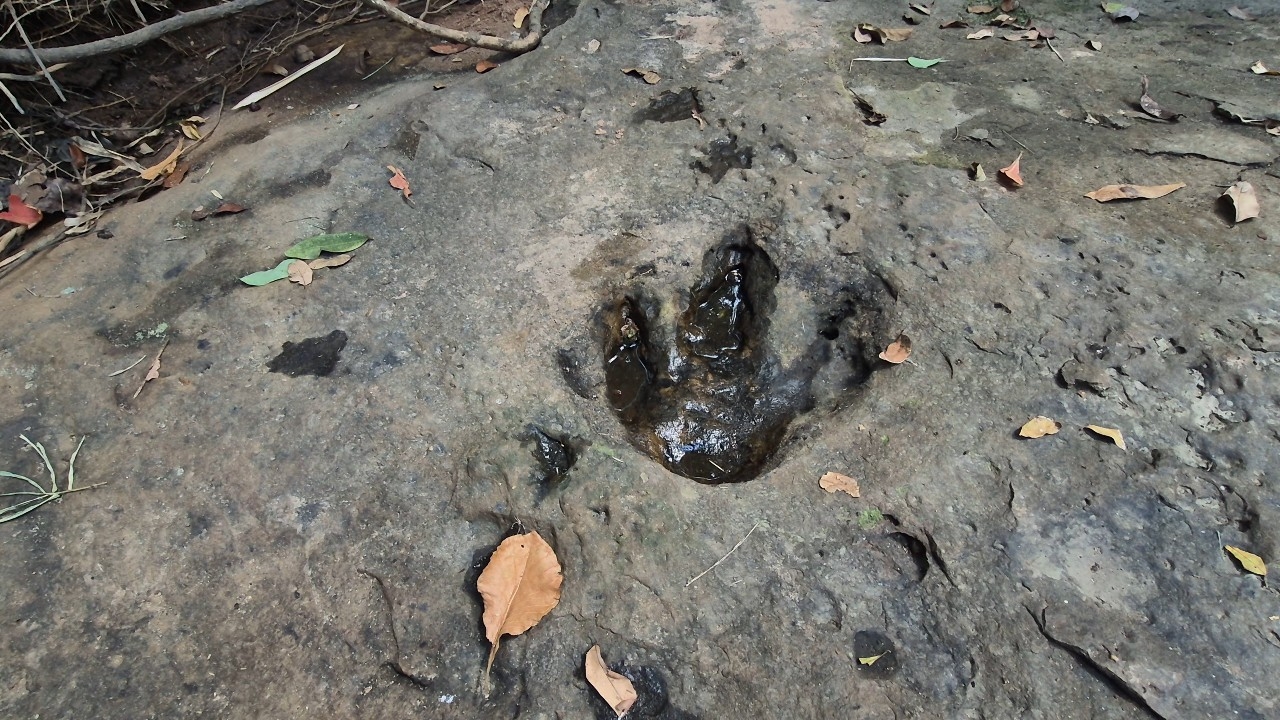
The government is protecting "120-million-year-old dinosaur footprints" found in Udon Thani province, emphasizing that these traces are legally recognized as fossil remains. Authorities are taking swift action to prevent damage to the area before developing it into a learning center.
On 21 Oct 2026 GMT+7, Ms. Lalida Pertviwattana, Deputy Spokesperson for the Prime Minister’s Office, revealed that the government prioritizes conserving and protecting the country's geological heritage, especially in relation to the discovery of "dinosaur footprints" in Udon Thani province. These footprints are important geological and paleontological evidence. Mr. Suchart Chomklin, Minister of Natural Resources and Environment, has ordered the Department of Mineral Resources to urgently verify the facts and coordinate with relevant agencies to implement legal protective measures. These aim to prevent damage caused by tourist disturbances and water erosion.
Ms. Lalida added, that inspections at the Phu Hin Chom That-Phu Phrabat National Park (preparatory phase), Muang Phan Subdistrict, Ban Phue District, Udon Thani, revealed a trackway of theropod dinosaur footprints—carnivorous dinosaurs walking on hind legs—consisting of six footprints. These appeared on sandstone layers of the Phu Phan Formation dating back approximately 120 million years to the Early Cretaceous period. This evidence is valuable for studying past life forms and environments in Thailand.
According to Section 3 of the 2008 Fossil Protection Act, "fossil remains" encompass not only bones or teeth of ancient animals but also traces of prehistoric life. Therefore, the verified dinosaur footprints are legally protected fossil remains, even though no skeletons were found nearby.
Regarding protection measures, Section 25 of the law requires anyone who discovers something reasonably believed to be a fossil to notify local officials within seven days of the find. Upon notification, local officials must prohibit use or entry into the area, clearly mark the restricted zone, and report to the Director-General of the Department of Mineral Resources or other officials within seven days. Subsequently, relevant agencies must complete an initial inspection within seven days of the report to decide on further actions.
Ms. Lalida emphasized that fossil protection begins from the discovery notification and inspection stages and does not require waiting for official fossil site registration. The site restriction under Section 25 is separate from the registration process under Section 14 and should not be mistaken as official fossil site designation.
The public who find traces or possible fossils can report to the local subdistrict administrative organization or municipality. They should record the location, describe the trace, and take photos as safely as possible to assist officials in consulting experts. Cooperation is requested to avoid digging, moving, or any actions that could damage the evidence.
The Deputy Government Spokesperson concluded by stating, "The government values preserving natural heritage for future generations to study and learn. The discovery of dinosaur footprints not only reflects the richness of geological evidence in Thailand but also offers opportunities to develop knowledge and geotourism in the future. Prioritizing conservation and academic study is essential. Currently, actions are limited to protection and consideration of development plans, not official fossil site registration or tourism opening."