

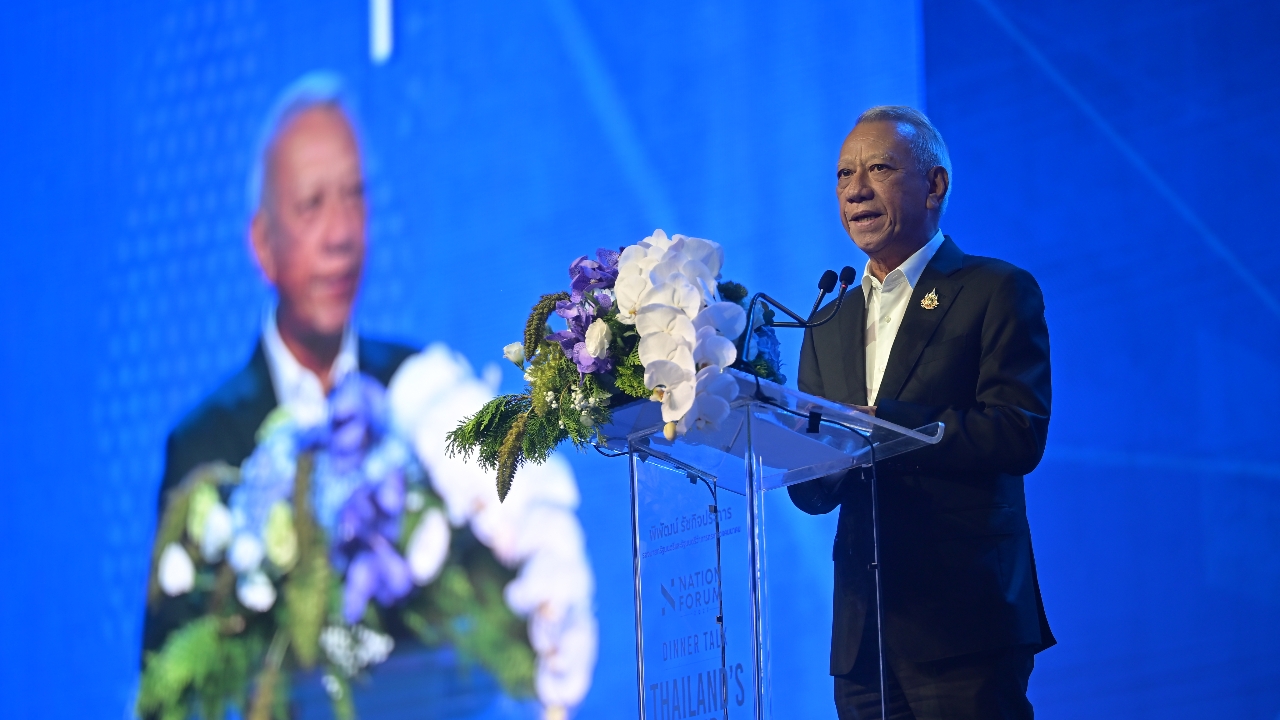
Phiphat presented a vision to transform Thailand’s infrastructure by focusing on reducing logistics costs and integrating water and air transport, alongside developing a new economic city around Krung Thep Aphiwat Central Station.
On 21 Oct 2026 GMT+7, Mr. Phiphat Ratchakitprakarn, Deputy Prime Minister and Minister of Transport, delivered a vision titled “Infrastructure Blueprint for the Future” at Nation Forum 2027 held at Paragon Hall, Siam Paragon. He announced a major transformation direction for the country’s infrastructure by emphasizing the integration of road, rail, water, and air transport into a unified network to elevate Thailand as a sustainable regional hub for travel, trade, and logistics.
Mr. Phiphat revealed that Thailand has a significant geographical advantage, located at the crossroads of China, ASEAN, India, the Middle East, and Europe. However, past infrastructure development lacked full connectivity. The government has shifted from isolated projects to developing a nationwide interconnected network to facilitate travel for citizens, reduce transport costs for businesses, and distribute new economic opportunities across all regions.

To upgrade the rail system as the main logistics network, the government plans to add 1,479 kilometers of double-track railways, alongside promoting the Open Access policy to allow private sector participation in rail operations. This strategy aims to maximize the use of state-invested infrastructure. The goal is to increase rail capacity utilization from the current 35% to 50–55% by 2029 and 65–70% by 2034, reducing reliance on road transport and lowering long-term logistics costs. This will be complemented by developing motorway networks M8 and M82 to seamlessly connect Bangkok to the southern region.
Additionally, the government proposed developing ports on both coasts to link the Gulf of Thailand and the Andaman Sea by rail, opening a new trade route between the Pacific and Indian Oceans. This will provide a crucial alternative for international freight transport and establish Thailand as a true maritime transport hub. Simultaneously, the plan focuses on advancing Thailand as an Aviation Hub by upgrading Suvarnabhumi Airport from a travel center to a high-value cargo center, aiming to increase air cargo warehouse capacity from 1.77 million tons to 2.36 million tons per year by 2029 to support the growth of future industries, exports, investments, and employment.
Regarding economic and urban development, the plan includes transforming over 2,353 rai of Khlong Toei Port area by studying the repositioning of Bangkok Port as a Premium Port for high-value goods, while developing parts of the area into a riverfront economic zone along the Chao Phraya River, creating a new business, trade, and tourism center. The development will proceed alongside improving the quality of life for existing local communities in housing, utilities, education, and job creation. Furthermore, nearly 1,500 rai around Krung Thep Aphiwat Central Station will be developed into a Smart City and new economic center for Bangkok, integrating rail, bus, and expressway systems, and opening space for business, residential, and public areas to foster a livable city environment.
Mr. Phiphat concluded that the ultimate goal of all infrastructure development is to deliver “better lives and opportunities for Thai people,” reflected through more convenient travel, reduced costs, job and income creation, and tangible improvements in quality of life. He emphasized the government’s key role in seriously implementing policies to achieve real results and ensure maximum benefits for the people.

