

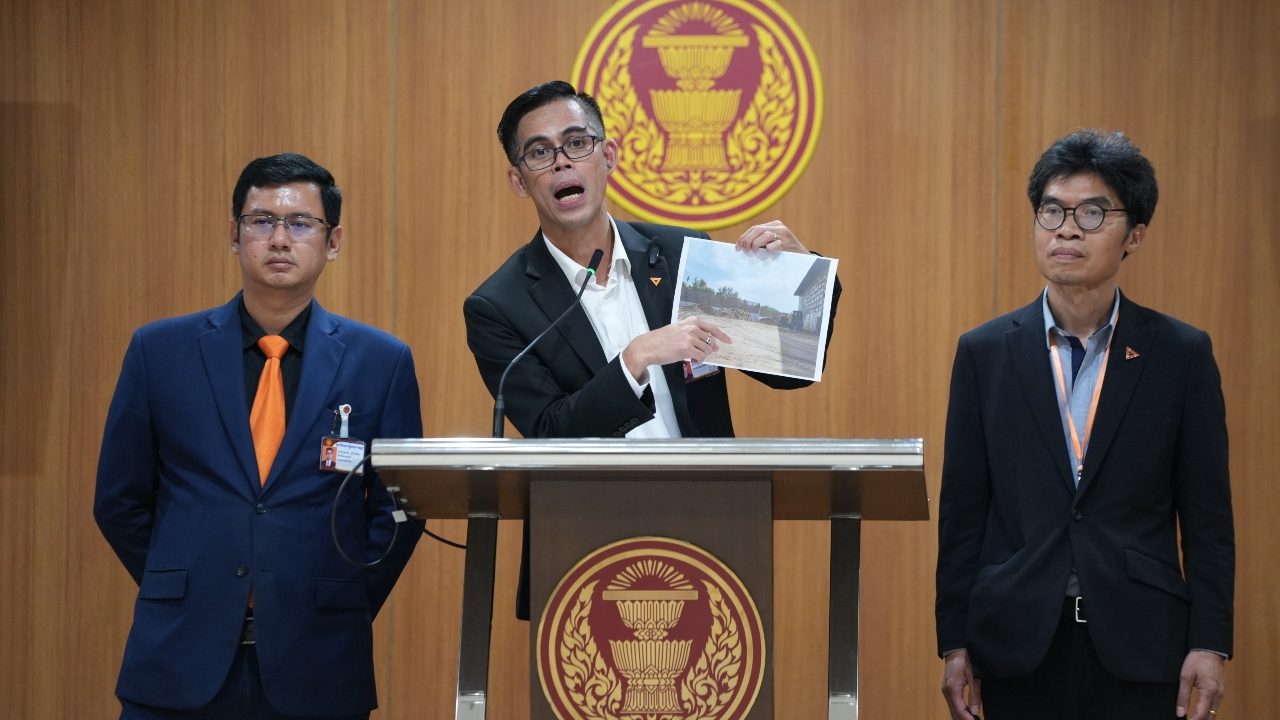
Kittipong and Poonsak urged the Industry Minister to take decisive action against the illegal factory in Khlong Sai, Natawi, which has ignored closure orders and continues to pollute, affecting the health of students and local residents. They emphasized that it is time to restructure the system.
On 21 October 2026 at the Parliament Building, Kittipong Piyawanno and Poonsak Janjamphai, list MPs of the People's Party, held a press conference addressing the distress of residents in Khlong Sai subdistrict, Natawi district, Songkhla province. The community has been severely affected by an industrial factory releasing pollution, wastewater, toxic smoke, and operating beyond legally permitted hours, causing ongoing health concerns for local people and schoolchildren.
Kittipong said that last Saturday he visited Khlong Sai subdistrict in Natawi, Songkhla to meet and hear the problems faced by residents affected by the factory. The factory is licensed to operate from 08:00 to 18:00 but has repeatedly violated regulations. On 2 May, a joint meeting was held between villagers, relevant authorities, the Pollution Control Office Region 16, Songkhla provincial industry office, and factory representatives. The factory admitted to releasing dust, noise, and toxic smoke causing community problems. Previously, the Songkhla provincial industry office had issued several suspension and closure orders for the factory on 21 May 2025, 4 June 2025, 16 June 2025, 10 September 2025, and on 7 October 2025, invoked Section 39 of the Factory Act to order a 30-day full shutdown due to seven violations including overtime operation, wastewater, smoke, dust, and unauthorized wastewater or sediment system installation. However, during his recent visit, the factory was still secretly operating and causing problems for residents as before.

Poonsak added that this case in Songkhla is not the first and shares similar problems with factories in Prachinburi, Saraburi, and Lopburi provinces. It reflects issues with the Ministry of Industry and provincial industry offices' law enforcement. If the Ministry could decisively manage these factories, pollution problems would not persist and harm the public. He called on the Industry Minister to undertake a major restructuring of the Ministry's operations, especially provincial industry offices, which should not only support businesses but also strictly control factories to prevent environmental damage. Moreover, environmental regulatory agencies and local governments must actively participate in inspections, as pollution extends beyond factory boundaries into communities.
Poonsak concluded that local residents have expressed frustration via phone calls, saying if the government does not act, they might have to handle the problem themselves due to health concerns for their children, since the factory is located next to a school. He urged the Industry Minister to urgently address this issue before the public's patience runs out.
